Home
Class 12
MATHS
Consider the function f(x)={{:(x-[x]-(1)...

Consider the function `f(x)={{:(x-[x]-(1)/(2),x !inI),(0, "x inI):}` where [.] denotes the greatest integer function and I is the set of integers. Then find `g(x)max.[x^(2),f(x),|x|},-2lexle2.`

Text Solution

Verified by Experts
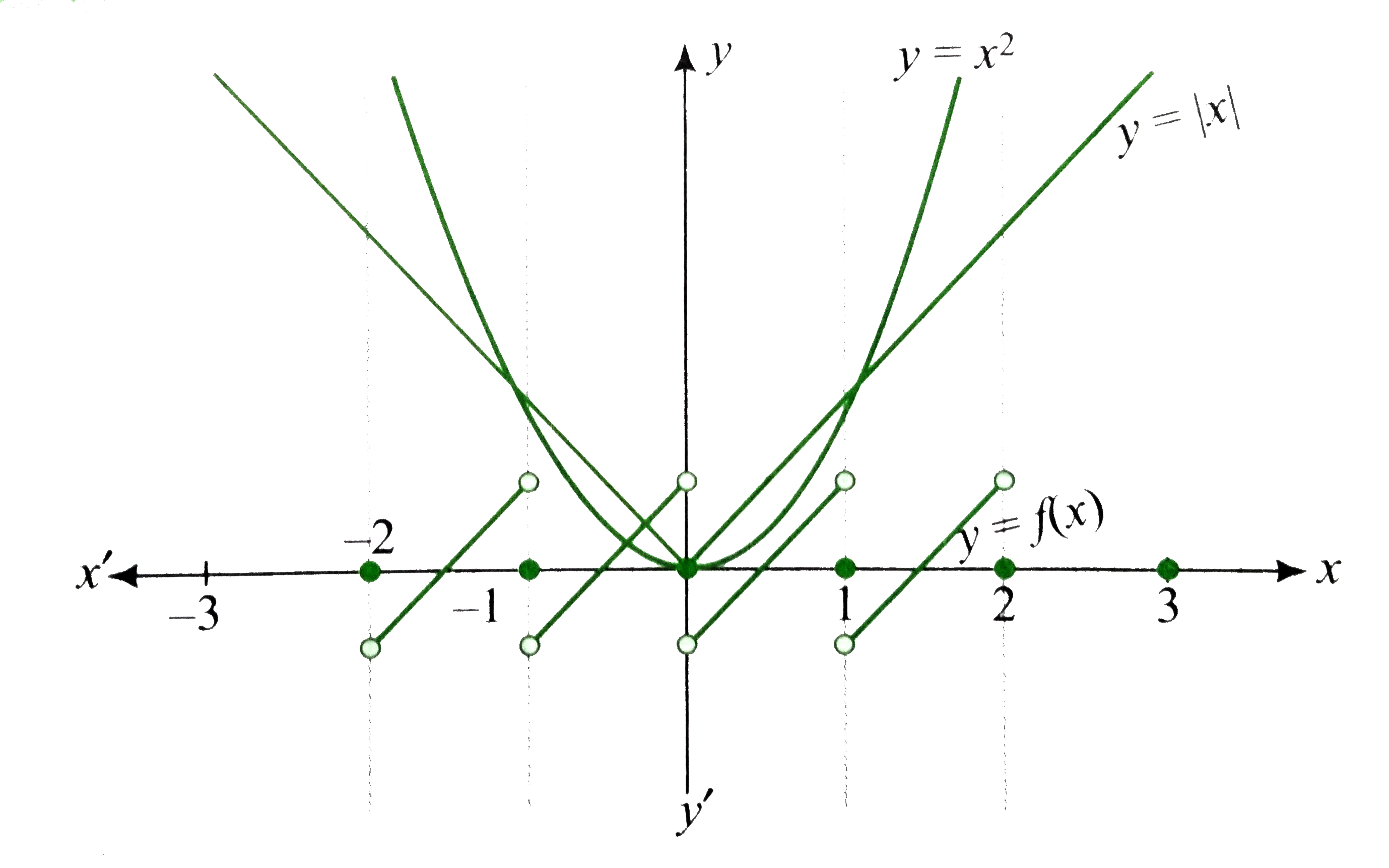
Clearly, from graph,

`g(x)={(x^(2)",",-2 le x le -1),(-x",",-1lt x le -1//4),((1)/(2)+x",",-(1)/(4)lt x lt 0),(x",",0 le x lt1),(x^(2)",",1le x lt 2):}`
Promotional Banner

Topper's Solved these Questions

  • PROPERTIES AND SOLUTIONS OF TRIANGLE

    CENGAGE PUBLICATION|Exercise Archives (Numerical Value Type)|3 Videos
  • SCALER TRIPLE PRODUCTS

    CENGAGE PUBLICATION|Exercise DPP 2.3|11 Videos

Similar Questions

Explore conceptually related problems

If f(x)= [sin^2x] (where [.] denotes the greatest integer function ) then :

The greatest integer function f(x)=[x] is -

If [x+[2x]] lt3 , where [.] denotes the greatest integer function, then x is

lim_(xrarr1([x]+[x]) , (where [.] denotes the greatest integer function )

If f(x)={(x[x], 0lexlt2),((x-1)[x], 2lexle3'):} , where [.] denotes the greatest integer function, then

Draw the graph of f(x) = [x^(2)], x in [0, 2) , where [*] denotes the greatest integer function.

The function f(x)=(tan{pi[x-(pi)/(2)]})/(2+[x]^(2)) where [x] denotes the greatest integer ltx , is-

If [x]^2-5[x]+6=0 (where [.] denotes the greatest integer function), then x belongs to

The range of the function f(x)=sin^-1(log [x])+log(sin^-1[x]), (where [,] denotes the greatest integer function) is

Find the domain of the function f(x)=(1)/([x]^(2)-7[x]-8) , where [.] represents the greatest integer function.

CENGAGE PUBLICATION-RELATIONS AND FUNCTIONS-All Questions
  1. If a , b are two fixed positive integers such that f(a+x)=b+[b^3+1-3b^...

    Text Solution

    |

  2. If f(x)=x+1,g(x)=x^2+1, then (f+g)/(fg) (0) =?

    Text Solution

    |

  3. Consider the function f(x)={{:(x-[x]-(1)/(2),x !inI),(0, "x inI):} whe...

    Text Solution

    |

  4. Let f(x) be defined on [-2,2] and be given by f(x)={(-1",",-2 le x l...

    Text Solution

    |

  5. If f(x)=(a^x)/(a^x+sqrt(a ,)),(a >0), then find the value of sum(r=1)...

    Text Solution

    |

  6. If sets A =[-4,1] and B=[0,3), then find the following sets: (a) A c...

    Text Solution

    |

  7. Find the value of x^(2) for the following values of x: (a) [-5,-1] ...

    Text Solution

    |

  8. Find the values of 1/x for the following values fo x: (a) (2,5) " ...

    Text Solution

    |

  9. Find all possible values ( range) of the quadratic expression: 1+6x -x...

    Text Solution

    |

  10. Find all possible values of expressions (2+x^2)/(4-x^2)

    Text Solution

    |

  11. Solve (x(3-4x)(x+1))/(2x-5)lt 0

    Text Solution

    |

  12. Solve ((2x+3)(4-3x)^3(x-4))/((x-2)^2x^5)le0

    Text Solution

    |

  13. Solve (5x+1)/((x+1)^2) - 1 < 0

    Text Solution

    |

  14. Find the number of integal values of x satisfying sqrt(-x^2+10x-16)...

    Text Solution

    |

  15. Find all the possible values of f(x) =(1-x^2)/(x^2+3)

    Text Solution

    |

  16. Find the values of x for which the follwing function is defined: f(x)=...

    Text Solution

    |

  17. Solve |4-|x-1||=3

    Text Solution

    |

  18. Find all values of f(x) for which f(x) =x+sqrt(x^2)

    Text Solution

    |

  19. Solve the following : (a) 1 le |x-2| le 3 " (b) "0 lt |x-3|l...

    Text Solution

    |

  20. Find all possible values of expression sqrt(1-sqrt(x^(2)-6x+9)).

    Text Solution

    |

