Home
Class 12
MATHS
Prove that the least positive value of x...

Prove that the least positive value of `x ,` satisfying `tanx=x+1,lies `in` the `in`terval(pi/4,pi/2)dot`

Text Solution

Verified by Experts
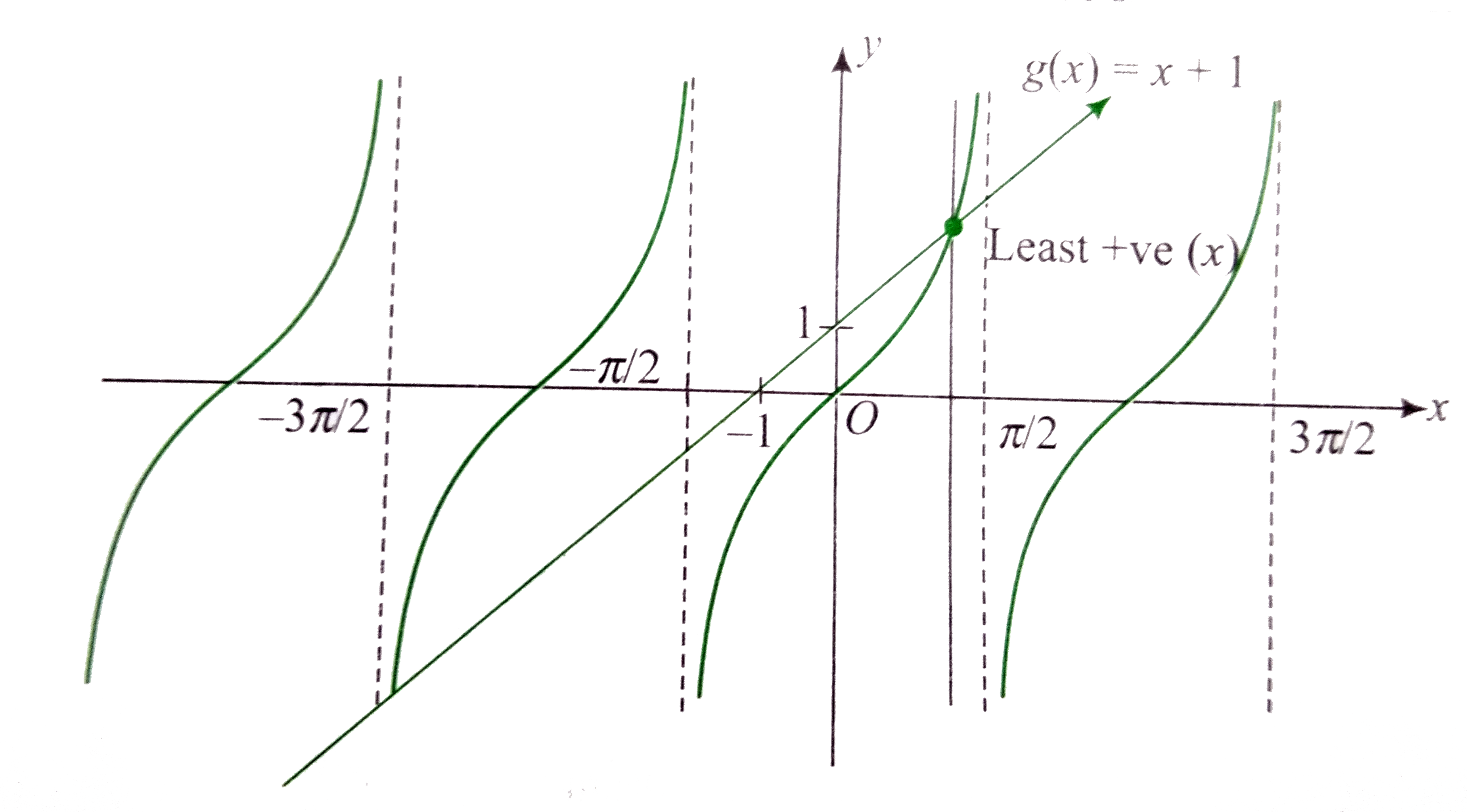
Let `f(x)=tan x " and " g(x)=x+1,` which can be shown as follows.

From the figure, `tanx =x+1` has infinitely many solutions but the least positive value of x lies in `((pi)/(4),(pi)/(2)).`
Promotional Banner

Topper's Solved these Questions

  • PROPERTIES AND SOLUTIONS OF TRIANGLE

    CENGAGE PUBLICATION|Exercise Archives (Numerical Value Type)|3 Videos
  • SCALER TRIPLE PRODUCTS

    CENGAGE PUBLICATION|Exercise DPP 2.3|11 Videos

Similar Questions

Explore conceptually related problems

Find the smallest positive values of xa n dy satisfying x-y=pi/4a n dcotx+coty=2

There exists a positive real number of x satisfying "cos"(tan^(-1)x)=xdot Then the value of cos^(-1)((x^2)/2)i s pi/(10) (b) pi/5 (c) (2pi)/5 (d) (4pi)/5

The smallest positive x satisfying log_sin x cos x+log_(cos x) (sin x)=2 , when x in (0,pi/2) , is

The smallest positive root of the equation tanx-x=0 lies in (a) (0,pi/2) (b) (pi/2,pi) (pi,(3pi)/2) (d) ((3pi)/2,2pi)

Prove that the function are increasing for the given intervals: f(x)=sinx+tanx-2x ,x in (0,pi/2)

The number of real values of x satisfying tan^-1(x/(1-x^2))+tan^-1 (1/x^3) = (3pi)/(4)

The number of roots of the equation x+2tanx=pi/2 in the interval [0, 2pi] is

The number of values of x in [0 , 4pi] satisfying abs(sqrt3 cos x - sin x) ge 2 , is

The smallest positive value of x (in radians) satisfying the equation (log)_(cosx)((sqrt(3))/2sinx)=2-(log)_(secx)(tanx) is (a) pi/(12) (b) pi/6 (c) pi/4 (d) pi/3

If x+y=pi/4 and tanx+tany=1, then

CENGAGE PUBLICATION-RELATIONS AND FUNCTIONS-All Questions
  1. Find the domain of f(x)=sqrt(sinx)+sqrt(16-x^2)

    Text Solution

    |

  2. Solve sinx > -1/2

    Text Solution

    |

  3. Prove that the least positive value of x , satisfying tanx=x+1,lies i...

    Text Solution

    |

  4. Find the range of f(x)=sec(pi/4cos^2x)

    Text Solution

    |

  5. If x in [1,2] , then find the range of f(x)=tanx

    Text Solution

    |

  6. Find the range of f(x)=1/(1-3sqrt(1-sin^2x))

    Text Solution

    |

  7. Find the range of f(x)=(2sin^2x+2sinx+3)/(sin^2x+sinx+1)

    Text Solution

    |

  8. Draw the graph of y=(sin2x)sqrt(1+tan^2x) , find its domain and range.

    Text Solution

    |

  9. Find the domain of the following following functions: f(x)=cos^(-1)(...

    Text Solution

    |

  10. Find the range of f(x)=tan^(-1)sqrt((x^2-2x+2))

    Text Solution

    |

  11. Find the range of the function f(x)=cot^(-1)(log)(0. 5)(x^4-2x^2+3)

    Text Solution

    |

  12. The domain of definition of the function f(x)=sqrt(sin^(-1)(2x)+pi/6) ...

    Text Solution

    |

  13. Find the domain and range of f(x)=sin^(-1)x+tan^(-1)x+sec^(-1)x.

    Text Solution

    |

  14. Find the domain of the function : f(x)=sqrt(4^x+8^((2/3)(2x-2))-13-2^(...

    Text Solution

    |

  15. Find the domain of the function : f(x)=sin^(-1)((log)2x)

    Text Solution

    |

  16. Find Domain of the following function : f(x)=log(x-4)(x^2-11x+24)

    Text Solution

    |

  17. Find the domain of the function : f(x)=3/(4-x^2)+(log)(10)(x^3-x)

    Text Solution

    |

  18. Find the domain of the function : f(x)=sqrt(((log)(0. 2)|x-2|)/(|x|))

    Text Solution

    |

  19. Find the domain of the function : f(x)=(log)(10){((log)(10)x)/(2(30(lo...

    Text Solution

    |

  20. Find the domain of the function : f(x)=1/(sqrt((log)(1/2)(x^2-7x+13)))

    Text Solution

    |

