Home
Class 12
MATHS
Let f(x)=sqrt(|x|-|x+)(w h e r e{dot} de...

Let `f(x)=sqrt(|x|-|x+)(w h e r e{dot}` denotes the fractional part of `(x)a n dX , Y` are its domain and range, respectively). Then `x in (-oo,1/2)a n dY in (1/2,oo)` `x in (-oo in ,1/2)uu[0,oo)a n dY in (1/2,oo)` `X in (-oo,-1/2)uu[0,oo)a n dY in (1/2,oo)`

A

` x in (-oo,(1)/(2)]" and " Y in [(1)/(2), oo)`

B

` x in (-oo, -(1)/(2)]cup [0,oo) " and " Y in [(1)/(2), oo)`

C

` X in (-oo, -(1)/(2)]cup [0,oo) " and " Y in [0, oo)`

D

None of these

Text Solution

Verified by Experts

The correct Answer is:
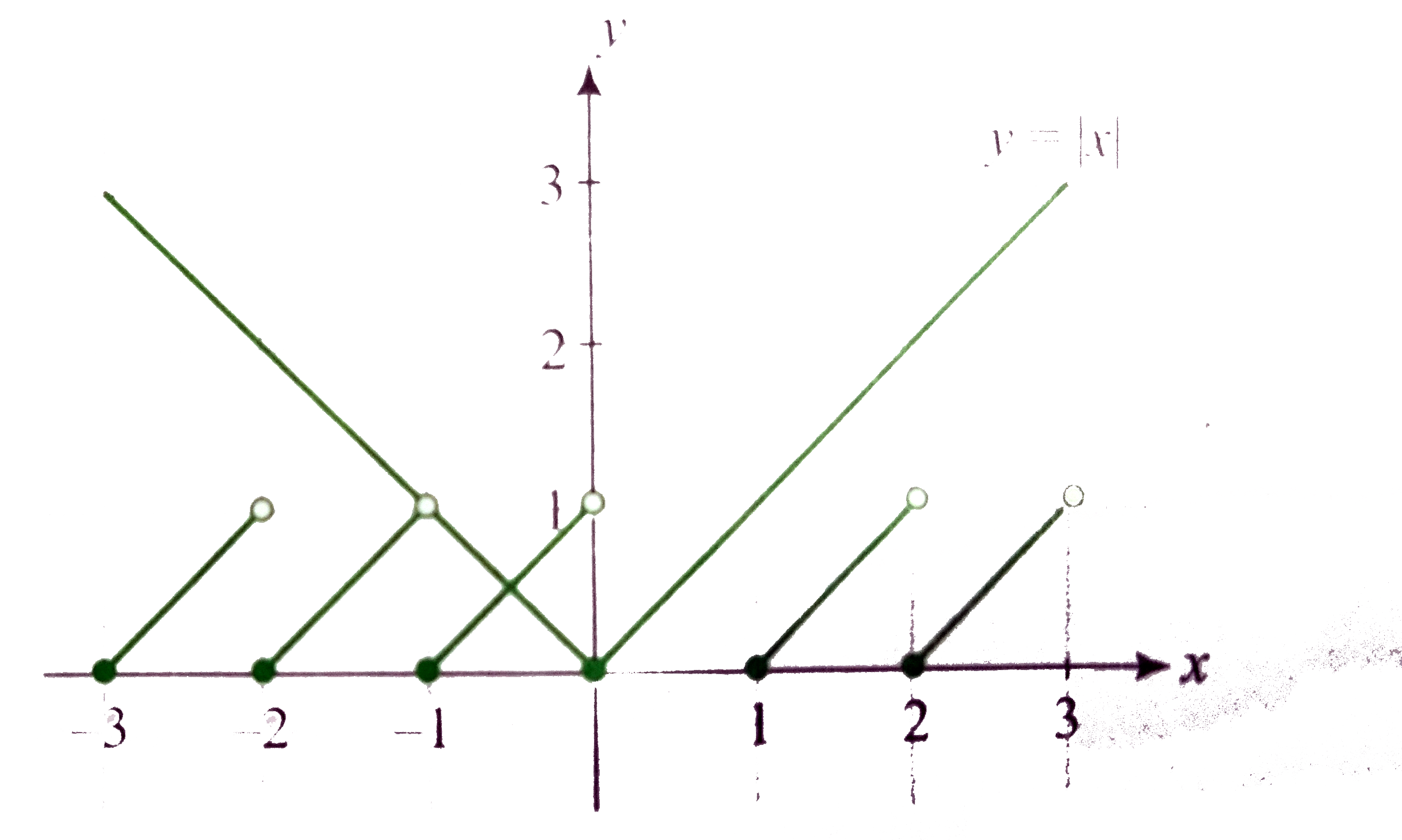
C

`f(x)=sqrt(|x|-{x}) ` is defined if `|x| ge {x}`
or ` x in (-oo-(1)/(2)] cup [0,oo) " or " Y in [0,oo).`
Promotional Banner

Topper's Solved these Questions

  • PROPERTIES AND SOLUTIONS OF TRIANGLE

    CENGAGE PUBLICATION|Exercise Archives (Numerical Value Type)|3 Videos
  • SCALER TRIPLE PRODUCTS

    CENGAGE PUBLICATION|Exercise DPP 2.3|11 Videos

Similar Questions

Explore conceptually related problems

Let f(x)=sqrt(|x|-{x})(w h e r e{dot} denotes the fractional part of (x)a n dX , Y are its domain and range, respectively). Then (a) X in (-oo,1/2) and Y in (1/2,oo) (b) X in (-oo in ,1/2)uu[0,oo)a n dY in (1/2,oo) (c) X in (-oo,-1/2)uu[0,oo)a n dY in [0,oo) (d) none of these

If f^(prime)(x)=|x|-{x}, where {x} denotes the fractional part of x , then f(x) is decreasing in (a) (-1/2,0) (b) (-1/2,2) (-1/2,2) (d) (1/2,oo)

The domain of f(x)="log"|logx|i s (0,oo) (b) (1,oo) (c) (0,1)uu(1,oo) (d) (-oo,1)

The function defined by f(x)=(x+2)e^(-x) is (a)decreasing for all x (b)decreasing in (-oo,-1) and increasing in (-1,oo) (c)increasing for all x (d)decreasing in (-1,oo) and increasing in (-oo,-1)

f(x)=(x-2)|x-3| is monotonically increasing in (a) (-oo,5/2)uu(3,oo) (b) (5/2,oo) (c) (2,oo) (d) (-oo,3)

The range of a for which the equation x^2+ax-4=0 has its smaller root in the interval (-1,2)i s a. (-oo,-3) b. (0,3) c. (0,oo) d. (-oo,-3)uu(0,oo)

The set of all real numbers x for which x^2-|x+2|+x >0 is (-oo,-2) b. (-oo,-sqrt(2))uu(sqrt(2),oo) c. (-oo,-1)uu(1,oo) d. (sqrt(2),oo)

Let A (0,2),B and C be points on parabola y^(2)+x +4 such that /_CBA (pi)/(2) . Then the range of ordinate of C is (a) (-oo,0)uu (4,oo) (b) (-oo,0] uu[4,oo) (c) [0,4] (d) (-oo,0)uu [4,oo)

Statement 1: The function f(x)=x^4-8x^3+22 x^2-24 x+21 is decreasing for every x in (-oo,1)uu(2,3) Statement 2: f(x) is increasing for x in (1,2)uu(3,oo) and has no point of inflection.

The function f(x) = "max"{(1-x), (1+x), 2}, x in (-oo, oo) is

CENGAGE PUBLICATION-RELATIONS AND FUNCTIONS-All Questions
  1. The range of the function f defined by f(x)=[1/(sin{x})] (where [.] an...

    Text Solution

    |

  2. Range of function f(x) = cos (k sin x) is [-1, 1], then the least posi...

    Text Solution

    |

  3. Let f(x)=sqrt(|x|-|x+)(w h e r e{dot} denotes the fractional part of (...

    Text Solution

    |

  4. The range of f(x)=cos^(-1)((1+x^3)/(x2))+sqrt(2-x^2) is {0,1+pi/2} (b...

    Text Solution

    |

  5. The range of the following function is f(x)=sqrt((1-cosx)sqrt((1-cosx)...

    Text Solution

    |

  6. The range of f(x)=(x+1)(x+2)(x+3)(x+4)+5 for x in [-6,6] is [4, 5045] ...

    Text Solution

    |

  7. The range of f(x)=sec^(-1)((log)3tanx+(log)(tanx)3) is (a) [pi/3,pi/2...

    Text Solution

    |

  8. The domain of definition of the function f(x)={x}^({x})+[x]^([x]) is w...

    Text Solution

    |

  9. 49. If [x^2-2x + a] = 0 has no solution then

    Text Solution

    |

  10. The value of sum(r=1)^(2000) {{x+r}}/2000 is

    Text Solution

    |

  11. If f(x)=(sin([x]pi))/(x^2+x+1) , where [dot] denotes the greatest inte...

    Text Solution

    |

  12. Let f(x)=([a]^2-5[a]+4)x^3-(6{a}^2-5{a}+1)x-(tanx)xsgnx be an even fun...

    Text Solution

    |

  13. The solution set for [x]{x}=1 (where {x} and [x] are respectively, fra...

    Text Solution

    |

  14. Let [x] represent the greatest integer less than or equal to x If [sqr...

    Text Solution

    |

  15. The number of roots of x^2-2=[sinx],w h e r e[dot] stands for the grea...

    Text Solution

    |

  16. The domain of f(x)=sin^(-1)[2x^2-3],w h e r e[dot] denotes the greates...

    Text Solution

    |

  17. The domain of f(x)=sqrt(2{x}^2-3{x}+1), where {.} denotes the fraction...

    Text Solution

    |

  18. Find the range of the following function f(x)=sin^(-1)[x^2+1/2]+cos^(...

    Text Solution

    |

  19. Let f(x)=e^({e^(|x|sgnx)})a n dg(x)=e^([e^(|x|sgnx)]),x in R , where ...

    Text Solution

    |

  20. Number of solutions of the equation, [y+[y]]=2cosx is: (where y=(1//3)...

    Text Solution

    |

