Home
Class 12
MATHS
Let f(x)=sgn(cot^(-1)x)+tan((pi)/(2)[x])...

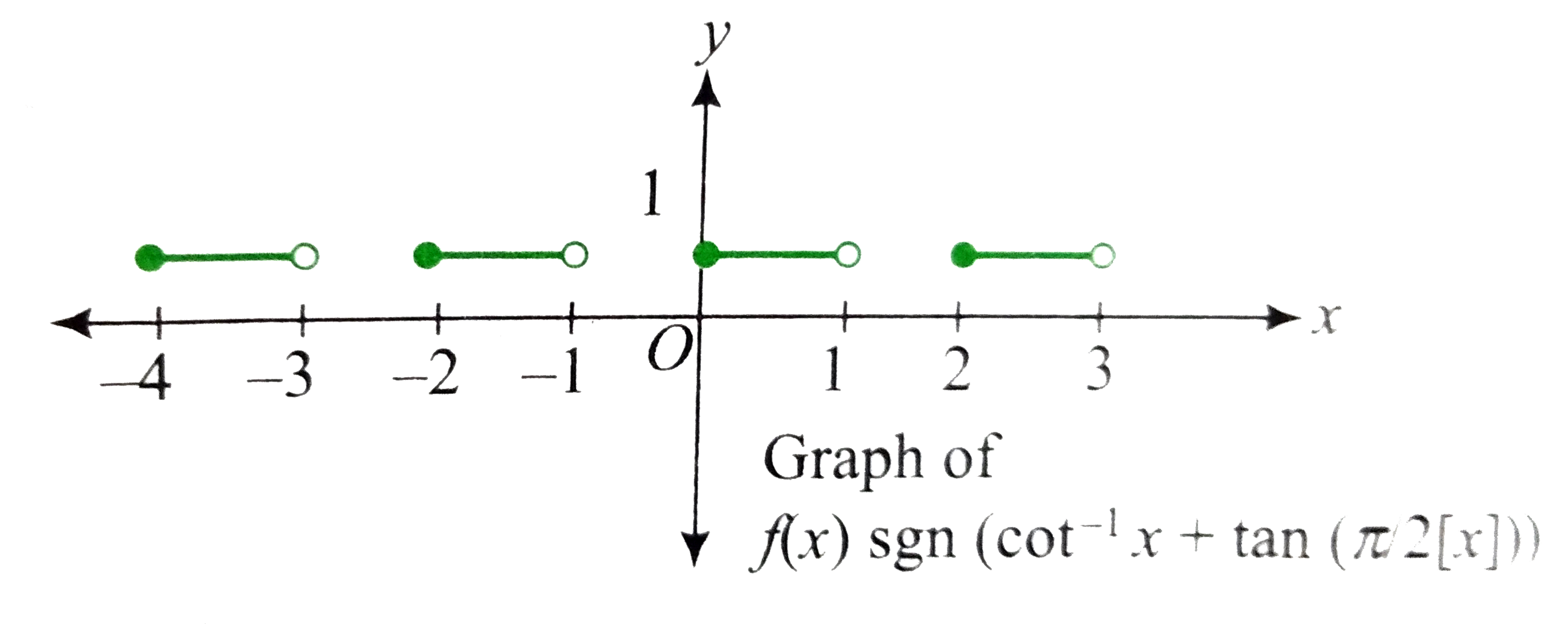
Let `f(x)=sgn(cot^(-1)x)+tan((pi)/(2)[x]),` where [x] is the greatest integer function less than or equal to x. Then which of the following alternatives is/are true?

A

`f(x)` is many-one but not an even function.

B

`f(x)` is a periodic function.

C

`f(x)` is a bounded function.

D

The graph of `f(x)` remains above the x-axis.

Text Solution

Verified by Experts

The correct Answer is:
A, B, C, D

`f(x)=sgn (cot^(-1)x)+tan((pi)/(2)[x])`
`sgn(cot^(-1)x)` is dedfined when `cot^(-1)x` is defined, which is `AA x in R.`
`tan((pi)/(2)[x])` is defined when `(pi)/(2)[x] ne ((2n+1))/(2)pi, " where " n in Z,`
`or [x] ne 2n+1 or x in [2n+1, 2n+2).`
Hence, domain of `f(x) " is " underset (n in Z)(cup) [2n, 2n+1).`
Also, `cot^(-1)x gt 0 AA x in R.` Then
`f(x)=1+tan ((pi)/(2)[x])=1`
` :. f(x)=1, x in D_(f)`

From the graph, `f(x)` si periodic with period 2.
Promotional Banner

Topper's Solved these Questions

  • PROPERTIES AND SOLUTIONS OF TRIANGLE

    CENGAGE PUBLICATION|Exercise Archives (Numerical Value Type)|3 Videos
  • SCALER TRIPLE PRODUCTS

    CENGAGE PUBLICATION|Exercise DPP 2.3|11 Videos

Similar Questions

Explore conceptually related problems

For the function f(x)=[(1)/([x])] , where [x] denotes the greatest integer less than or equal to x, which of the following statements are true?

Let f(x) = (x^2-9x+20)/(x-[x]) where [x] denotes greatest integer less than or equal to x ), then

If f(x)= [sin^2x] (where [.] denotes the greatest integer function ) then :

If f(x)=cos([pi^2|x)+cos([-pi^2|x) , where [x] stands for the greatest integer function, then

lim_(xto1) (xsin(x-[x]))/(x-1) , where [.] denotes the greatest integer function, is equal to

If f(x)=cos[pi^2]x +cos[-pi^2]x , where [x] stands for the greatest integer function, then

Let f (x)= [x] where [x] denotes the greatest integer contained in x. Which one of the following is correct ?

Solve [cot^(-1) x] + [cos^(-1) x] =0 , where [.] denotes the greatest integer function

f(x)=sin^(-1)[e^(x)]+sin^(-1)[e^(-x)] where [.] greatest integer function then

Let [x] denotes the greatest integer less than or equal to x. If f(x) =[x sin pi x] , then f(x) is

CENGAGE PUBLICATION-RELATIONS AND FUNCTIONS-All Questions
  1. If f: R ->Nuu{0}, where f (area of triangle joining points P(5,0),Q(8,...

    Text Solution

    |

  2. The domain of the function f(x)=(log)e{(log)(|sinx|)(x^2-8x+23)-{3/((l...

    Text Solution

    |

  3. Let f(x)=sgn(cot^(-1)x)+tan((pi)/(2)[x]), where [x] is the greatest in...

    Text Solution

    |

  4. f(x)=sqrt(1-sin^(2)x)+sqrt(1+tan^(2)x) then

    Text Solution

    |

  5. If the following functions are defined from [-1,1]to[-1,1], select tho...

    Text Solution

    |

  6. Let f(x)={x^2-4x+3,x<3x-4,xgeq3 a n dg(x)={x-3,x<4x^2+2x+2,xgeq4 the...

    Text Solution

    |

  7. Let f(x)=max{1+sinx,1,1-cosx}, xin[0,2pi] and g(x)=max{1,|x-1|} x in R...

    Text Solution

    |

  8. If the function f(x) satisfies the condition f(x + 1/x) = x^2 + 1/x^2,...

    Text Solution

    |

  9. Consider the real-valued function satisfying 2f(sinx)+f(cosx)=xdot the...

    Text Solution

    |

  10. If f: R^+vecR^+ is a polynomial function satisfying the functional equ...

    Text Solution

    |

  11. f(x)=x^2-2a x+a(a+1),f:[a ,oo)vec[a ,oo)dot If one of the solution of ...

    Text Solution

    |

  12. Which of the following function is/are periodic? A. f(x)={(1, "x is...

    Text Solution

    |

  13. Let f(x)=(3)/(4)x+1,f^(n)(x) be defined as f^(2)(x)=f(f(x)), and for n...

    Text Solution

    |

  14. lf the fundamental period of function f(x)=sinx + cos(sqrt(4-a^2))x is...

    Text Solution

    |

  15. f(x)=sin^(-1)[e^(x)]+sin^(-1)[e^(-x)] where [.] greatest integer funct...

    Text Solution

    |

  16. [2x]-2[x]=lambda where [.] represents greatest integer function and {....

    Text Solution

    |

  17. The set of all values of x satisfying {x}=x[xx] " where " [xx] repres...

    Text Solution

    |

  18. The function 'g' defined by g(x)= sin(sin^(-1)sqrt({x}))+cos(sin^(-1)s...

    Text Solution

    |

  19. If the function f satisfies the relation f(x+y)+f(x-y)=2f(x)xxf(y), AA...

    Text Solution

    |

  20. Let f(x)+f(y)=f(xsqrt(1-y^2)+ysqrt(1-x^2))[f(x) is not identically zer...

    Text Solution

    |

