Find the area bounded by
(a) `y = (log)_e|x|a n dy=0`
(b) `y=|(log)_e|x||a n dy=0`
Text Solution
Verified by Experts
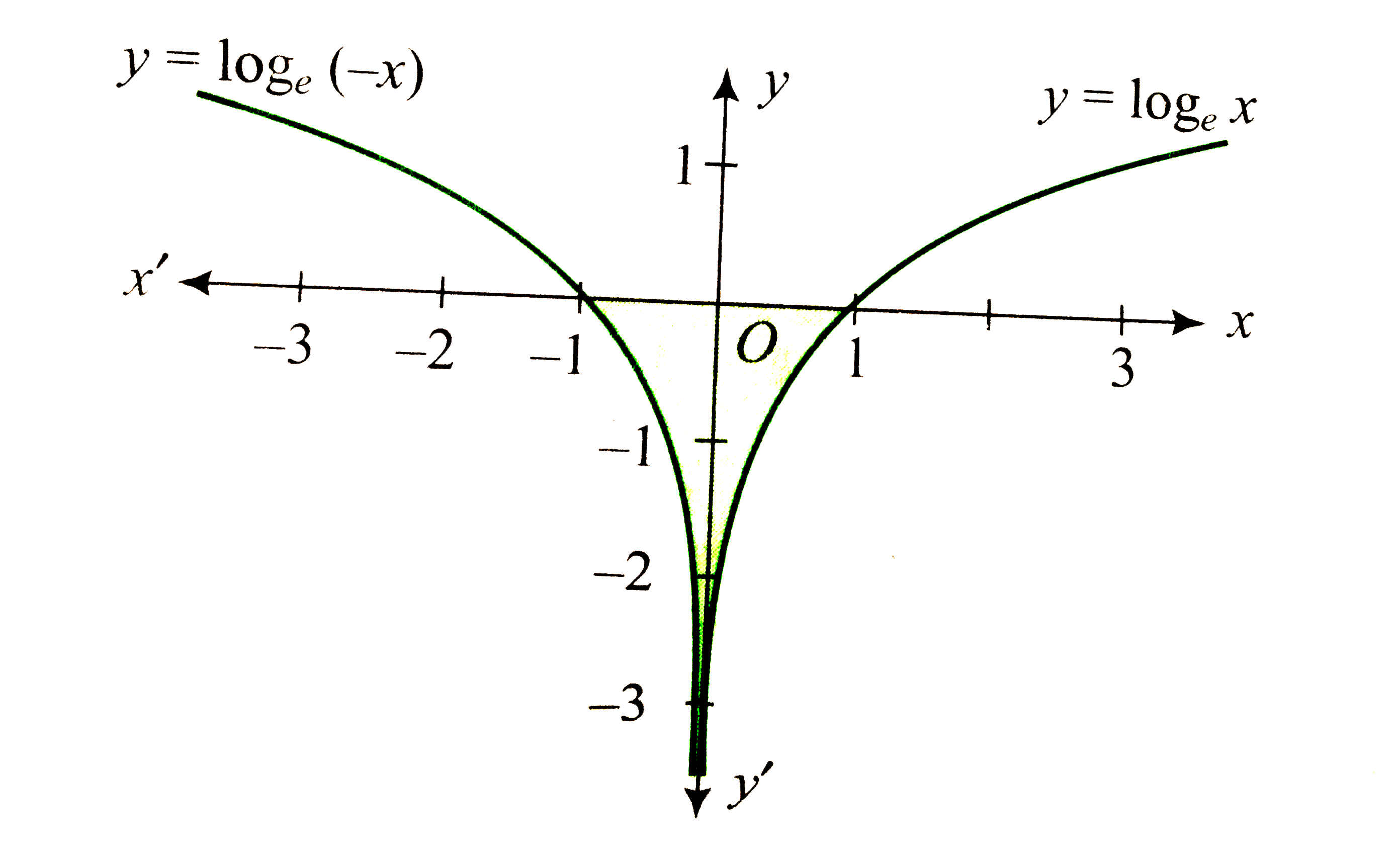
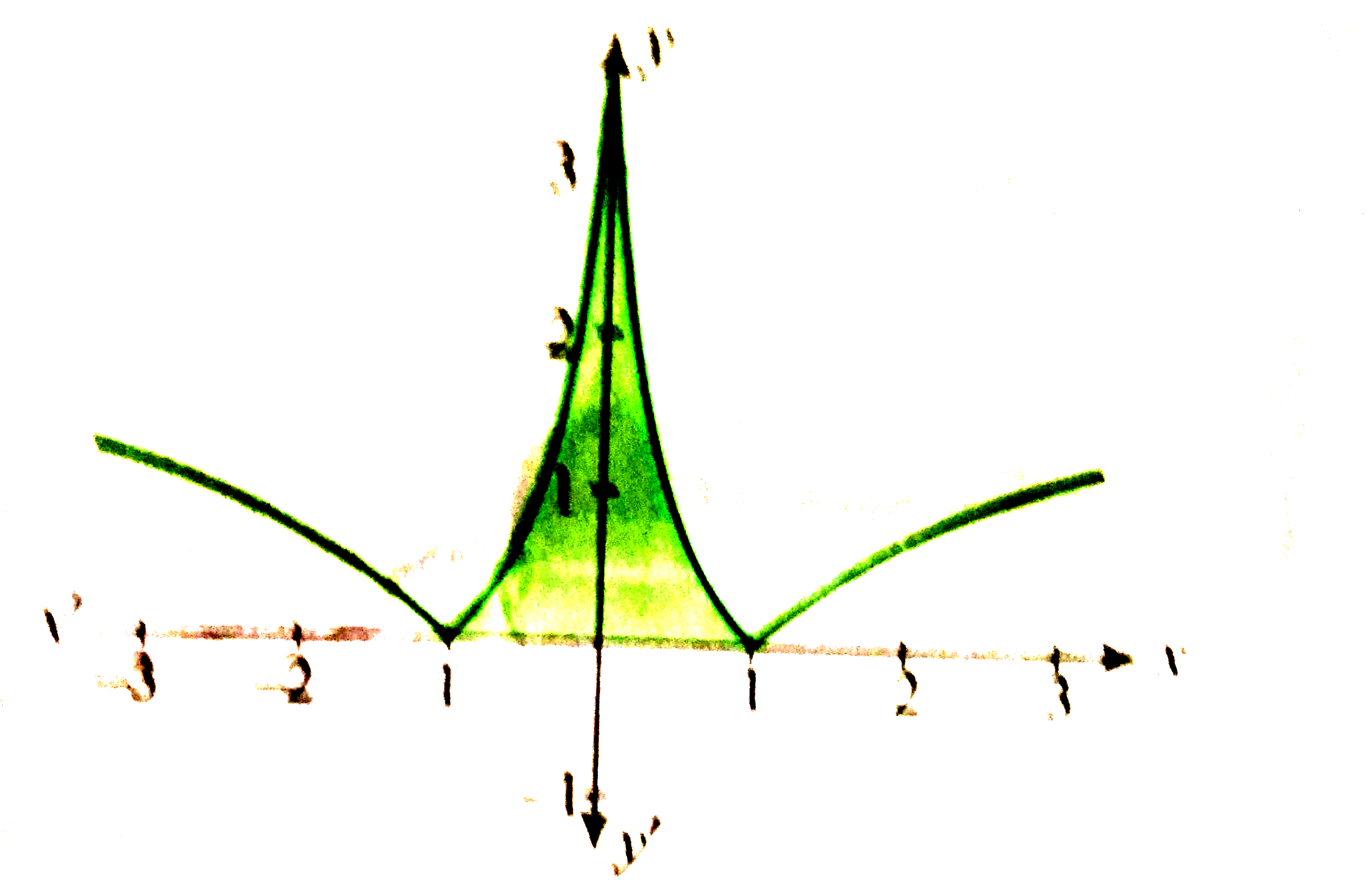
(i) y`=log""_(e)|x|andy=0` From the figure, required area = area of the shaded region = 1 + 1 =2 sq. units (as we know that area bounded by `y=log_(e)x, x= 0 and y= 0` is 1 sq. units) (ii) `y=|log""_(e)|x||andy=0` From the figure, Required area = Area of the shaded region = 1 + 1 =2 sq. units.
The area bounded by the curves y=(log)_e xa n dy=((log)_e x)^2 is
Find the area bounded by y=log_e x , y=-log_e x ,y=log_e(-x),a n dy=-log_e(-x)dot
Compute the area of the region bounded by the curves y=e x(log)_e xa n dy=(logx)/(e x)
Find (dy)/(dx) , when y=log|x|
Find (dy)/(dx) : y = log _(2)x
Each question has four choices a,b,c and d, out of which only one is correct. Each question contains STATEMENT 1 and STATEMENT 2. If both the statements are TRUE and STATEMENT 2 is the correct explanation of STATEMENT 1 If both the statements are TRUE but STATEMENT 2 is NOT the correct explanation of STATEMENT 1. If STATEMENT 1 is TRUE and STATEMENT 2 is FALSE. If STATEMENT 1 is FALSE and STATEMENT 2 is TRUE. Statement 1 : The area bounded by y=e^x , y=0a n dx=0 is 1 sq. unites. Statement 2 : The area bounded by y=(log)_e x ,x=0,a n dy=0 is 1 sq. units.
y log y dx - x dy = 0
Find the general solution of (x+log y)dy + y dx =0
Find the range of f(x)=(log)_e x-((log)_e x)^2/(|(log)_e x|)