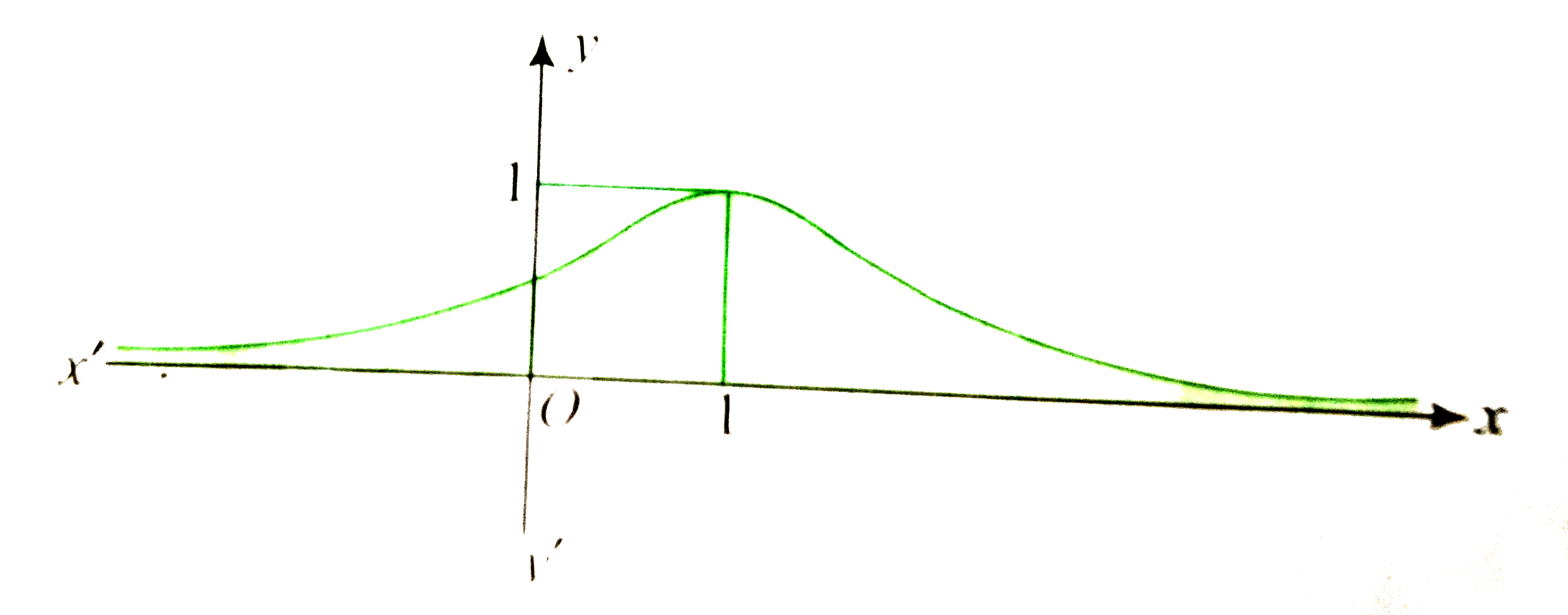
Find the area bounded by `y=1/(x^2-2x+2)`
and x-axis.
Text Solution
Verified by Experts
`y=(1)/((x-1)^(2)+1)` When `x=1, ""^(y)"max ."1` When `xrarrpmoo,yrarr0` Therefore, x-axis is the asymptote. Also `f(1+x)=f(1-x)` Hence, the graph is symmetrical about line x = 1 From these information the graph of function is as shown in the figure. `"Area "=2overset(oo)underset(1)int(1)/((x-1)^(2)+1)dx=[2tan^(-1)(x-1)]_(1)^(oo)=pi" sq. units."`
Find the area bounded by y=sin^(-1)(sinx) and x-axis for x in [0,100pi]
Find the area bounded by x=2y-y^2 and the y-a x i s .
Find the area bounded by y=-x^(3)+x^(2)+16x and y=4x
"If "f: [-1,1]rarr[-(1)/(2),(1)/(2)]:f(x)=(x)/(1+x^(2)), then find the area bounded by y=f^(-1)(x), the x -axis and the lines x=(1)/(2), x=-(1)/(2).
Find the area bounded by the curves y=x^(3)-x and y=x^(2)+x.
Find the area bounded by the curve y=4x(x-1)(x-2) and the x-axis.
A curve C passes through (2,0) and the slope at (x , y) as ((x+1)^2+(y-3))/(x+1)dot Find the equation of the curve. Find the area bounded by curve and x-axis in the fourth quadrant.
Find the area bounded by y=x^(2) and y=x^(1//3)" for "x in [-1,1].
Find a continuous function f, where (x^(4)-4x^(2))lef (x) le (2x^(2)-x^(3)) such that the area bounded by y=f(x), y=x^(4)-4x^(2), the y-axis, and the line x=t," where "(0letle2) is k times the area bounded by y=f(x),y=2x^(2)-x^(3), y-axis, and line x=t("where "0le t le 2).