Home
Class 12
MATHS
Let O(0,0),A(2,0),a n dB(1, 1/(sqrt(3)))...

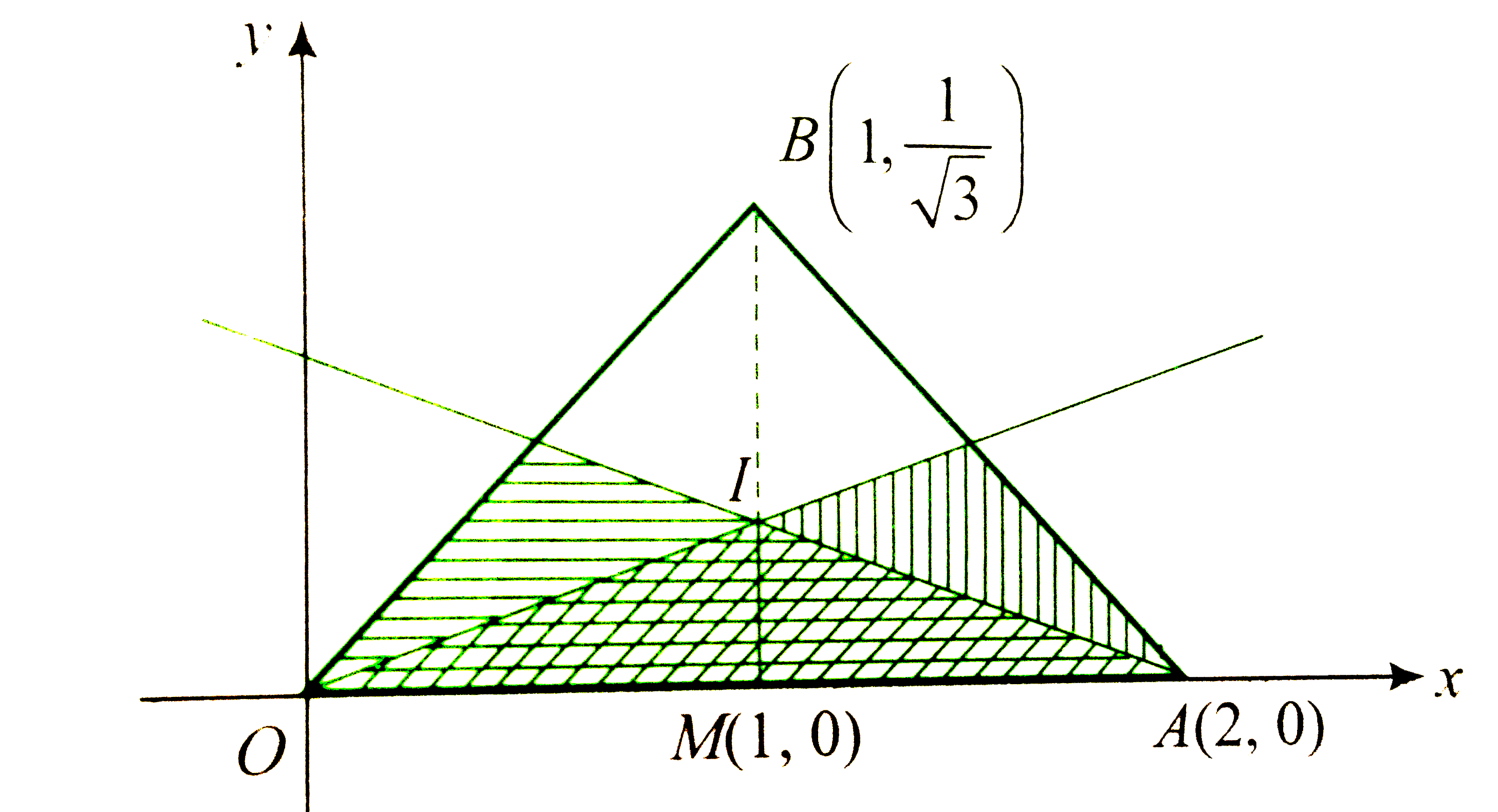
Let `O(0,0),A(2,0),a n dB(1, 1/(sqrt(3)))` be the vertices of a triangle. Let `R` be the region consisting of all those points `P` inside ` O A B` which satisfy `d(P , O A)lt=min[d(P, O B),d(P,A B)]` , where `d` denotes the distance from the point to the corresponding line. Sketch the region `R` and find its area.

Text Solution

Verified by Experts


`d(P,OA)le" min "[d(P,OB), d(P,AB)]`
`rArr" "d(P,OA)le d(P,OB) and d(P,OA)led(P,AB)`
When `d(P,OA)=d(P,OB),P` is equidistant from OA and OB, or
P lies on the angular bisector of lines OA and OB.
Hence when `d(P,OA) le d(P,OB),` point P is nearer to OA than to
OB, i.e., lies on or below the bisector of OA and OB.
Similarly, when `d(P,OA)led(P,AB)`, P is nearer to OA then to OB, i.e., lies on or below the bisector of OA and AB.
`therefore" Required area = Area of "Delta OIA.`
`"Now, tan "angleBOA=(1//sqrt(3))/(1)=(1)/(sqrt(3))`
`"or "angleBOA=30^(@)rArrangleIOA=15^(@)`
`rArr" "IM=tan 15^(@)=2-sqrt(3).`
`"Hence, Area of "DeltaOIA =(1)/(2)OAxxIM=(1)/(2)xx2xx(2-sqrt(3))`
`2-sqrt(3)` sq. units.

Promotional Banner

Topper's Solved these Questions

  • AREA

    CENGAGE PUBLICATION|Exercise Solved Examples|10 Videos
  • AREA

    CENGAGE PUBLICATION|Exercise Concept Application Exercise 9.1|9 Videos
  • APPLICATIONS OF DERIVATIVES

    CENGAGE PUBLICATION|Exercise Subjective Type|2 Videos
  • BINOMIAL THEOREM

    CENGAGE PUBLICATION|Exercise Comprehension|11 Videos

Similar Questions

Explore conceptually related problems

Let A-=(6,7),B-=(2,3)a n dC-=(-2,1) be the vertices of a triangle. Find the point P in the interior of the triangle such that P B C is an equilateral triangle.

Two points O(0,0) and A(3,sqrt(3)) with another point P form an equilateral triangle. Find the coordinates of Pdot

Let O(0,0),P(3,4), and Q(6,0) be the vertices of triangle O P Q . The point R inside the triangle O P Q is such that the triangles O P R ,P Q R ,O Q R are of equal area. The coordinates of R are

If the points A(6, 1), B(8, 2), C(9, 4) and D(p, 3) are the vertices of a parallelogram, taken inorder, find the value of p.

Let P(-9, 4, 5) and Q(11, 0, -1) be two given points. If O be the origin and ON be perpendicular to PQ then find the coordinates of N.

A point P(x ,y ,z) is such that 3P A=2P B , where Aa n dB are the point (1,3,4)a n d(1,-2,-1), irrespectivley. Find the equation to the locus of the point P and verify that the locus is a sphere.

P and Q are points on the line joining A(-2,5) and B(3,1) such that A P=P Q=Q B . Then, the distance of the midpoint of P Q from the origin is 3 (b) (sqrt(37))/2 (b) 4 (d) 3.5

For points P-=(x_1y_1) and Q-=(x_2,y_2) of the coordinate plane, a new distance d(P,Q) is defined by d (P,Q)=|X_1-X_2|+|y_1-y_2| Let O=(0,0),A=(1,2), B-=(2,3) and C-=(4,3) are four fixed points on x-y plane Answer the following questions based on above passage: Let R (x,y), such that R is equidistant from the points O and A with respect to new distance and if 0 < x < 1 and 0 < y < 2 then R lie on a line segment whose equation is

Let P(x) denote the probability of the occurrence of event xdot Plot all those point (x , y)=(P(A),P(B)) in a plane which satisfies the conditions, P(AuuB)geq3//4a n d1//8lt=P(AnnB)lt=3//8

Let L_1=0a n dL_2=0 be two fixed lines. A variable line is drawn through the origin to cut the two lines at R and SdotPdot is a point on the line A B such that ((m+n))/(O P)=m/(O R)+n/(O S)dot Show that the locus of P is a straight line passing through the point of intersection of the given lines R , S , R are on the same side of O)dot
