Home
Class 12
MATHS
If S(0),S(1),S(2),… are areas bounded by...

If `S_(0),S_(1),S_(2),…` are areas bounded by the x-axis and half-wave of the curve `y=sin pi sqrt(x)," then prove that "S_(0),S_(1),S_(2),…` are in A.P…

A

`(1)/(2)(1+e^(pi))` sq. units

B

`(1)/(2)(1+e^(-pi))` sq. units

C

`(1)/(2)(1-e^(-pi))` sq. units

D

`(1)/(2)(e^(pi)-1)` sq. units

Text Solution

Verified by Experts

The correct Answer is:
A

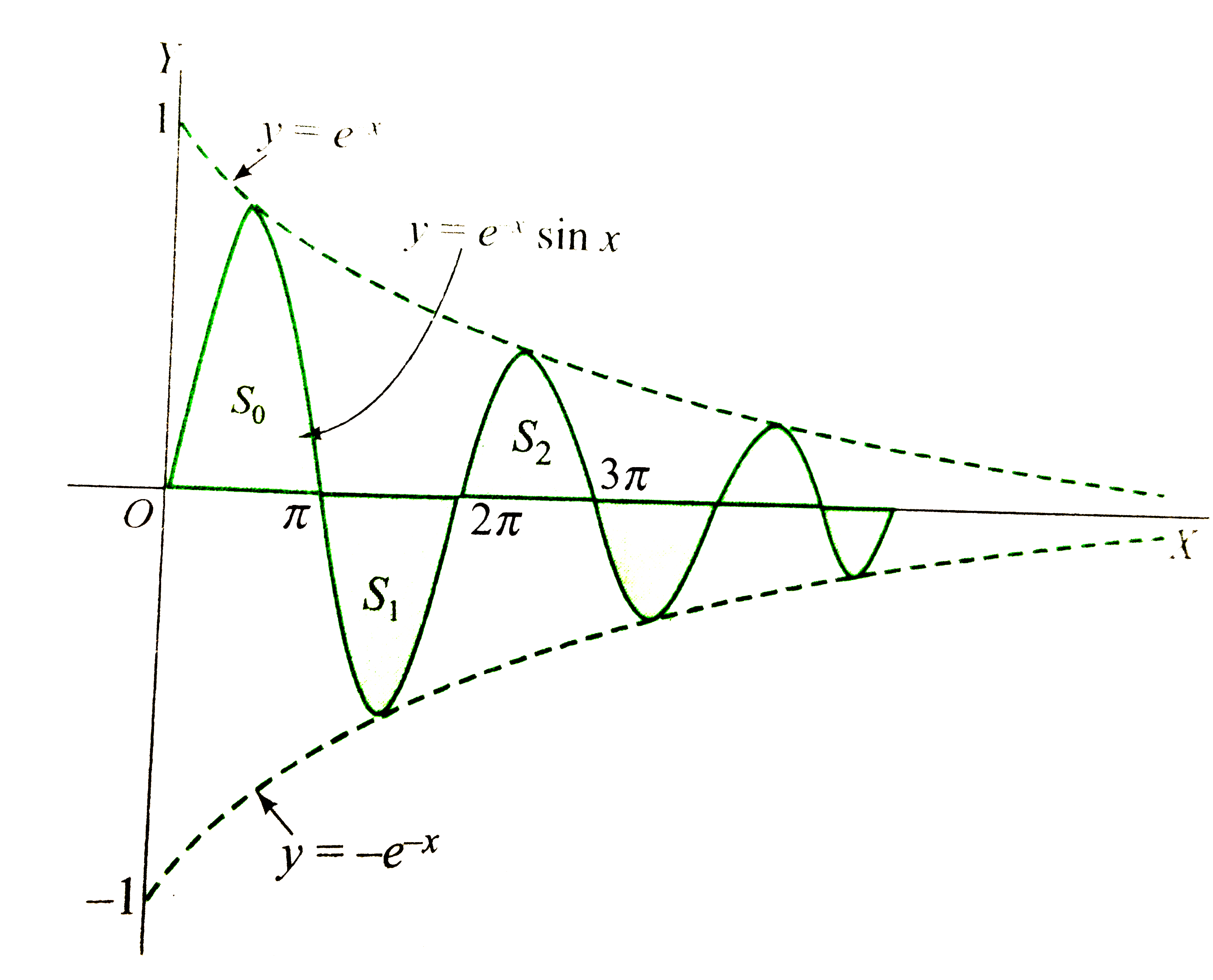
`"Since "-1 le sin x le 1," the curve "y=e^(-x) sin x " is bounded by the curve "y=e^(-x)and y=e^(-x).`

Also, the curve `y=e^(-x) sin x` intersects the positive semi-axis OX at the points where sin x=0, where `x_(n)=npi, n in Z.`
`"Also "|y_(n)|=|y" coordinate in the half-wave "S_(n)|`
`therefore" "S_(n)=(-1)^(n)overset((n+1)pi)underset(npi)inte^(-x)sin xdx`
`=((-1)^(n+1))/(2)[e^(-x)(-sin x + cos x)]_(npi)^((n+1)pi)`
`=((-1)^(n+1))/(2)[e^(-(n+1)x)(-1)^(n+1)-e^(npi)(-1)^(n)]`
`=(e^(-npi))/(2)(1+e^(pi))`
`rArr" "(S_(n+1))/(S_(n))=e^(-pi)`
`"and "S_(0)=(1)/(2)(1+e^(pi)).`
Therefore, the sequence `S_(0),S_(1),S_(2),...` forms an infinite G.P. with common ratio `e^(-pi)`. we have
`overset(oo)underset(n=0)SigmaS_(n)=((1)/(2)(1+e^(pi)))/(1-e^(-pi))`
Promotional Banner

Topper's Solved these Questions

  • AREA

    CENGAGE PUBLICATION|Exercise Matrix Match Type|5 Videos
  • AREA

    CENGAGE PUBLICATION|Exercise Numerical Value Type|18 Videos
  • AREA

    CENGAGE PUBLICATION|Exercise Multiple Correct Answers Type|13 Videos
  • APPLICATIONS OF DERIVATIVES

    CENGAGE PUBLICATION|Exercise Subjective Type|2 Videos
  • BINOMIAL THEOREM

    CENGAGE PUBLICATION|Exercise Comprehension|11 Videos

Similar Questions

Explore conceptually related problems

Find the area bounded by x=2y-y^2 and the y-a x i s .

Find the area bounded by the curve y=sin^(-1)x and the line x=0,|y|=pi/2dot

If in Delta ABC, (a -b) (s-c) = (b -c) (s-a) , prove that r_(1), r_(2), r_(3) are in A.P.

If S_(1), S_(2), S_(3) are the sums of n natural numbers, their squares, their cubes respectively show that 9S_(2)^(2) = S_(3)(1+8S_(1)) .

Sixteen players S_(1) , S_(2) , S_(3) ,…, S_(16) play in a tournament. Number of ways in which they can be grouped into eight pairs so that S_(1) and S_(2) are in different groups, is equal to

If S_(1), S_(2), S_(3) be respectively the sums of n, 2n and 3n terms of a G.P., prove that, S_(1)(S_(3) - S_(2)) = (S_(2) - S_(1))^(2) .

The parabolas y^(2)= 4x and x^(2) = 4y divide the square region bounded by the line x = 4 , y = 4 and the coordinate axes into three parts. If S_(1), S_(2), S_(3) are respectively the areas of these three parts numbered from top to bottom then S_(1) : S_(2) : S_(3) is-

If S is the area bounded byb the curve y =sqrt( 1-x^(2)) and y= x^(3) -x then the value of (pi)/( S) is equal to-

If s_1 be the sum of (2n+1) terms of an A.P and s_2 be the sum its odd terms, then prove that s_1:s_2=(2n+1):(n+1)

CENGAGE PUBLICATION-AREA-Linkded Comprehension Type
  1. Let A(r) be the area of the region bounded between the curves y^(2)=(e...

    Text Solution

    |

  2. If y=f(x) is a monotonic function in (a,b), then the area bounded by t...

    Text Solution

    |

  3. If y=f(x) is a monotonic function in (a,b), then the area bounded by t...

    Text Solution

    |

  4. If y=f(x) is a monotonic function in (a,b), then the area bounded by t...

    Text Solution

    |

  5. If S(0),S(1),S(2),… are areas bounded by the x-axis and half-wave of t...

    Text Solution

    |

  6. Consider the sequence of natural numbers S0,S1,S2,... such that S0 =3,...

    Text Solution

    |

  7. If S(0),S(1),S(2),… are areas bounded by the x-axis and half-wave of t...

    Text Solution

    |

  8. Two curves C(1)equiv[f(y)]^(2//3)+[f(x)]^(1//3)=0 and C(2)equiv[f(y)]^...

    Text Solution

    |

  9. Two curves C(1)equiv[f(y)]^(2//3)+[f(x)]^(1//3)=0 and C(2)equiv[f(y)]^...

    Text Solution

    |

  10. The area bounded by the curve y^(2)(2-x)=x^(3) and x=2 is

    Text Solution

    |

  11. Consider the two curves C(1):y=1+cos x and C(2): y=1 + cos (x-alpha)" ...

    Text Solution

    |

  12. Consider two curves C1: y=1/x a n dC2: y=logx on the x y plane. Let D1...

    Text Solution

    |

  13. Consider the function defined implicity by the equation y^(2)-2ye^(sin...

    Text Solution

    |

  14. Consider the function defined implicity by the equation y^(2)-2ye^(sin...

    Text Solution

    |

  15. Consider two functions f(x)={([x]",",-2le x le -1),(|x|+1",",-1 lt x...

    Text Solution

    |

  16. Computing area with parametrically represented boundaries : If the bou...

    Text Solution

    |

  17. Computing area with parametrically represented boundaries : If the bou...

    Text Solution

    |

  18. Computing area with parametrically represented boundaries : If the bou...

    Text Solution

    |

  19. Let f(x) be a continuous function fiven by f(x)={(2x",", |x|le1),(x^(2...

    Text Solution

    |

  20. Let f(x) be continuous function given by f(x)={2x ,|x|lt=1and x^2+a x+...

    Text Solution

    |

