Home
Class 12
MATHS
Let f:RtoR be a differentiable function ...

Let `f:RtoR` be a differentiable function such that `f(x)=x^(2)+int_(0)^(x)e^(-t)f(x-t)dt`.
`y=f(x)` is

A

The curve y=f(x) passes through the point (1,2)

B

The curve y=f(x) passes through the point (2,-1)

C

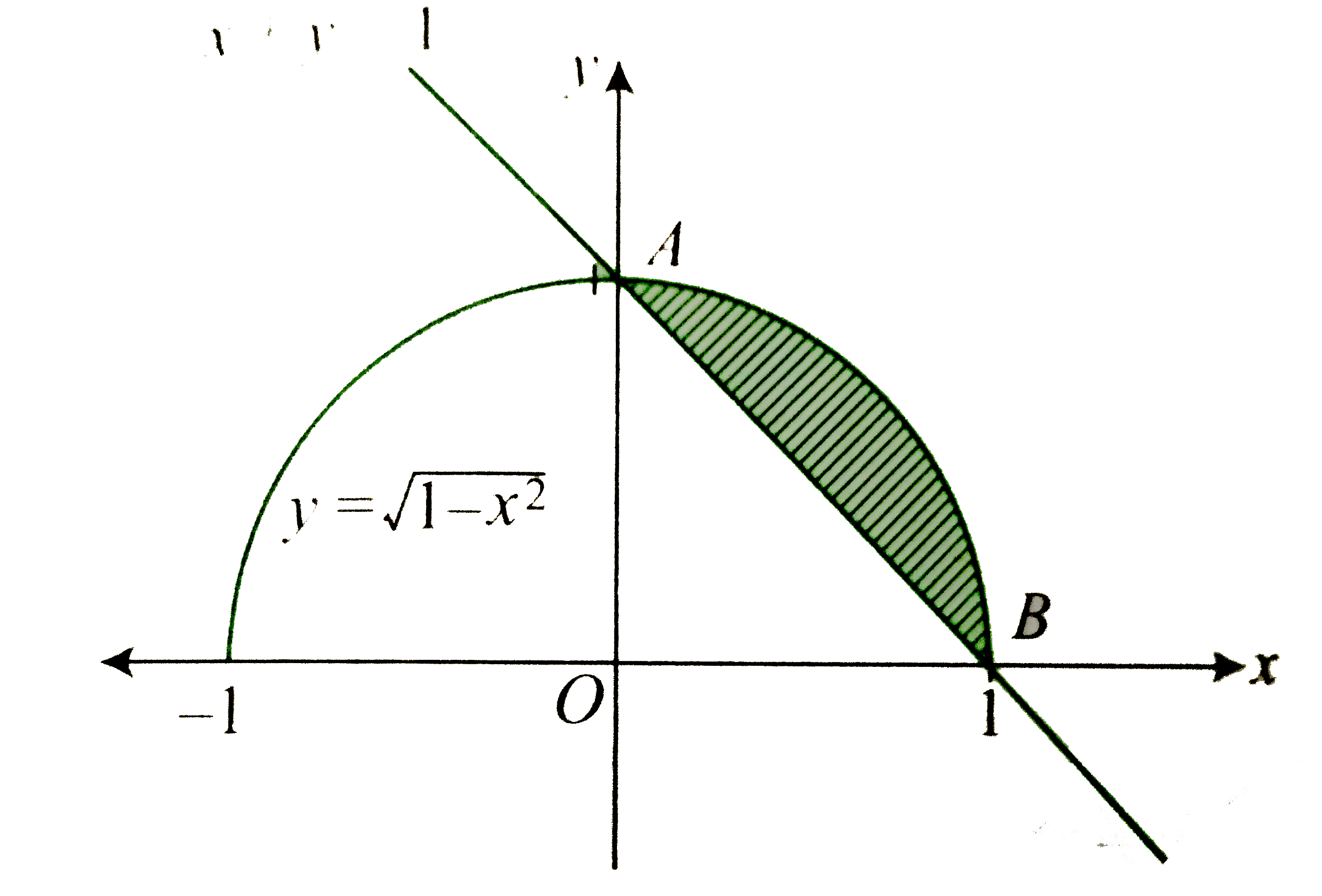
The area of the region `{(x,y) in [0,1]xxR:f(x)leylesqrt(1-x^(2))}" is "(pi-2)/(4)`

D

The area of the region `{(x,y)in [0,1]xxR:f(x)leylesqrt(1-x^(2))}" is "(pi-1)/(4)`

Text Solution

Verified by Experts

The correct Answer is:
B, C

`f(x)=1-2x+overset(x)underset(0)inte^(x-1)f(t)dt`
`rArr" "f(x)=1-2x+e^(x)overset(x)underset(0)inte^(-t)f(t)dt" ...(i)"`
Differentiating w.r.t. x, we get
`f'(x)=-2+e^(x)e^(-x)f(x)+e^(x)overset(x)underset(0)inte^(-t)f(t)dt" ...(ii)"`
Subtracting (i) from (ii), we get
`f'(x)-f(x)=-2+f(x)-1+2x`
`rArr" "f'(x)-2f(x)=2x-3`
This is linear differential equation.
`I.F. =e^(int-2dx)=e^(-2x)`
Therefore, solution is
`ycdote^(-2x)=int(2x-3)e^(-2x)dx+c`
`rArr" "ycdote^(-2x)=(2x-3)cdot(e^(-2x))/(-2)-int2xx(e^(-2x))/(-2)dx+c`
`rArr" "ycdote^(-2x)=-((2x-3)e^(-2x))/(2)-(e^(-2x))/(2)+c`
`rArr" "ycdote^(-2x)=(1-x)e^(-2x)+c`
`rArr" "y=(1-x)+c.e^(2x)" ...(iii)"`
Putting x=0 in (i), we get f(0)=1.
So, from above equation, we have
`1=1+c rArr c=0`
Now, (iii) reduces to y=1-x, which passes through point (2,-1).
`"Now,"f(x)leylesqrt(1-x^(2))`
`rArr" "1-xleylesqrt(1-x^(2))`
`1-xley` represents the region above the line `1-x=y and yle sqrt(1-x^(2))` represents the region inside the semicircle (lying above x-axis) `x^(2)+y^(2)=1.`
So, common region is as the shaded one in the following figure :

Area of the shaded region
=Area of quarter of the circle - Area of triangle OAB
`=(1)/(4)xxpi(1)^(2)-(1)/(2)xx1xx1=(pi-2)/(4)`
Promotional Banner

Topper's Solved these Questions

  • AREA

    CENGAGE PUBLICATION|Exercise Linkded Comprehension Type|21 Videos
  • AREA

    CENGAGE PUBLICATION|Exercise Matrix Match Type|5 Videos
  • AREA

    CENGAGE PUBLICATION|Exercise Exercises - Single Correct Answer Type|40 Videos
  • APPLICATIONS OF DERIVATIVES

    CENGAGE PUBLICATION|Exercise Subjective Type|2 Videos
  • BINOMIAL THEOREM

    CENGAGE PUBLICATION|Exercise Comprehension|11 Videos

Similar Questions

Explore conceptually related problems

Let f:R to R be a differentiable function such that f(x)=x^(2)+int_(0)^(x)e^(-t)f(x-t)dt . f(x) increases for

Let f(x) be a differentiable function such that f(x)=x^2 +int_0^x e^-t f(x-t) dt then int_0^1 f(x) dx=

Let f:RtoR be a differntiable function satisfying f(x)=x^(2)+3int_(0)^(x^(1/3))e^(-t^(3)).f(x-t^(3))dt . Then find f'(x) .

Let f(x) be a differentiable function satisfying f(x)=int_(0)^(x)e^((2tx-t^(2)))cos(x-t)dt , then find the value of f''(0) .

Let f:[1,oo) → [2, ∞) be a differentiable function such that f(1)=2. If 6int_1^xf(t)dt=3xf(x)-x^3 for all xgeq1, then the value of f(2) is

Let f be a differentiable function satisfying int_(0)^(f(x))f^(-1)(t)dt-int_(0)^(x)(cost-f(t)dt=0 and f((pi)/2)=2/(pi) The value of lim_(x to 0)(cosx)/(f(x)) is equal to where [.] denotes greatest integer function

Let f be a differentiable function satisfying int_(0)^(f(x))f^(-1)(t)dt-int_(0)^(x)(cost-f(t)dt=0 and f((pi)/2)=2/(pi) The value of int_(0)^(pi//2) f(x)dx lies in the interval

Let f:(0,oo)->R be a differentiable function such that f'(x)=2-f(x)/x for all x in (0,oo) and f(1) =1 , then

Let f:(0,oo)vec(0,oo) be a differentiable function satisfying, xint_0^x(1-t)f(t)dt=int_0^x tf(t)dtx in R^+a n df(1)=1. Determine f(x)dot

A minimum value of the function f(x) = int_(0)^(x) te^(-t^(2))dt is-

