Home
Class 12
MATHS
If A(3,4) and B(-5,-2) are the extremiti...

If `A(3,4)` and `B(-5,-2)` are the extremities of the base of an isosceles triangle ABC with tan `C = 2`, then point C can be

A

`((3sqrt(5)-1)/(2),-(1+2sqrt(5)))`

B

`(-((3sqrt(5)+5))/(2),3+2sqrt(5))`

C

`((3sqrt(5)-1)/(2),3-2sqrt(5))`

D

`(-((3sqrt(5)-5))/(2),-(1-2sqrt(5)))`

Text Solution

Verified by Experts

The correct Answer is:
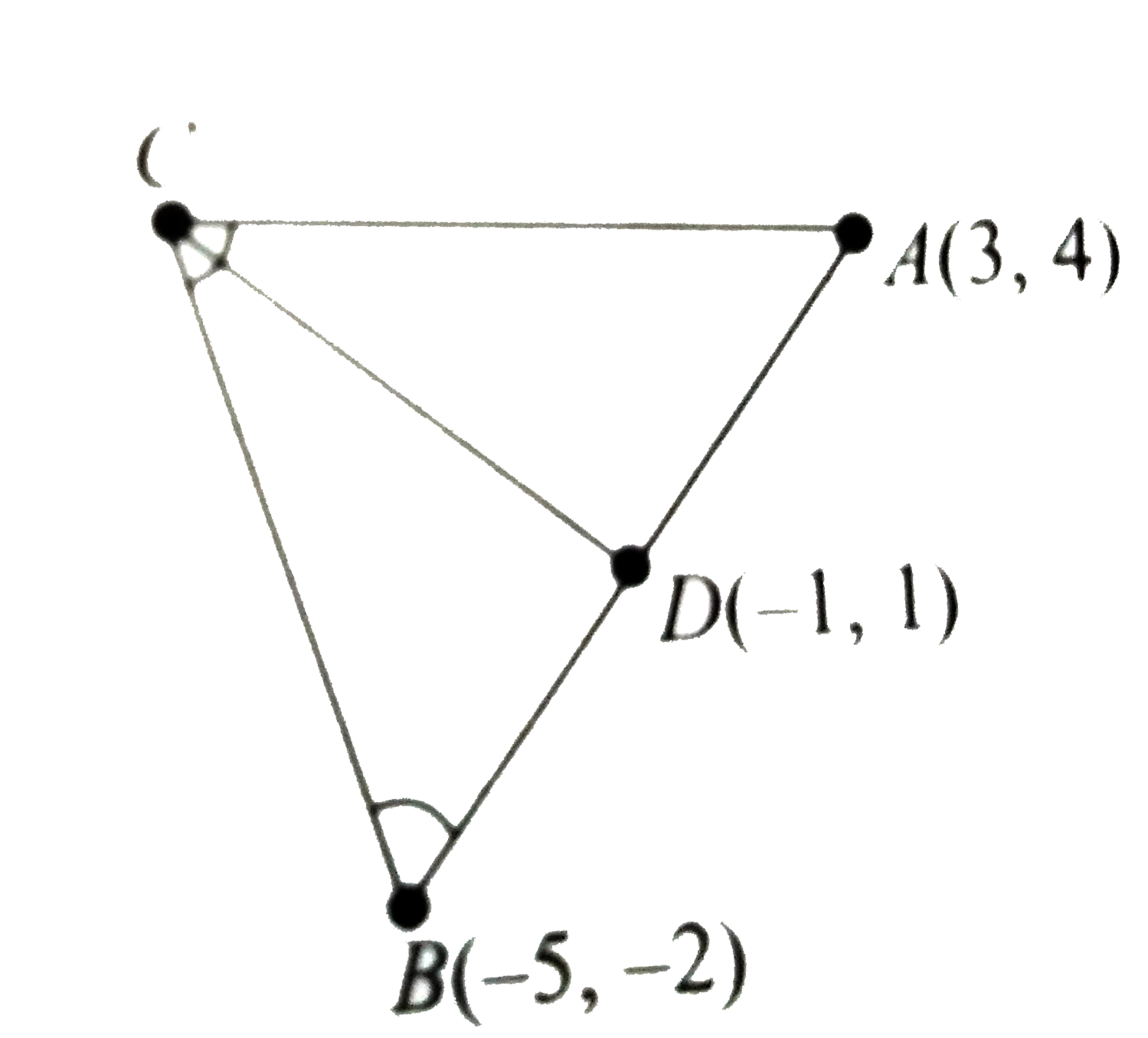
A, B


`D(-1,1)` is midpoint of AB.
`CD = BD cot.(C)/(2) =5. cot.(C)/(2)`
Now, `tan C = 2`
`rArr (2tan.(C)/(2))/(1-tan^(-2).(C)/(2)) =2`
`rArr tan^(2).(C)/(2) +tan.(C)/(2)-1 =0`
`rArr tan.(C)/(2) =(-1+sqrt(5))/(2)`
`rArr cot.(C)/(2) =(sqrt(5)+1)/(2)`
`rArr CD = 5 ((sqrt(5)+1)/(2)) =(5)/(2) (sqrt(5)+1)`
Slope of BD is `3//4`.
`:.` Slope of CD is `-4//3 = tan alpha`
Using parametric form of straight line, coordinates of C are given by
`(-1+-(5(sqrt(5)+1))/(2)cos alpha,1+-(5(sqrt(5)+1))/(2)sin alpha)`
or `(-(5+3sqrt(5))/(2),2sqrt(5)+3)` and `((3sqrt(5)-1)/(2),-(2sqrt(5)+1))`
Promotional Banner

Topper's Solved these Questions

  • STRAIGHT LINE

    CENGAGE PUBLICATION|Exercise Single Correct Answer Type|32 Videos
  • STATISTICS

    CENGAGE PUBLICATION|Exercise Archives|10 Videos
  • STRAIGHT LINES

    CENGAGE PUBLICATION|Exercise ARCHIVES (NUMERICAL VALUE TYPE)|1 Videos

Similar Questions

Explore conceptually related problems

If the extremities of the base of an isosceles triangle are the points (2a ,0) and (0, a), and the equation of one of the side is x=2a , then the area of the triangle is

Prove that A(3,3) B (8,-2) and C(-2,-2) are the vertices of a right - angled isosceles triangle . Also, find the length of the hypotenuse of triangle(ABC)

If A(1, 4, 2), B(-2, 1, 2) and C(2, -3, 4) are the vertices of the triangle ABC, then find the angles of the triangle ABC.

In a triangle ABC, if (sqrt3-1)a = 2b, A = 3B , then /_C is

In triangle ABC, If cos B= a/(2c) , then the triangle is-

ABC is an isosceles triangle of which AC=BC and AB^(2) = 2AC^(2) . Then value of /_C will be -

ABC is an isosceles triangle right angled at C. Prove that AB^(2) = 2AC^(2) .

The line segment joining the points (7,-1) and (9,3) is the base of an isosceles triangle . If the abscissa of the triangle be 4, find the vertex.

If Delta =a^(2) -(b-c) ^(2), where Delta is the area of the triangle ABC, then tan A is equal to-

