Home
Class 12
MATHS
A point moves such that the sum of the s...

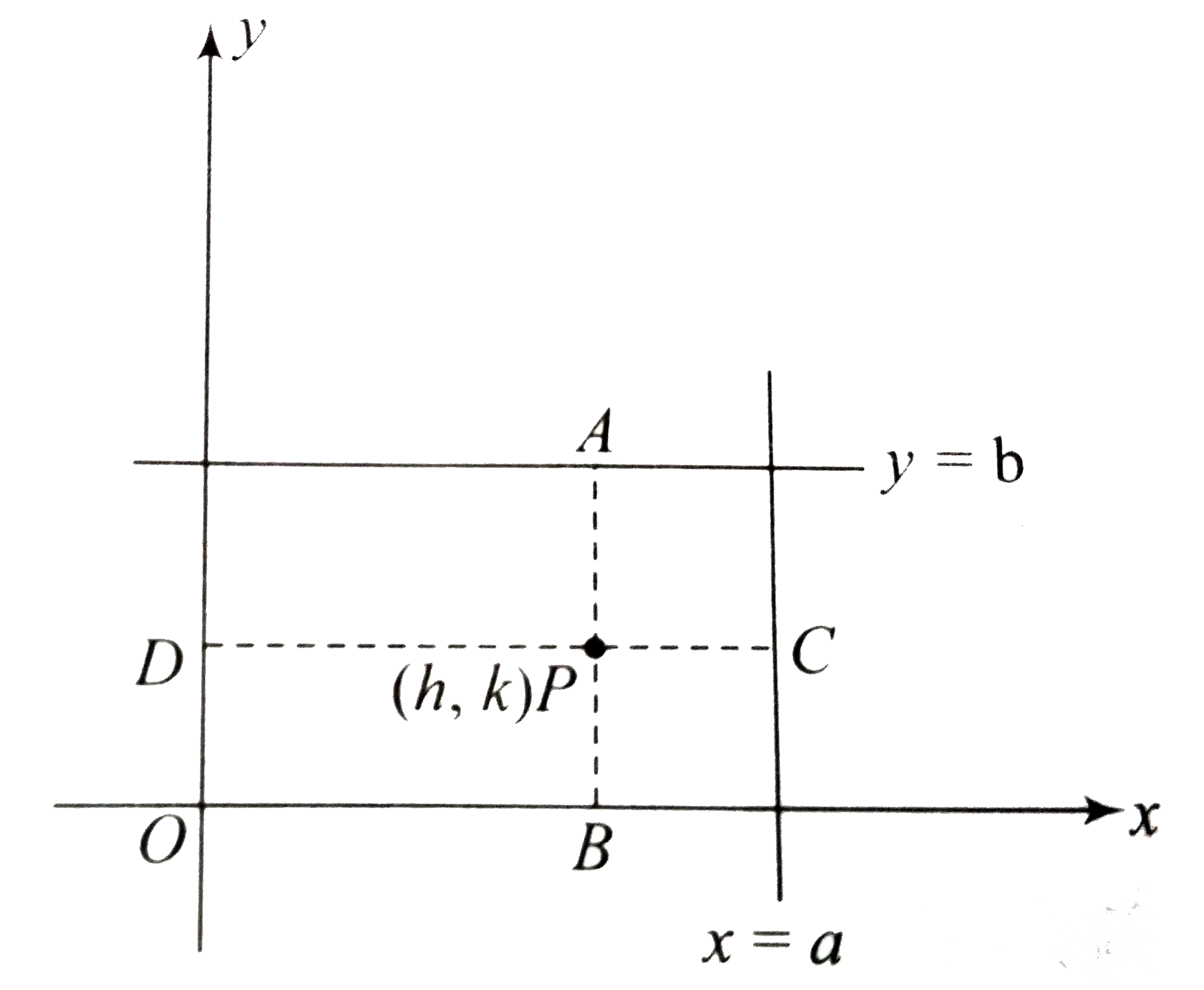
A point moves such that the sum of the squares of its distances from the two sides of length ‘a’ of a rectangle is twice the sum of the squares of its distances from the other two sides of length b. The locus of the point can be:

A

a circle

B

an ellipse

C

a hyperbola

D

a pair of lines

Text Solution

Verified by Experts

The correct Answer is:
C, D

Let the two sides of the rectangle lie along x-axis and y-axis.

Let point P be (h,k)
Given that
`(PA)^(2) + (PB)^(2) = 2 (PC^(2)+PD^(2))`
`rArrk^(2) - (k-b)6(2) = 2(h^(2) + (a-h)^(2))`
`rArr 2k^(2) - 2kb + b^(2) = 4h^(2) - 4ah + 2a^(2)`
Replacing h by x and k by y
`rArr 2y^(2) - 2by + b^(2) = 4x^(2) - 4ax + 2a^(2)`
or `2(y^(2)-by) + b^(2) = 4(x^(2)-ax) + 2a^(2)`
or `4(x-(a)/(2))^(2) - 2(y-(b)/(2))^(2) = (b^(2))/(2) -a^(2)`
Hence it is a hyperbola if `(b^(2))/(2) -a^(2) ne 0`
or pair of lines if `(b^(2))/(2) -a^(@) =0`
Promotional Banner

Similar Questions

Explore conceptually related problems

A point moves so that the sum of squares of its distances from the points (1, 2) and (-2,1) is always 6. Then its locus is

A point moves so that the sum of squares of its distances from the points (1,2) and (-2,1) is always 6 . Then its locus is _

A point moves so that the sum of squares of its distances from the points (1, 2) and (-2, 1) is always 6. Then its locus is

A point movs in such a manner that the sum of the squares of its distances from the points (a,0) and (-a, 0) is 2b^(2). Then the locus of the moving point is-

Prove that the sum of the squares of the sides of a rhombus is equal to the sum of the squares of its diagonals

A point moves in such a manner that the sum of the squares of its distances from the origin and the point (2, -3) is always 19. Show that the locus of the moving point is a circle. Find the equation to the locus.

A point moves so that sum of the squares of its distances from the vertices of a triangle is always constant. Prove that the locus of the moving point is a circle whose centre is the centroid of the given triangle.

Prove that the sum of the areas of the squares drawn on the sides of a rhombus is equal to the sum of the areas of two squares drawn on the diagonals of the given square.

A point moves so that the sum of the squares of the perpendiculars let fall from it on the sides of an equilateral triangle is constant. Prove that its locus is a circle.

Prove that the locus of the point that moves such that the sum of the squares of its distances from the three vertices of a triangle is constant is a circle.

