Home
Class 12
MATHS
Base BC of triangle ABC is fixed and opp...

Base BC of triangle ABC is fixed and opposite vertex A moves in such a way that `tan.(B)/(2)tan.(C)/(2)` is constant. Prove that locus of vertex A is ellipse.

Text Solution

Verified by Experts
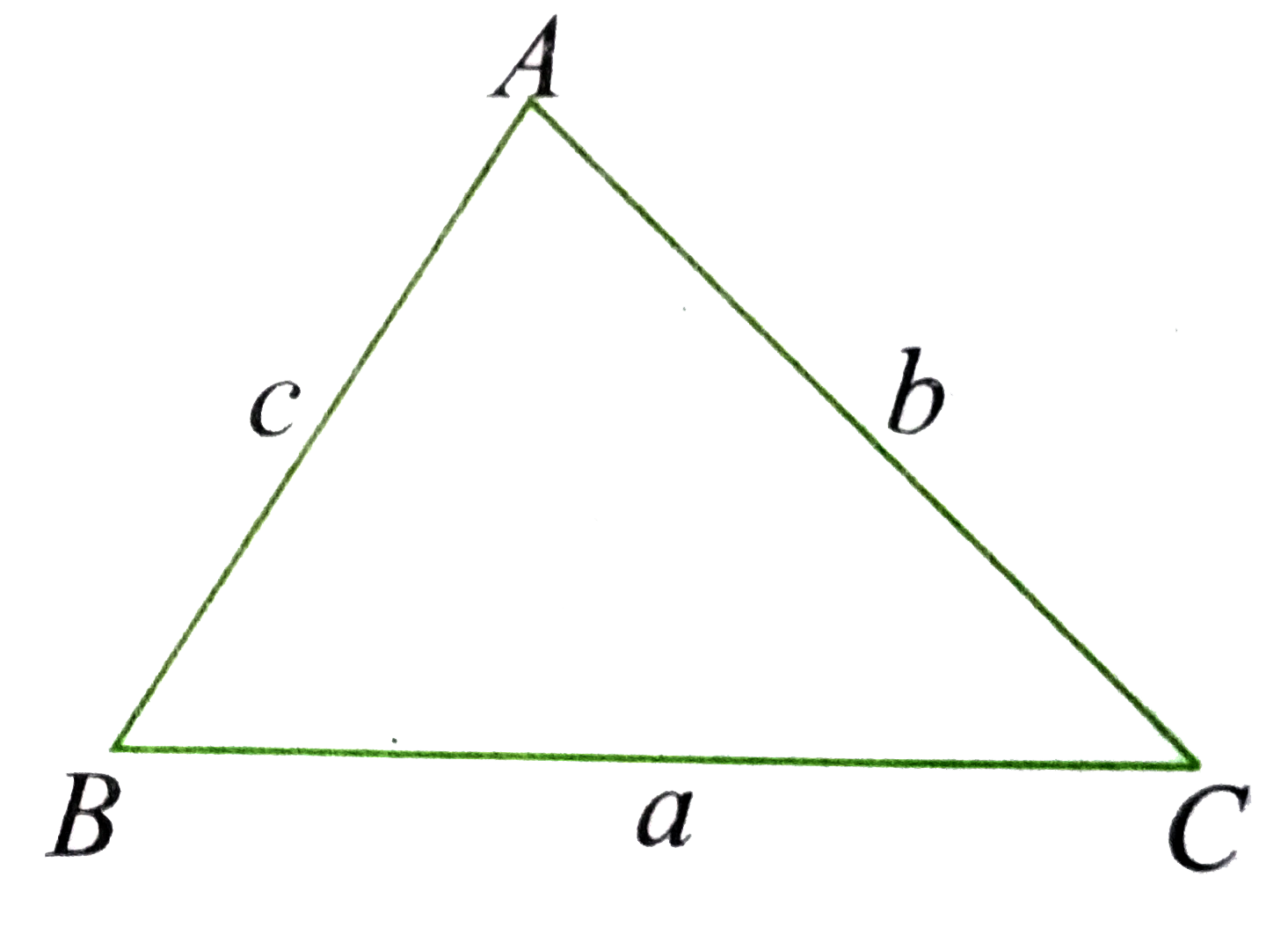
Given the at in triangle ABC, 'a' is constnat

and `tan.(B)/(2)tan.(C)/(2)= lambda` (constant)
`rArrsqrt(((s-c)(s-c))/(s(s-b)))sqrt(((s-a)(s-b))/(s(s-c)))=lambda`
`rArr (s-a)/(s)=lambda`
`rArr (2s-a)/(a)=a(lambda+1)/(1-lambda)` (constant)
Thus, sum of distance of variable point A from two given fixed ponts Ba dn C is contant , therefore, locus of A is ellipse
Promotional Banner

Similar Questions

Explore conceptually related problems

The coordinates of the vertices Ba n dC of a triangle A B C are (2, 0) and (8, 0), respectively. Vertex A is moving in such a way that 4tan(B/2)tan(C/2)=1. Then find the locus of A

In triangle ABC, base BC is fixed. Then prove that the locus of vertex A such that tan B+tan C= Constant is parabola.

B and C are the vertex of a triangle ABC with coordinate (2 , 0) and (8 , 0) respectively. Another vertex A moves in such a way that it satisfies the relation 4 " tan" (B)/(2) "tan" (C)/(2) = 1 . If the equation of locus of A is (x - 5)^(2)/5^2+ (y^(2))/(k^(2)) = 1 , then the value fo k is _

The base B C of A B C is fixed and the vertex A moves, satisfying the condition cot(B/2)+cot(C/2)=2cot(A/2), then (a) b+c=a (b) b+c=2a (c) vertex A moves along a straight line (d) Vertex A moves along an ellipse

A and B are two fixed points on a plane and P moves on the plane in such a way that PA : PB = constant. Prove analytically that the locus of P is a circle.

a triangle A B C with fixed base B C , the vertex A moves such that cosB+cosC=4sin^2(A/2)dot If a ,b and c , denote the length of the sides of the triangle opposite to the angles A , B and C , respectively, then (a) b+c=4a (b) b+c=2a (c) the locus of point A is an ellipse (d) the locus of point A is a pair of straight lines

A variable triangle A B C is circumscribed about a fixed circle of unit radius. Side B C always touches the circle at D and has fixed direction. If B and C vary in such a way that (BD) (CD)=2, then locus of vertex A will be a straight line. (a)parallel to side BC (b)perpendicular to side BC (c)making an angle (pi/6) with BC (d) making an angle sin^(-1)(2/3) with B C

If A , B and C are interior angles of a triangle ABC, then show that tan ((A+B) /(2)) =cot (C/2)

If on a given base B C , a triangle is described such that the sum of the tangents of the base angles is m , then prove that the locus of the opposite vertex A is a parabola.

