Home
Class 12
MATHS
A line passing through the origin O(0,0)...

A line passing through the origin `O(0,0)` intersects two concentric circles of radii `aa n db` at `Pa n d Q ,` If the lines parallel to the X-and Y-axes through `Qa n dP ,` respectively, meet at point `R ,` then find the locus of `Rdot`

Text Solution

Verified by Experts
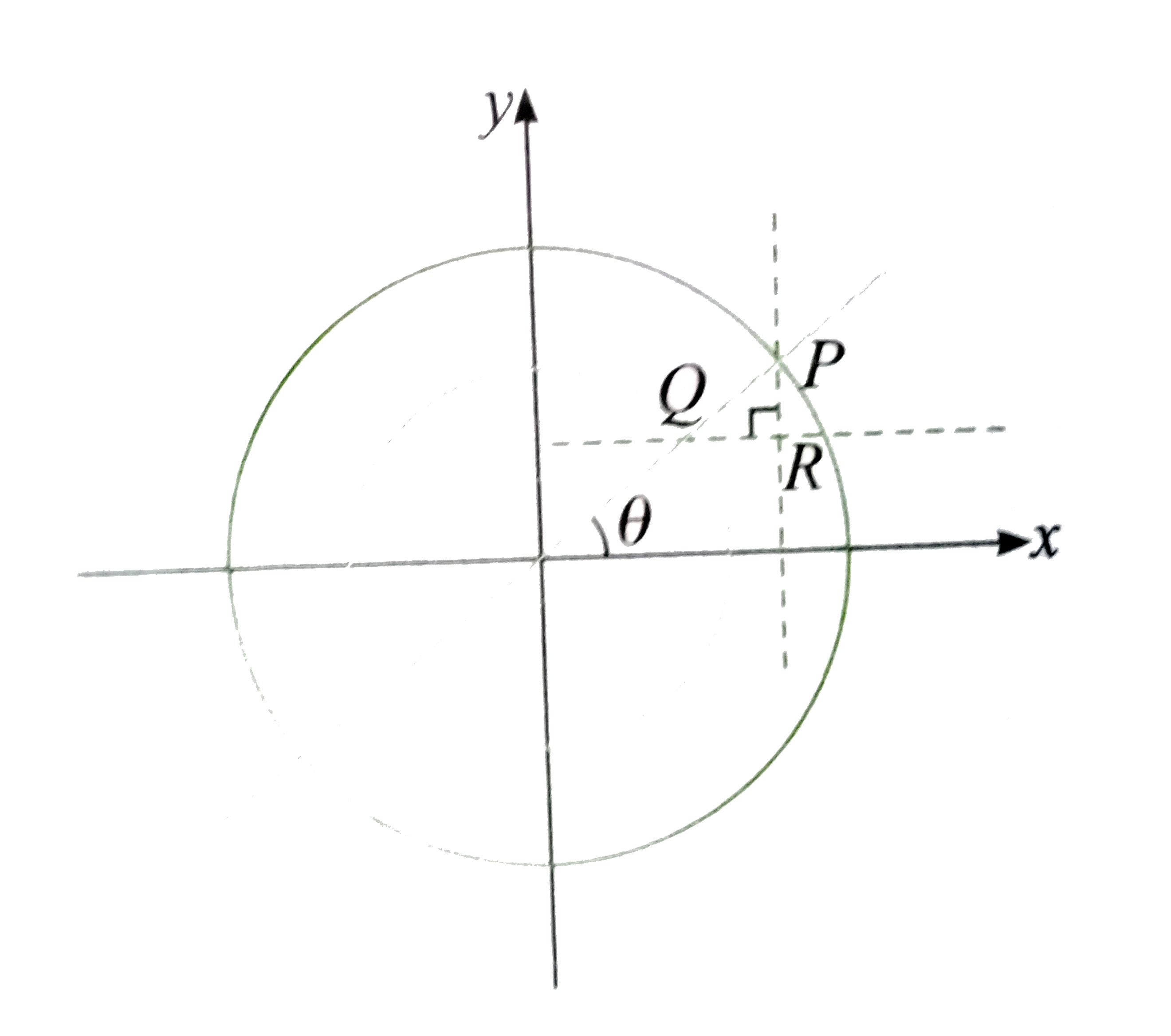
Let `R-=(h,k)`
From the fiugure,
`h=a cos theta`
and `k=b sin theta`

Squaring and adding, we get
`(h^(2))/(a^(2))+(k^(2))/(b^(2))=1`
So, `(x^(2))/(a^(2))+(y^(2))/(b^(2))=1` is required locus.
Promotional Banner

Similar Questions

Explore conceptually related problems

If the line passing through (4,3)a n d(2,k) is parallel to the line y=2x+3, then find the value of kdot

A point P moves on a plane x/a+y/b+z/c=1. A plane through P and perpendicular to O P meets the coordinate axes at A , Ba n d Cdot If the planes through A ,Ba n dC parallel to the planes x=0,y=0a n dz=0, respectively, intersect at Q , find the locus of Qdot

Find equation of the line parallel to the line 3x - 4y + 2 = 0 and passing through the point (-2, 3) .

T P and T Q are tangents to the parabola y^2=4a x at Pa n dQ , respectively. If the chord P Q passes through the fixed point (-a ,b), then find the locus of Tdot

A line L passing through the point (2, 1) intersects the curve 4x^2+y^2-x+4y-2=0 at the point Aa n dB . If the lines joining the origin and the points A ,B are such that the coordinate axes are the bisectors between them, then find the equation of line Ldot

Find the equation of the line which is parallel to 3x-2y+5=0 and passes through the point (5,-6) .

A straight line is drawn through P(3,4) to meet the axis of x and y at Aa n dB , respectively. If the rectangle O A C B is completed, then find the locus of Cdot

If a circle passes through the points of intersection of the coordinates axes with the lines lambdax-y+1=0 and x-2y+3=0 , then find the value of lambda .

If a circle passes through the point (0,0),(a ,0)a n d(0, b) , then find its center.

The equation of the plane through the line of intersection of the planes ax + by+cz + d= 0 and a'x + b'y+c'z + d'= 0 parallel to the line y=0 and z=0 is

