Home
Class 12
MATHS
Find the area of the greatest isosceles ...

Find the area of the greatest isosceles triangle that can be inscribed in the ellipse `((x^2)/(a^2))+((y^2)/(b^2))=1` having its vertex coincident with one extremity of the major axis.

Text Solution

Verified by Experts
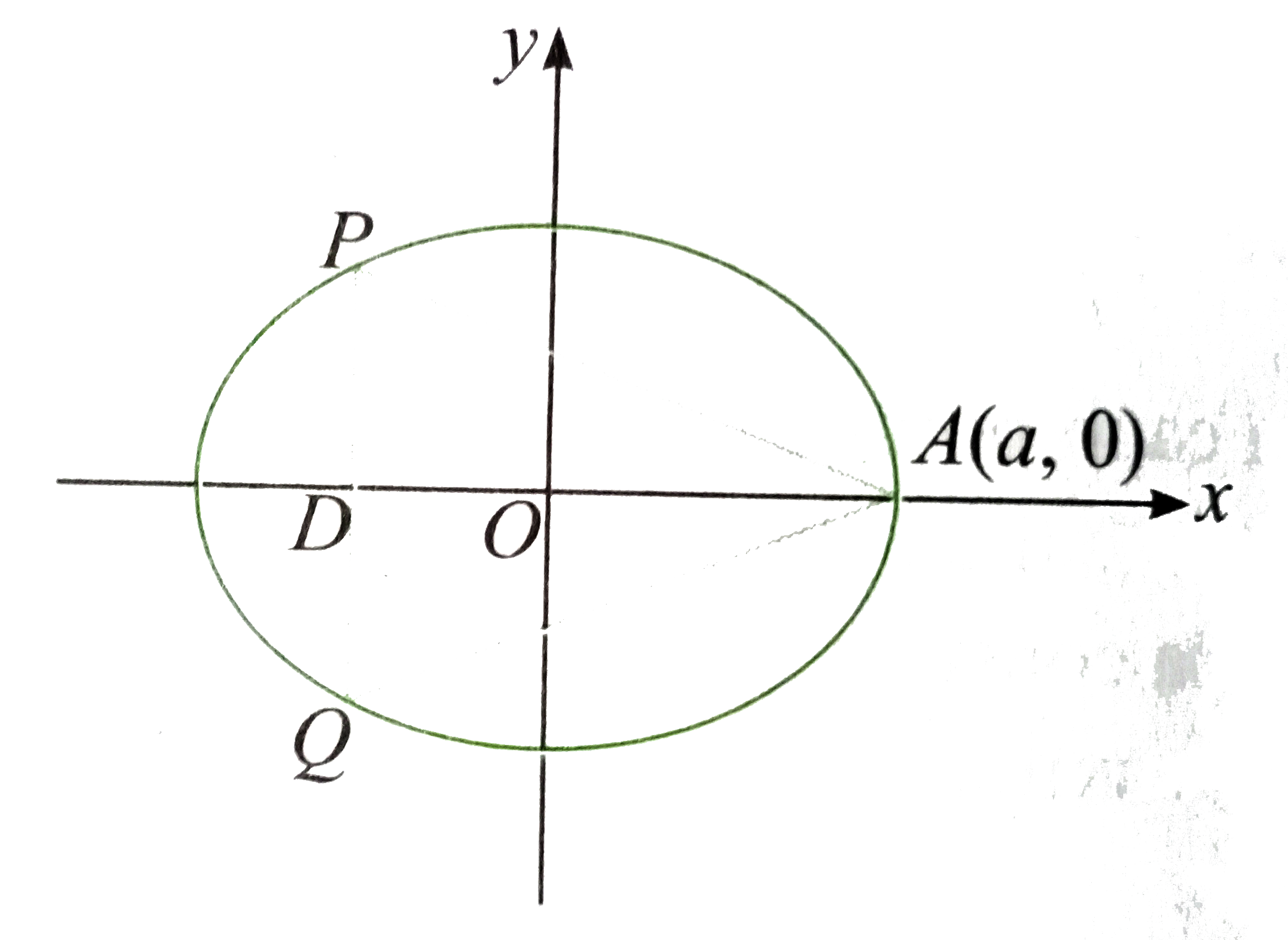
Let APQ be the isoceles triangle inscribed in the ellipse `(x^(2)//a^(2))+(y^(2)//b^(2))=1` with one vertex A at the extermity (a,0) of the major axis. If the coordinates of P are `(a cos theta, -b sin theta)` then those of Q will be `(acos theta b- sin theta)`,
So, area of `DeltaAPQ`. is given by
`Delta=(1)/(2)PQ*AD`
`=PD*AD`
`=PD(OA+OD)`
`= b sin theta (a-a cos theta)`
`=(1)/(2)ab(2 sin theta-sin 2theta),0lt thetalepi`

`:. (dDelta)/(Delta theta)=ab(cos theta-cos 2theta)`
and `(d^(2)Delta)/(d theta^(2))=ab(-sin theta+2 sin 2 theta)`
For maximum or minimum of `Delta`.
`(dDelta)/(d theta)=0`
`or costheta-cos2theta=0`
`or 2 cos^(2)theta-cos theta-1=0`
or ` (2costheta+1)(cos theta-1)=0`
`or cos theta=(1)/(2)" " ( :. cos theta ne 1 as thetane0)`
or `theta=(2pi)/(3)`
Whern `theta=2pi//3`, we have
`(d^(2)Delta)/(d theta^(2))=-(1)/(2)(3sqrt(3))ab,(-ve)`
Therfore the area is maximum when `theta =2pi//3`
Therefore, maximum area
`Delta=(1)/(2)ab[2sin.(2pi)/(3)-sin.(4pi)/(3)]`
`=(1)/(4)(3sqrt(3))ab`
Promotional Banner

Similar Questions

Explore conceptually related problems

Find the area of the greatest rectangle that can be inscribed in an ellipse (x^2)/(a^2)+(y^2)/(b^2)=1 .

Area ( in square unit) of the greatest rectangle that can be inscribed in the ellipse (x^(2))/(a^(2)) +(y^(2))/(b^(2))=1 is -

Find the maximum area of an isosceles triangle inscribed in the ellipse (x^(2))/(a^(2))+(y^(2))/(b^(2))=1 with its vertex at one end of the major axis.

The sides of the rectangle of the greatest area that can be inscribed in the ellipse x^(2)+2y^(2)=8 are given by

The sides of the rectangle of the greatest area, that can be inscribed in the ellipse x^2+2y^2=8 are given by

Find the area of greatest square that can be inscribed given straight lines :2x+5y+8=0&2x+5y-12=0

Find the area of the region bounded by the ellipse (x^(2) )/( a^(2)) +( y^(2))/( b^(2))=1

Find the eccentric angles of the extremities of the latus recta of the ellipse (x^2)/(a^2)+(y^2)/(b^2)=1

Find the area of the equilateral triangle inscribed in the circle x^(2) + y^(2) - 4x + 6y - 3 = 0 .

Find the maximum area of the ellipse (x^2)/(a^2)+(y^2)/(b^2)=1 which touches the line y=3x+2.

