Home
Class 12
MATHS
show that the area of the triangle inscr...

show that the area of the triangle inscribed in the circle `x^(2)/a^(2)+y^(2)/b^(2)=1` meet the ellipse respictively at P,Q,R so that P,Q,R lie on the same side of the major axis as A,B,C respictively. Prove that the normal to the ellipse drawn at the points P,Q and R are concurrent.

Text Solution

Verified by Experts
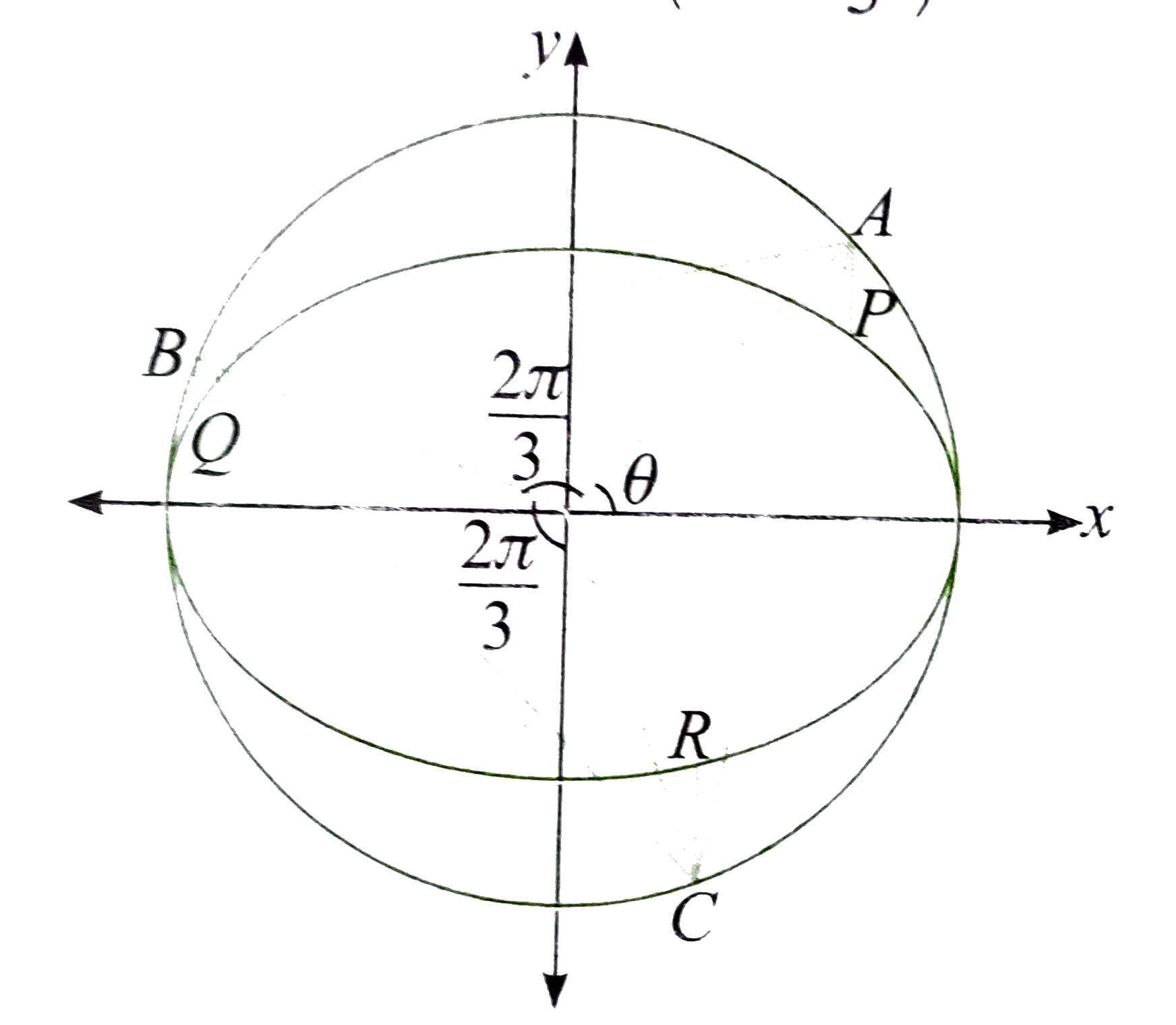
Let A , B and C, be the points on the cicle whose cooridnates are
`A(a cos theta, a sin theta)`
`B(a cos (theta+(2pi)/(3)),asin(theta+(2pi)/(3)))`
`C(a cos (theta+(4pi)/(3)),asin(theta+(4pi)/(3)))`
Hence, `P-=(a cos theta, b sin theta)`
`Q-=(a cos (theta+(2pi)/(3)),asin(theta+(2pi)/(3)))`
`R-=(a cos (theta+(4pi)/(3)),asin(theta+(4pi)/(3)))`
It is given that P,Q and R are on the same side of the x-axis as A,B, and C.
So, the required nomrmals ot the ellipse at P,Q and R are
`ax sec theta-"by cosec" theta=a^(2)-b^(2)" "(1)`
`ax sec(theta+(2pi)/(3)-"by cosec"(theta+(2pi)/(3))=a^(2)-n^(2)" "(2)`
`ax sec(theta+(4pi)/(3)-"by cosec"(theta+(4pi)/(3))=a^(2)-n^(2)" "(3)`

Now, `Delta`= `|{:(sec theta,"cosec"theta,1),(sec (theta+(2pi)/(3)),"cosec"(theta+(2pi)/(3)),1),(sec (theta+(2pi)/(3)),"cosec"(theta+(2pi)/(3)),1):}|`
Multiplying `R_(1),R_(2) and R_(3)`, by `sin theta cos, theta, sin (theta+(2pi)/(3))co (theta+(2pi)/(3))and sin (theta+(4pi)/(3))` respectively, we get
`Delta=(1)/(k)|{:(sin theta,cos theta,sin2theta),(sin (theta+(2pi)/(3)),cos(theta+(2pi)/(3)),sin (2 theta+(4pi)/(3))),(sin (theta-(2pi)/(3)),cos(theta-(2pi)/(3)),sin (2 theta-(4pi)/(3))):}|`
Where
`k=2sin theta cos theta sin(theta+(2pi)/(3))cos(theta-(2pi)/(3))sin(theta+(4pi)/(3))cos (theta+(4pi)/(3))`
Operating `R_(2)toR_(2)+R_(3)`
`Delta=(1)/(k)|{:(sin theta,cos theta,sin2theta),(2sin theta*cos.(2pi)/(3),2cos theta*cos.(2pi)/(3),2sin theta*cos.(4pi)/(3)),(sin(theta-(2pi)/(3)),cos(theta-(2pi)/(3)),sin (2theta-(4pi)/(3))):}|`
`=(1)/(k)|{:(sin theta,cos theta,sin2theta),(-sin theta ,-cos theta,-sin theta),(sin(theta-(2pi)/(3)),cos(theta-(2pi)/(3)),sin(2theta-(4pi)/(3))):}|`
Promotional Banner

Similar Questions

Explore conceptually related problems

If the tangent at any point on the ellipse (x^(2))/(a^(2)) + (y^(2))/(b^(2)) =1 intersects the coordinate axes at P and Q , then the minimum value of the area (in square unit ) of the triangle OPQ is (O being the origin )-

The p th ,q th and r th terms of an A.P are a,b,c respectively. Show that (p-r)a+(r-p)b+(p-q) c=0

Let p,q,r be the sides opposite to the angles P,Q,R respectively in a triangle PQR. Then 2prsin((P-Q+R)/2) equal

P is a variable on the ellipse (x^2)/(a^2)+(y^2)/(b^2)=1 with A A ' as the major axis. Find the maximum area of triangle A P A '

Let P be a point on the ellipse (x^(2))/(9)+(y^(2))/(4)=1 and the line through P parallel to the y-axis meets the circle x^(2)+y^(2)=9 at Q, where P,Q are on the same side of the x-axis. If R is a point on PQ such that (PR)/(RQ)=(1)/(2) , then the locus of R is

Let p,q,r be the sides opposite to the angles P,Q, R respectively in a triangle PQR if r^(2)sin P sin Q= pq , then the triangle is

The line x =2 y intersects the ellipse (x^(2))/(4) +y^(2) = 1 at the points P and Q . The equation of the circle with pq as diameter is _

Let p,q,r be the sides opposite to the angles P,Q, R respectively in a triangle PQR if 2prsin((P-Q+R)/(2)) equals

P is the point on the ellipse is x^2/16+y^2/9=1 and Q is the corresponding point on the auxiliary circle of the ellipse. If the line joining the center C to Q meets the normal at P with respect to the given ellipse at K, then find the value of CK.

The image of P(a,b) on the line y=-x is Q and the image of Q on the line y=x is R find the mid-point of P and R

