Home
Class 12
MATHS
If the ellipse (x^2)/(a^2)+(y^2)/(b^2)=1...

If the ellipse `(x^2)/(a^2)+(y^2)/(b^2)=1` is inscribed in a rectangle whose length to breadth ratio is `2:1` , then the area of the rectangle is `4.(a^2+b^2)/7` (b) `4.(a^2+b^2)/3` `12.(a^2+b^2)/5` (d) `8.(a^2+b^2)/5`

A

`4*(a^(2)+b^(2))/(7)`

B

`4*(a^(2)+b^(2))/(3)`

C

`12*(a^(2)+b^(2))/(5)`

D

`8*(a^(2)+b^(2))/(5)`

Text Solution

Verified by Experts

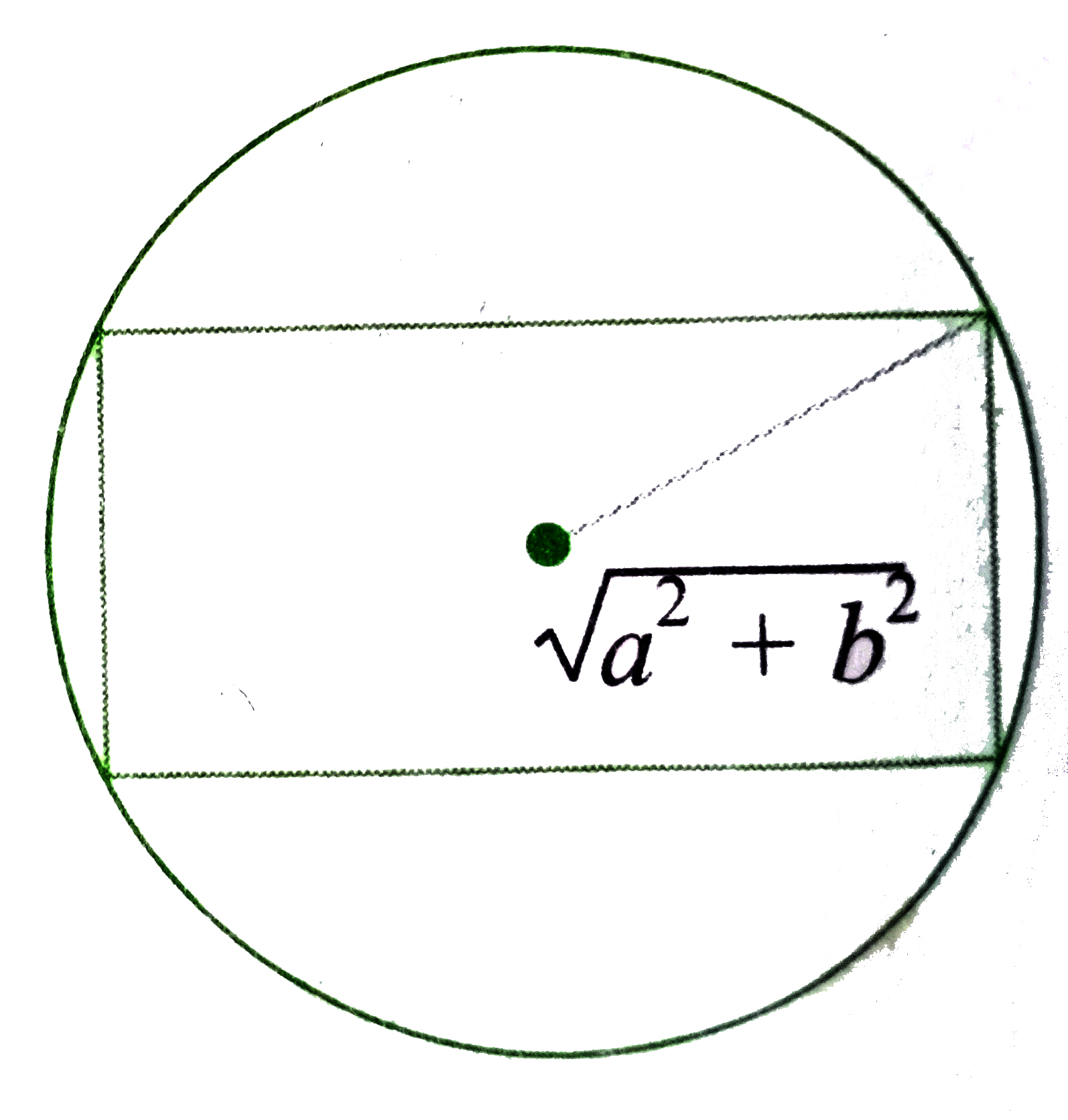
Since mutually perpendicualar tangents can be drawn from the vartices of the reactangle , all the vertices of the rectangle should lie on the director circle `x^(2)+y^(2)=a^(2)+b^(2)`

Let breadht =2l and length =4l . then,
`l^(2)+(2l)^(2)=a^(2)+b^(2)`
or `l^(2)=(a^(2)+b^(2))/(5)`
or Area of `4lxx2l=8((a^(2)+b^(2))/(5))`
Promotional Banner

Similar Questions

Explore conceptually related problems

If the area of the ellipse ((x^2)/(a^2))+((y^2)/(b^2))=1 is 4pi , then find the maximum area of rectangle inscribed in the ellipse.

A rectangle is inscribed in an equilateral triangle of side length 2a units. The maximum area of this rectangle can be (a) sqrt(3)a^2 (b) (sqrt(3)a^2)/4 a^2 (d) (sqrt(3)a^2)/2

Prove that area common to ellipse (x^2)/(a^2)+(y^2)/(b^2)=1 and its auxiliary circle x^2+y^2=a^2 is equal to the area of another ellipse of semi-axis a and a-b.

The maximum area of the rectangle whose sides pass through the vertices of a given rectangle of sides a and b is (a) 2(a b) (b) 1/2(a+b)^2 (c) 1/2(a^2+b^2) (d) non eoft h e s e

Give possible values for length and breadth of the rectangle whose area is 2x ^(2) + 9x -5.

The sum of the squares of the perpendiculars on any tangents to the ellipse (x^2)/(a^2)+(y^2)/(b^2)=1 from two points on the minor axis each at a distance a e from the center is (a) 2a^2 (b) 2b^2 (c) a^2+b^2 (d) a^2-b^2

Find the area of the greatest rectangle that can be inscribed in an ellipse (x^2)/(a^2)+(y^2)/(b^2)=1 .

A O B is the positive quadrant of the ellipse (x^2)/(a^2)+(y^2)/(b^2)=1 which has O A=a ,O B=b . Then find the area between the arc A B and the chord A B of the ellipse.

Pa n dQ are the foci of the ellipse (x^2)/(a^2)+(y^2)/(b^2)=1 and B is an end of the minor axis. If P B Q is an equilateral triangle, then the eccentricity of the ellipse is 1/(sqrt(2)) (b) 1/3 (d) 1/2 (d) (sqrt(3))/2

Let the eccentricity of the hyperbola (x^(2))/(a^(2))-(y^(2))/(b^(2))=1 be reciprocal to that of the ellipse x^(2)+9y^(2)=9 , then the ratio a^(2):b^(2) equals