Home
Class 12
MATHS
Two concentric ellipses are such that th...

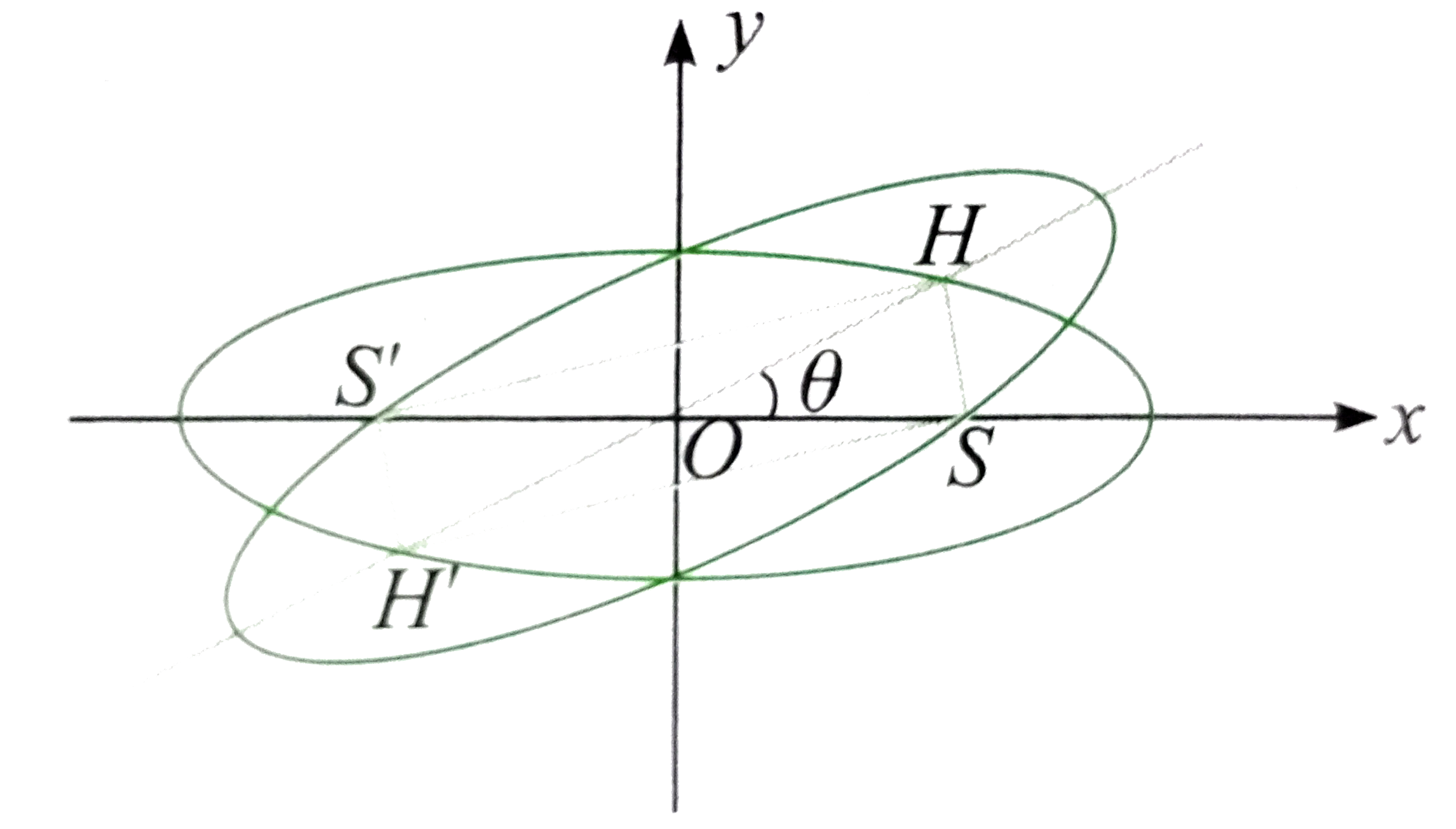
Two concentric ellipses are such that the foci of one are on the other and their major axes are equal. Let `ea n de '` be their eccentricities. Then. the quadrilateral formed by joining the foci of the two ellipses is a parallelogram the angle `theta` between their axes is given by `theta=cos^(-1)sqrt(1/(e^2)+1/(e^('2))=1/(e^2e^('2)))` If `e^2+e^('2)=1,` then the angle between the axes of the two ellipses is `90^0` none of these

A

the quadrilateral formed by joining the foci of the two ellipe is a parallelogram

B

the angle `theta` between their axes is give by `theta=cos^(-1)sqrt((1)/(e^(2))+(1)/(e'^(2))-(1)/(e^(2)e'^(2)))`

C

If `e^(2)+e'^(2)=1`, then the angle between th axes of the two ellipse is `90^(@)`

D

none of these

Text Solution

Verified by Experts

Celeary, O is the midpoint of SS' and HH'

Therfore, the disagonals of quadrilateral HSH'S'' bisect each other. So it is a parallelogram.
The point H lies on
`(x^(2))/(a^(2))+(y^(2))/(b^(2))` (Suppose)
`:. (r^(2) cos^(2)theta)/(a^(2))+(r^(2)sin^(2) theta)/(b^(2))=1`
`e'^(2) cos^(2) theta+(e^(2)sin^(2) theta)/(1-e^(2))=1 " " [ :. b^(2)=a^(2)(1-e^(2))]`
or `e'^(2) cos^(2) theta -(e'^(2) cos^(2) theta)/(1-e^(2))=1-(e'^(2))/(1-e^(2))`
or `cos^(2)theta(1)/(e^(2))+(1)/(e'^(2))=(1)/(e^(2)e'^(2))`
or `theta= cos^(-1)sqrt((1)/(e^(2))+(1)/(e'^(2))-(1)/(e^(2)e'^(2)))`
For `theta=90^(@)`,
` (e^(2)+e'^(2))/(e^(2)e'^(2))=(1)/(e^(2)e'^(2))`
` or e^(2)+e'^(2)=1`
Promotional Banner

Similar Questions

Explore conceptually related problems

Let y=e^(x^(2)) and y=e^(x^(2))sinx be two given curves. Then the angle between the tangents to the curves at any point of their intersection is

Find the coordinates of the foci, the vertices, the lengths of major and minor axes and the eccentricity of the ellipse 9x^(2)+4y^(2)=36

The foci of an ellipse are (-2,4) and (2,1). The point (1,(23)/(6)) is an extremity of the minor axis. What is the value of the eccentricity?

If e is the eccentricity of the hyperbola (x^(2))/(a^(2))-(y^(2))/(b^(2))=1 and theta is the angle between the asymptotes, then cos.(theta)/(2) is equal to

Let y=e^(x^(2))" and "y=e^(x^(2))sinx be two given curves. Then the angle between the tangents to the curves at any point of their intersection is-

An ellipse and a hyperbola are confocal (have the same focus) and the conjugate axis of the hyperbola is equal to the minor axis of the ellipse. If e_1a n de_2 are the eccentricities of the ellipse and the hyperbola, respectively, then prove that 1/(e_1^2)+1/(e_2^2)=2 .

If e_1 and e_2 be the eccentricities of a hyperbola and its conjugate, show that 1/(e_1^2)+1/(e_2^2)=1 .

Find the equation of an ellipse which passes through the point (-2, 2), (3,-1) and the major and minor axes as the axes of co¬ ordinate. Find its eccentricity.

Let the foci of the ellipse (x^(2))/(9) + y^(2) = 1 subtend a right angle at a point P . Then the locus of P is _

Let y=e^(x^2) and y=e^(x^2) sinx be two given curves. Then the angle between the tangents to the curves any point of their intersectons is