Home
Class 12
MATHS
A point moves so that the sum of the squ...

A point moves so that the sum of the squares of its distances from two intersecting straight lines is constant. Prove that its locus is an ellipse.

A

`(sqrt(cos 2 alpha))/(sin alpha)if alphalt(pi)/(4)`

B

`(sqrt(-cos 2 alpha))/(cos alpha)if alphalt(pi)/(4)`

C

`(sqrt(cos 2 alpha))/(cos alpha)if alphalt(pi)/(4)`

D

`(sqrt(-cos 2 alpha))/(sin alpha)if alphalt(pi)/(4)`

Text Solution

Verified by Experts

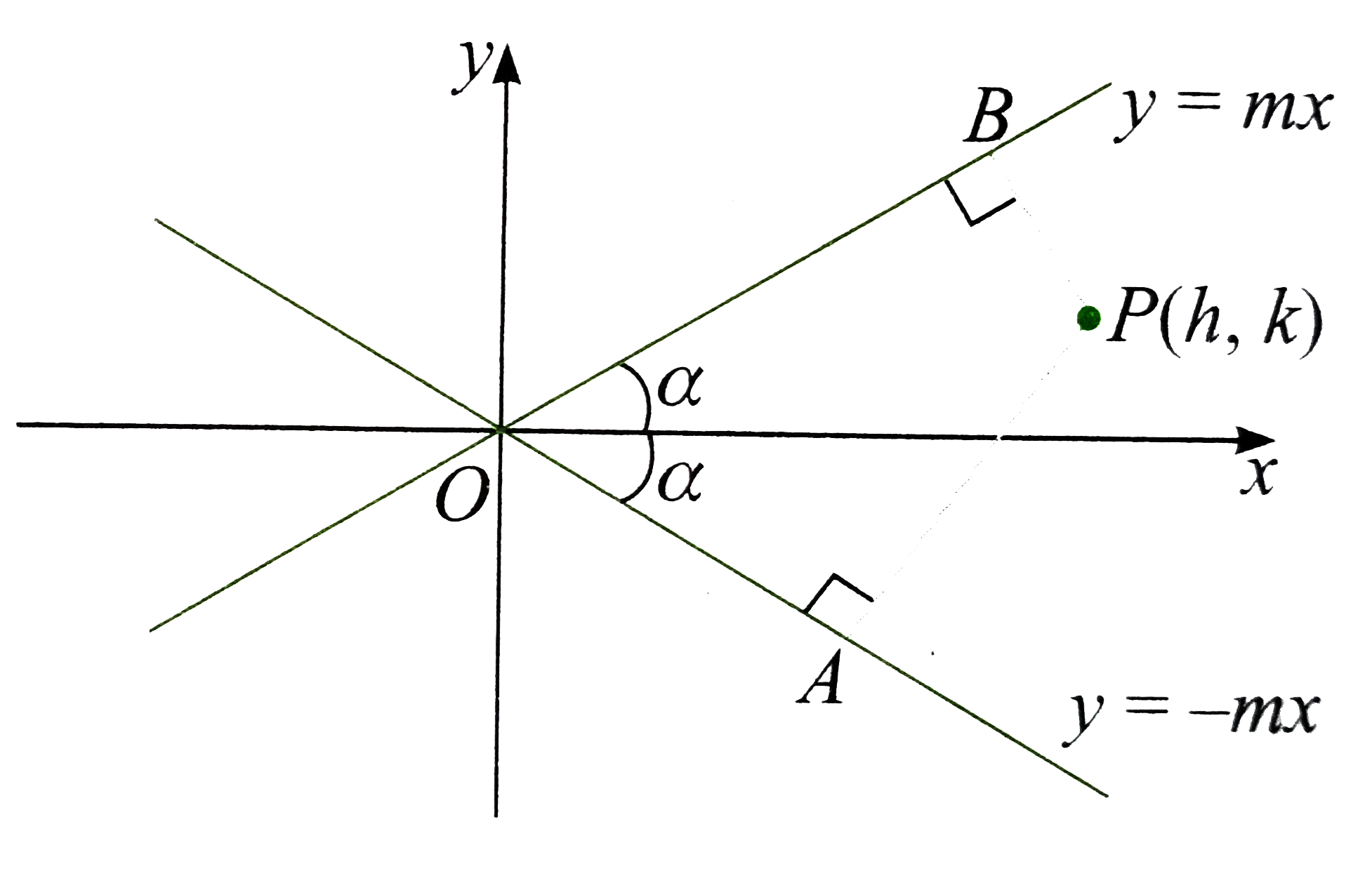
Let us chosse the point of intersection of the givne lines as the origin and their angular bisector as the x-axis. Thenequation of the two lines will bey mx and y=-mx , where = `tan alpha`,

Let P(h,k) be the point whose locus is to be foud.
Then accroding toe the given condition,
`PA^(2)+PB^(2)`= Constant
`rArr((k-mh)^(2))/(1+m^(2))+((k+mh)^(2))/(1+m^(2))" " ("c is constant")`
`rArr 2(k^(2)+m^(2)h^(2))=c(1+m^(2))`
Therfore, the locus of pointP is
`(x^(2))/(a^(2))+(y^(2))/(b^(2))=1`
where `a^(2)=(c(1+m^(2)))/(2m^(2)) and b^(2)=(c(1+m^(2)))/(2)` M
If `alpha lt pi //4`, then `m lt1, and a^(2)gtb^(2)`
`:.` Ecentricity `=sqrt(1-(b^(2))/(a^(2)))=sqrt(1-m^(2))=(sqrt(cos2alpha))/(cos alpha)`
If `alpha gt pi//4` then `mgt1 and a^(2)ltb^(2)`
`:.` Ecentricity `=sqrt(1-(b^(2))/(a^(2)))=sqrt(1-(1)/(m^(2)))=(sqrt(-cos 2 alpha))/(sin alpha)`
Promotional Banner

Similar Questions

Explore conceptually related problems

A point moves so that sum of the squares of its distances from the vertices of a triangle is always constant. Prove that the locus of the moving point is a circle whose centre is the centroid of the given triangle.

Prove that the locus of the point that moves such that the sum of the squares of its distances from the three vertices of a triangle is constant is a circle.

A point moves so that the sum of the squares of the perpendiculars let fall from it on the sides of an equilateral triangle is constant. Prove that its locus is a circle.

A point moves so that the sum of squares of its distances from the points (1, 2) and (-2,1) is always 6. Then its locus is

A point moves so that the sum of squares of its distances from the points (1,2) and (-2,1) is always 6 . Then its locus is _

A point moves so that the sum of squares of its distances from the points (1, 2) and (-2, 1) is always 6. Then its locus is

A point moves in such a manner that the sum of the squares of its distances from the origin and the point (2, -3) is always 19. Show that the locus of the moving point is a circle. Find the equation to the locus.

A variable plane moves in such a way that the sum of the reciprocals of its intercepts on the three coordinate axes is constant. Prove that the plane passes through a fixed point.

A straight line moves so that the product of the length of the perpendiculars on it from two fixed points is constant. Prove that the locus of the feet of the perpendiculars from each of these points upon the straight line is a unique circle.

A point movs in such a manner that the sum of the squares of its distances from the points (a,0) and (-a, 0) is 2b^(2). Then the locus of the moving point is-