Home
Class 12
MATHS
Consider an ellipse E: x^(2)/a^(2)+y^(2)...

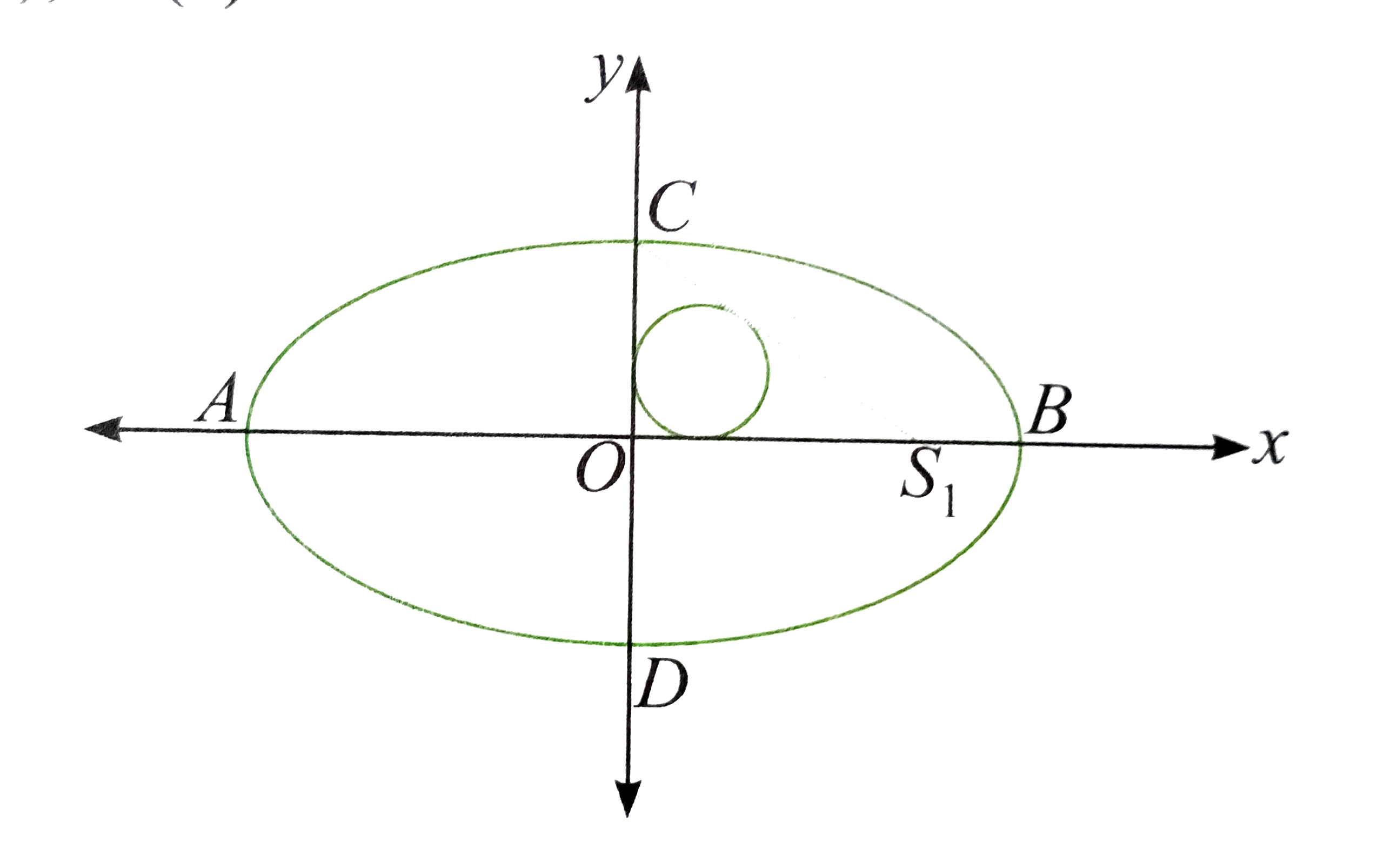
Consider an ellipse E: `x^(2)/a^(2)+y^(2)/b^(2)=1`, centered at point 'O' and having AB and CD as its major and minor axes respectively if `S_1`be one of the focus of the ellipse, radius of the incircle of ∆`OCS_1` be 1 unit and ` OS_1=6` units.
Q. If perimeter of `∆OCS_1` is p units, then the value of p is

A

`65pi//4`

B

`64pi//5`

C

`64pi`

D

`65pi`

Text Solution

Verified by Experts


`:.OS_(1)=ae=6,OC=b`
Also,` CS_(1)=a`
`:. "Area of " DeltaOCS_(1)=(1)/(2)=(OS_(1))xx(OC)=3b`
`:.` Semi-perimeter of `DeltaOCS_(1)=(1)/(2)=(OS_(1)+OC+CS_(1))`
`=(1)/(2)(6+a+b) " "(1)`
`:.` In radius of `DeltaOCS_(1) ", "( "Using" r=(Delta)/(S))`
=` (3b)/((1)/(2)(6+a+b))=1" "("Using"r=(Delta)/(S))`
`or 5b=6+a" "(2)`
Also, `b^(2)=a^(2)-a^(2)e^(2)=a^(2)-36" "(3)`
From (2), we get
`25(a^(2)-36)=36+a^(2)+12a`
`or 2a^(2)-a-78=0`
`a=(13)/(2),-6`
`:. a=(13)/(2) and b=(5)/(2)`
Area or ellipse `=piab=(65pi)/(4)` sq. unit
Perimeter of `DeltaOCS_(1)=6+a+b=6+(13)/(2)+(5)/(2)=15` units
The equation of director circle is
`x^(2)+y^(2)=a^(2)+b^(2)`
or `x^(2)+y^(2)=(97)/(2)`
Promotional Banner

Similar Questions

Explore conceptually related problems

Taking major and minor axes as x and y - axes respectively , find the equation of the ellipse which passes through the point (1,3) and (2,1) .

A tangent having slope of -4/3 to the ellipse (x^2)/(18)+(y^2)/(32)=1 intersects the major and minor axes at points A and B , respectively. If C is the center of the ellipse, then find area of triangle A B Cdot

Normal to the ellipse (x^2)/(64)+(y^2)/(49)=1 intersects the major and minor axes at Pa n dQ , respectively. Find the locus of the point dividing segment P Q in the ratio 2:1.

Taking major and minor axes as x and y - axes respectively , find the equation of the ellipse whose length of latus rectum is (18)/(5) unit and the coordinates of one focus are (4,0)

Taking the major and minor axes as the axes of coordinates, find the equation of the ellipse Which passes through the point (2,2) and (3,1)

Taking major and minor axes as x and y - axes respectively , find the equation of the ellipse whose eccentricity is (1)/(sqrt(2)) and length of latus rectum 3 .

P is a variable on the ellipse (x^2)/(a^2)+(y^2)/(b^2)=1 with A A ' as the major axis. Find the maximum area of triangle A P A '

Let p,q,r be the altitudes of a triangle with area s and perimeter 2t. Then the value of 1/p+1/q+1/r is

Consider an ellipse (x^(2))/(a^(2))+(y^(2))/(b^(2))=1(a gt b) . A hyperbola has its vertices at the extremities of minor axis of the ellipse and the length of major axis of the ellipse is equal to the distance between the foci of hyperbola. Let e_(1) and e_(2) be the eccentricities of ellipse and hyperbola, respectively. Also, let A_(1) be the area of the quadrilateral fored by joining all the foci and A_(2) be the area of the quadrilateral formed by all the directries. The relation between e_(1) and e_(2) is given by

Taking major and minor axes as x and y - axes respectively , find the equation of the ellipse whose eccentricity is (1)/(sqrt(2)) and the sum of the squares of major and minor axes is 24 .