Home
Class 12
MATHS
Curves C1:x^(2)+y^(2)=r^(2) and C2:x^(2)...

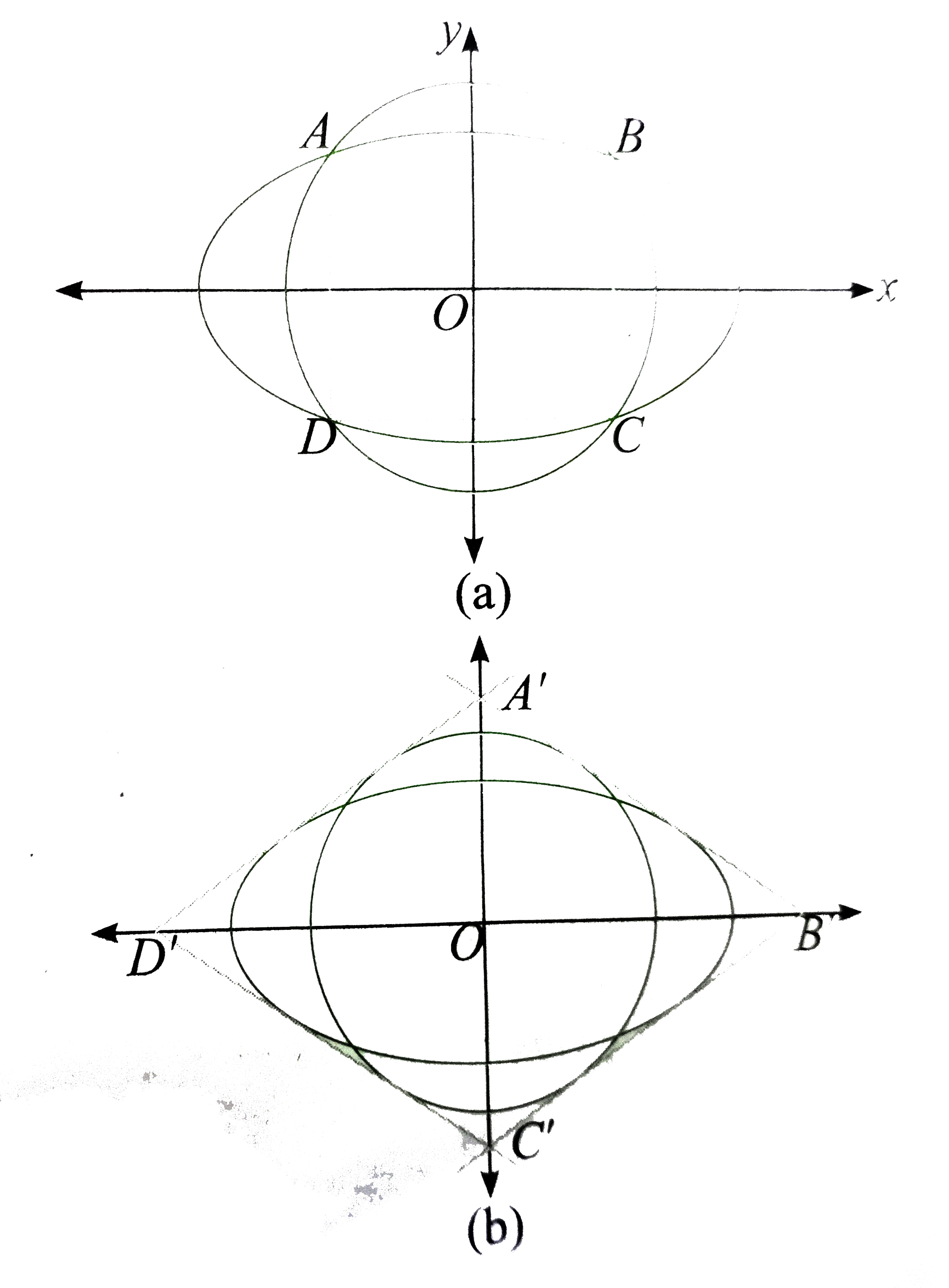
Curves `C_1:x^(2)+y^(2)=r^(2) and C_2:x^(2)/16+y^(2)/9=1` intersect at four distinct points A,B,C and D. Their common tangents from a parallelogram PQRS. Q. If ABCD is sqyare, then the value of `25r^(2)` is

A

`(12)/(5)sqrt(2)`

B

`(12)/(5)`

C

`(12)/(5sqrt(5))`

D

none of these

Text Solution

Verified by Experts


Solving the cruves given (eliminating `x^(2)`) , we have
`(r^(2)-y^(2))/(16)+(y^(2))/(8)=1`
or `y^(2)=(16r^(2)-144)/(7)`
If ABCD is a square, then
`x^(2)=y^(2)`
`or (144-9r^(2))/(7)=(16r^(r)-144)/(7)`
or `25r^(2)=288`
or `r=(12)/(5)sqrt(2)`
Promotional Banner

Similar Questions

Explore conceptually related problems

The circles x^(2)+y^(2)-10x+16=0 and x^(2)+y^(2)=a^(2) intersect at two distinct points if

If two circles (x-1) ^(2) + (y-3) ^(2) =r^(2)and x ^(2) +y^(2) -8x +2y + 8=0 intersect in two distinct points, then-

If two circles (x-1)^2+(y-3)^2=r^2 and x^2+y^2-8x+2y+8=0 intersect in two distinct points then

If the curves (x^(2))/(a)+(y^(2))/(b)=1 and (x^(2))/(c )+(y^(2))/(d)=1 intersect at right angles then prove that a-b=c-d

(x-1)(y-2)=5 and (x-1)^2+(y+2)^2=r^2 intersect at four points A, B, C, D and if centroid of triangle ABC lies on line y = 3x-4 , then locus of D is

If 16C_r=^16C_(2r+1) then the value of r will be

The curves x^(2) +y^(2) +6x - 24y +72 = 0 and x^(2) - y^(2) +6x +16y - 46 = 0 intersect in four points P,Q,R and S lying on a parabola. Let A be the focus of the parabola, then

Let C_(1) and C_(2) denote the centres of the circles x^(2) +y^(2) = 4 and (x -2)^(2) + y^(2) = 1 respectively and let P and Q be their points of intersection. Then the areas of triangles C_(1) PQ and C_(2) PQ are in the ratio _

A tangent is drawn to the ellipse to cut the ellipse x^2/a^2+y^2/b^2=1 and to cut the ellipse x^2/c^2+y^2/d^2=1 at the points P and Q. If the tangents are at right angles, then the value of (a^2/c^2)+(b^2/d^2) is

The circle with equation x^2 +y^2 = 1 intersects the line y= 7x+5 at two distinct points A and B. Let C be the point at which the positive x-axis intersects the circle. The angle ACB is