Home
Class 12
MATHS
The ellipse (x^(2))/(a^(2))+(y^(2))/(b^(...

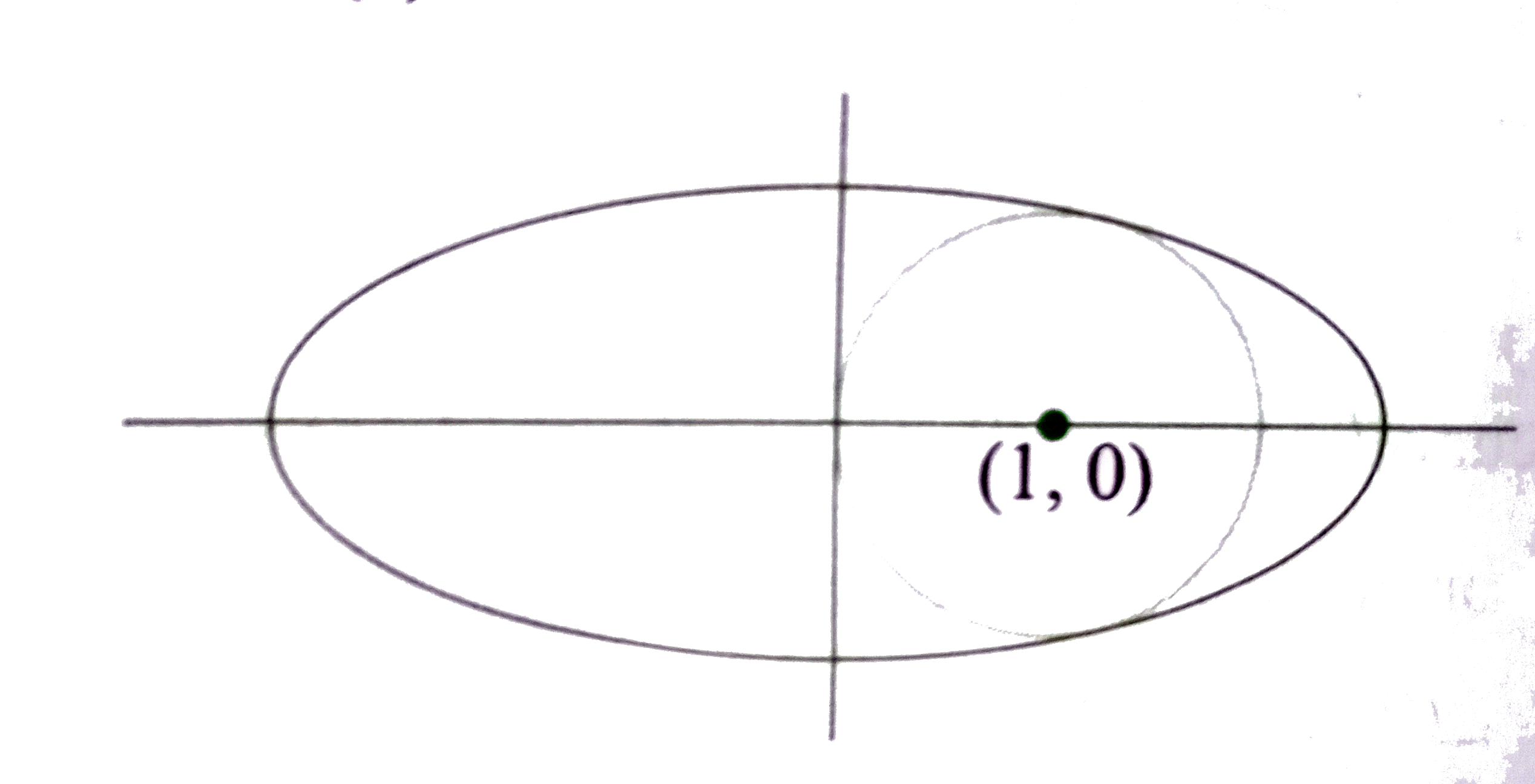
The ellipse `(x^(2))/(a^(2))+(y^(2))/(b^(2))=1` is such that its has the least area but contains the circel `(x-1)^(2)+y^(2)=1`
The length of latus of ellipse is

A

2 units

B

`sqrt(2)`units

C

3 units

D

`2.5` units

Text Solution

Verified by Experts


Solving both equations we have
`(x^(2))/(a^(2))+(1-(x-1)^(2))/(b^(2))=1`
or `b^(2)x^(2)+a^(2)[1-(x-1)^(2)]=a^(2)b^(2)`
or `(b^(2)-a^(2))x^(2)+2a^(2)x-a^(2)b^(2)=0" "(1)`
For leat area, the circle.
Therefore, the discriminant of (1) is zero. Thus,
`4a^(2)+4a^(2)b^(2)(b^(2)-a^(2))=0`
or `a^(2)+b^(2)(b^(2)-a^(2))=0`
or `a^(2)+b^(2)(-a^(2)e^(2))=0`
or `1-be^(2)e^(2)=0`
`or b=(1)/(e)`
Also, `a^(2)=(b^(2))/(1-e^(2))=(1)/(e^(2)(1-e^(2)))`
`or a=(1)/(esqrt(1-e^(2)))`
Let S be the area of the ellipse. Then,
`S=piab=(pi)/(e^(2)sqrt(1-e^(2)))=(pi)/(sqrt(e^(4)-e^(6)))`
The area is minimum if `(f)(e)=e^(2)-e^(6)` is maximum, i.e., when `f'(e)=4e^(3)-6e^(5)=0`
or `sqrt((2)/(3))` [ which is the point of maxima for f(e)]
So,S is the least when `e=sqrt(2//3)`
Therfore, the ellipse is `x^(2)+y^(2)=4.5`
Length of loatus rectum of ellipe `=(2b^(2))/(a)=(2xx(9)/(6))/((3)/(sqrt(2)))=sqrt(2)`
Promotional Banner

Similar Questions

Explore conceptually related problems

The ellipse (x^(2))/(a^(2))+(y^(2))/(b^(2))=1 passes through (-3 , 2) and its eccentricity is sqrt((3)/(5)) , find the length of its latus rectum.

The ellipse (x^(2))/(a^(2))+(y^(2))/(b^(2))=1 passes through the point of intersection of the lines 7x + 13 y - 87 = 0 and 5x - 8y + 7 = 0 and its length of latus rectum is (32sqrt(2))/(5) , find a and b .

Consider an ellipse (x^(2))/(a^(2))+(y^(2))/(b^(2))=1(a gt b) . A hyperbola has its vertices at the extremities of minor axis of the ellipse and the length of major axis of the ellipse is equal to the distance between the foci of hyperbola. Let e_(1) and e_(2) be the eccentricities of ellipse and hyperbola, respectively. Also, let A_(1) be the area of the quadrilateral fored by joining all the foci and A_(2) be the area of the quadrilateral formed by all the directries. The relation between e_(1) and e_(2) is given by

Let the eccentricity of the hyperbola (x^(2))/(a^(2))-(y^(2))/(b^(2))=1 be reciprocal to that of the ellipse x^(2)+4y^(2)=4 . If the hyperbola passes through a focus of the ellipse, then

If e be the eccentricity of the ellipse (x^(2))/(a^(2))+(y^(2))/(b^(2)) = 1 , then e =

The parametric equations of the ellipse (x^(2))/(a^(2))+(y^(2))/(b^(2)) = 1 are _

The ellipse (x^(2))/(169) + (y^(2))/(25) = 1 has the same eccentricity as the ellipse (x^(2))/(a^(2)) + (y^(2))/(b^(2)) = 1 . Find the ratio (a)/(b) .

A O B is the positive quadrant of the ellipse (x^2)/(a^2)+(y^2)/(b^2)=1 which has O A=a ,O B=b . Then find the area between the arc A B and the chord A B of the ellipse.

If foci of the ellipse (x^(2))/(16) + (y^(2))/(b^(2)) = 1 coincide with the foci of the hyperbola (x^(2)/(144) - (y^(2))/(81)) = (1)/(25) , then the value of b^(2) is -

Find the eccentricity of an ellipse (x^(2))/(a^(2))+(y^(2))/(b^(2))=1 whose latus reactum is half of its major axis.