Home
Class 12
MATHS
If ax^(2)+bx+c=0 have two distinct roots...

If `ax^(2)+bx+c=0` have two distinct roots lying int eh interval `(0,1),a,b,c epislonN`
The least value of `a` is

A

4

B

6

C

7

D

5

Text Solution

Verified by Experts

The correct Answer is:
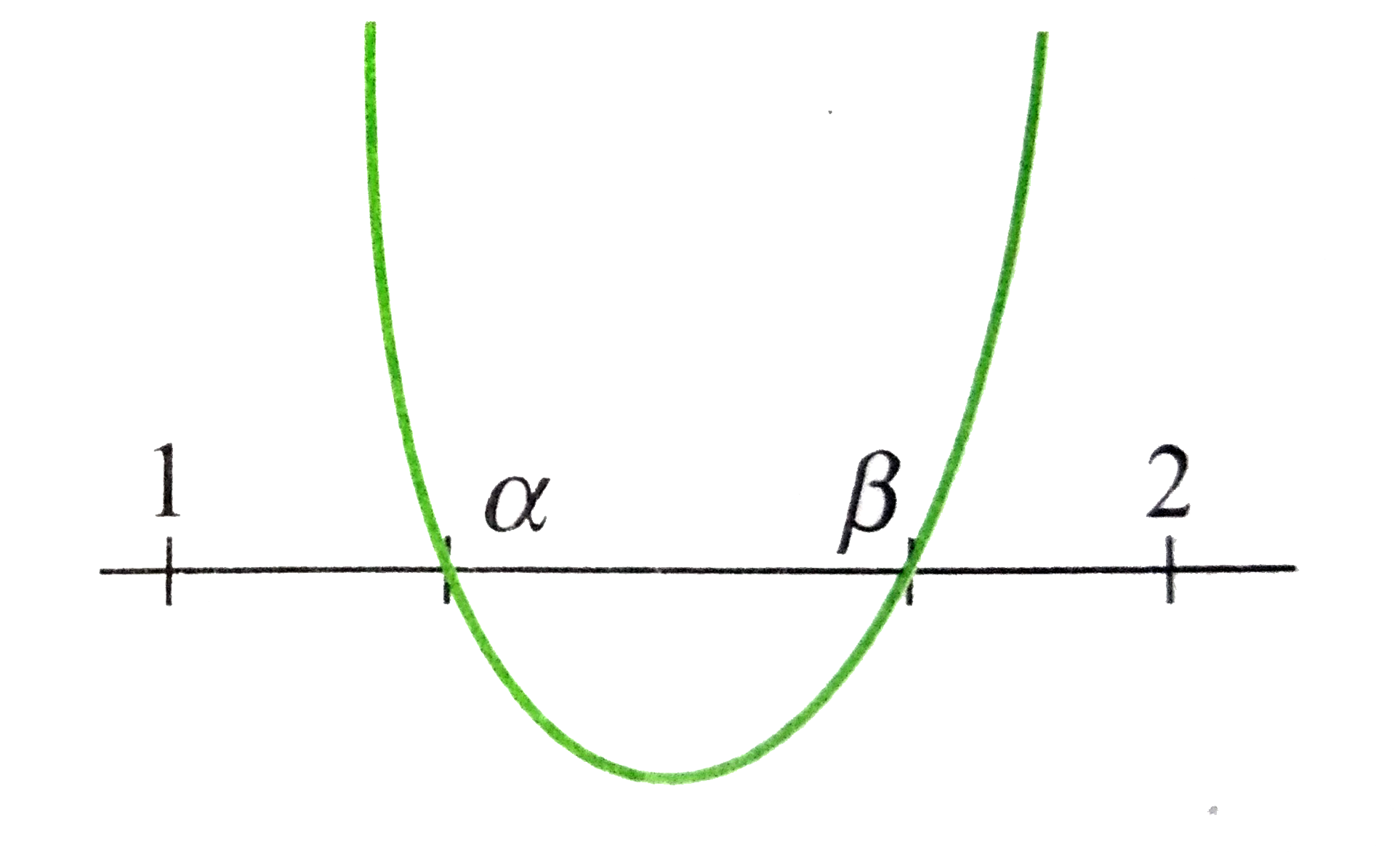
4

`az^(2) - bx + c =0`
Let `f(x) = ax^(2) - bx + c `be
the correspoding quadratic expression and `alpha,beta` be the roots of `f(x) = 0`.

Then, `f(x) = a(x-alpha) (x -beta)`
Now, `af(1) gt 0, af(2) gt 0,1lt(b)/(2a) lt2,b^(2) - 4ac gt 0`
`rArr a(1-alpha) (1-beta) gt 0, a(2-alpha)(2-beta) gt 0, 2a lt b lt 4a, b^(2) - 4ax gt 0`
`rArr a^(2) (1-alpha)(1-beta)(2-alpha) (2-beta) gt 0`
`rArr a^(2) (1-alpha)(1-beta)(2-alpha)(2-beta) gt 0`
As `f(x)` and `f(2)` both are integers and `f(1) gt 0`, and `f(2) gt 0`, so
`f(1)f(2) gt 0`
`rArr f(1) f(2) gt 1`
`rArr 1ge a^(2)(alpha -1)(2-alpha)(beta-1)(2-beta)" "(1)`
Now, `((alpha-1)+(2-alpha))/(2)gt ((alpha -1)(2-alpha))^(1//2)`
`rArr (alpha -1)(2-alpha) le (1)/(4)`
Similarly,
`(beta -1)(2-beta) le (1)/(4)`
`rArr (alpha -1)(2-alpha) (beta- 1)(2-beta)lt (1)/(16)`
As ` alpha ne beta`, so `alpha^(2) gt 1" "("Using (1)")`
`rArr a gt 5`
`rArr b^(2) gt 20c and b gt 10 rArr b ge 11`
Also, `b^(2) gt 100 rArr c gt 5 rArr c ge 6`
Promotional Banner

Topper's Solved these Questions

  • THEORY OF EQUATIONS

    CENGAGE PUBLICATION|Exercise MATRIX MATCH TYPE|6 Videos
  • THEORY OF EQUATIONS

    CENGAGE PUBLICATION|Exercise NUMERICAL VALUE TYPE|43 Videos
  • THEORY OF EQUATIONS

    CENGAGE PUBLICATION|Exercise Multiple Correct Answer Type|38 Videos
  • STRAIGHT LINES

    CENGAGE PUBLICATION|Exercise ARCHIVES (NUMERICAL VALUE TYPE)|1 Videos
  • THREE DIMENSIONAL GEOMETRY

    CENGAGE PUBLICATION|Exercise All Questions|291 Videos

Similar Questions

Explore conceptually related problems

If ax^2-bx+c =0 has two distinct roots lying in the interval (0,1),a,b,c in N. Then

The number of values of k for which the equation x^3-3x+k=0 has two distinct roots lying in the interval (0,1) is (a) three (b) two (c) infinitely many (d) zero

If 2a+3b+6c=0 then the equation ax^2+bx+c=0 has in the interval (0,1)

The number of values of k for which the equation x^(2)-3x+k=0 has two distinct roots lying in the interval ( 0 , 1 ) are

If a x^2+b x+6=0 does not have distinct real roots, then find the least value of 3a+bdot

if ax^2+bx+c = 0 has imaginary roots and a+c lt b then prove that 4a+c lt 2b

If ax^(2)+bx+c=0 , a ne 0 , a , b , c in R has distinct real roots in (1,2) , then a and 5a+2b+c have (a) same sign (b) opposite sign (c) not determined (d) none of these

If a,b,c in R and a+b+c=0, then the quadratic equation 3ax^2+2bx+c=0 has (a) at least one root in [0, 1] (b) at least one root in [1,2] (c) at least one root in [3/2, 2] (d) none of these

IF b=c=0 then both roots of the equation ax^2+bx+c=0(ane0) are-

Let a,b,c be real. If ax^2+bx+c=0 has two real roots alpha,beta where alphalt-1 and betagt 1 ,then show that 1+c/a+abs(b/a)lt0 .

CENGAGE PUBLICATION-THEORY OF EQUATIONS-Linked Comprechension Type
  1. Consdier the equaiton 2 + |x^(2) + 4x + 3| = m , m in R Set of all...

    Text Solution

    |

  2. Consdier the equaiton 2 + |x^(2) + 4x + 3|= m , m in R Set of all v...

    Text Solution

    |

  3. If ax^(2)+bx+c=0 have two distinct roots lying int eh interval (0,1),a...

    Text Solution

    |

  4. Consider the quadrationax^(2) - bx + c =0,a,b,c in N which has two di...

    Text Solution

    |

  5. Consider the quadrationax^(2) - bx + c =0,a,b,c in N which has two di...

    Text Solution

    |

  6. Consider the inequation x^(2) + x + a - 9 < 0 The values of the re...

    Text Solution

    |

  7. Consider the inequation x^(2) + x + a - 9 lt 0 The values of the re...

    Text Solution

    |

  8. Consider the inequation x^(2) + x + a - 9 lt 0 The value of the pa...

    Text Solution

    |

  9. Consider the inequation 9^(x) -a3^(x) - a+ 3 le 0, where a is real p...

    Text Solution

    |

  10. Consider the inequality 9^(x)-a*3^(x)-a+3le0, where a is a real parame...

    Text Solution

    |

  11. Consider the inequality 9^(x)-a*3^(x)-a+3le0, where a is a real parame...

    Text Solution

    |

  12. (af(mu) lt 0) is the necessary and sufficient condition for a particu...

    Text Solution

    |

  13. (af(mu) lt 0) is the necessary and sufficient condition for a particu...

    Text Solution

    |

  14. (af(mu) lt 0) is the necessary and sufficient condition for a particu...

    Text Solution

    |

  15. If the roots of the equation ax^2+bx+c=0(a!=0) be equal then

    Text Solution

    |

  16. If (x+2) is a common factor of (px^2+qx+r) and (qx^2+px+r) then (a) ...

    Text Solution

    |

  17. Consider the equation x^(4) + 2ax^(3) + x^(2)+2ax + 1 =0, where a in R...

    Text Solution

    |

  18. Consider the equation x^(4) + 2ax^(3) + x^(2)+2ax + 1 =0, where a in R...

    Text Solution

    |

  19. Consider the equation x^4 + 2ax^3 + x^2 + 2ax + 1 = 0 where a in R. Al...

    Text Solution

    |

  20. The real numbers x1, x2, x3 satisfying the equation x^3-x^2+b x+gamma=...

    Text Solution

    |

