Home
Class 12
MATHS
If ax^(2)+bx+c =0 where ane0 is satisfie...

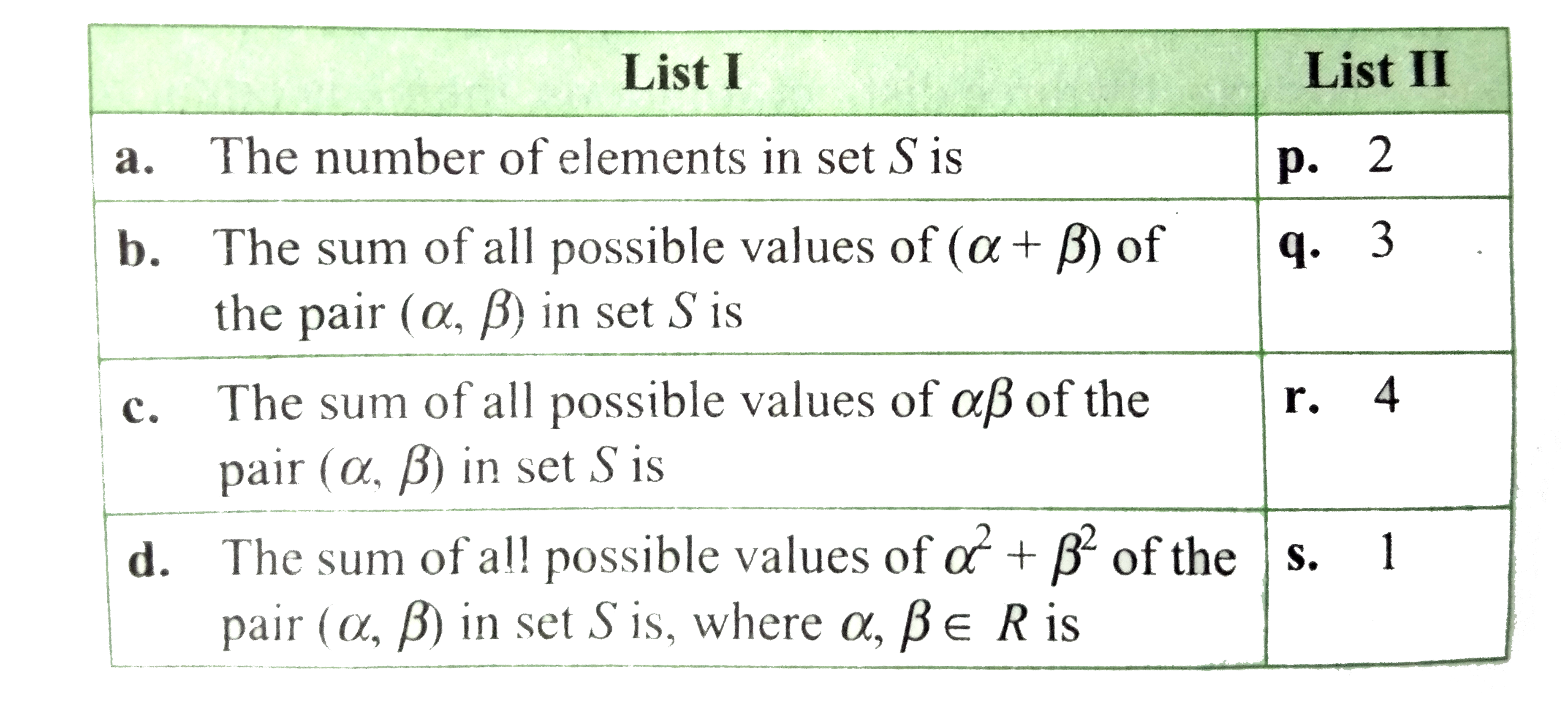
If `ax^(2)+bx+c =0` where `ane0` is satisfied by `alpha,beta,alpha^(2)andbeta^(2)` where `alphabetane0`. Let set S be the set of all possible unordered pairs `(alpha,beta)`.
Then match the following lists:

A

`{:(,a,b,c,d),((1),q,s,s,r):}`

B

`{:(,a,b,c,d),((2),r,s,q,p):}`

C

`{:(,a,b,c,d),((3),q,s,r,p):}`

D

`{:(,a,b,c,d),((4),r,s,p,q):}`

Text Solution

Verified by Experts

The correct Answer is:

1

Equation is satisfied by `alpha,beta,alpha^(2)andbeta^(2)`. So, we have following possibilities:
(1) Let `alpha^(2)=alphaandbeta^(2)=beta`.
`implies(alpha,beta)-=(1,1)`
(ii) `alpha^(2)=betaandbeta^(2)=alpha`
`impliesalpha^(4)=alpha`
`impliesalpha(alpha^(3)-1)=0`
`impliesalpha=0,1,(-1pmsqrt3i)/(2)`
`implies(alpha,beta)-=((-1-sqrt3i)/(2),(-1+sqrt3i)/(2))`
(iii) `alpha^(2)betaandbeta^(2)=beta(oralpha^(2)=alphaandbeta^(2)=alpha)`
`impliesalpha^(2)=beta^(2)impliesalpha=pmbeta`
`implies(alpha,beta)=(-1,1),(1,1)` Thus, possible unordered pairs `(alpha,beta)` such that that `alphabetane0` is
`(1,1),(-1,1)or((-1-sqrt3i)/(2),(-1+sqrt3i)/(2))`.
Promotional Banner

Topper's Solved these Questions

  • THEORY OF EQUATIONS

    CENGAGE PUBLICATION|Exercise NUMERICAL VALUE TYPE|43 Videos
  • THEORY OF EQUATIONS

    CENGAGE PUBLICATION|Exercise Archives JEE MAIN (single correct Answer Type )|7 Videos
  • THEORY OF EQUATIONS

    CENGAGE PUBLICATION|Exercise Linked Comprechension Type|37 Videos
  • STRAIGHT LINES

    CENGAGE PUBLICATION|Exercise ARCHIVES (NUMERICAL VALUE TYPE)|1 Videos
  • THREE DIMENSIONAL GEOMETRY

    CENGAGE PUBLICATION|Exercise All Questions|291 Videos

Similar Questions

Explore conceptually related problems

If alpha and beta are roots of ax^(2)+bx+c=0 then the equationnwhose roots are alpha^(2)andbeta^(2) is

Find the values of alpha and beta[ 0 lt alpha, beta lt (pi)/(2)] satisfying the equation cos alpha cos beta cos (alpha+ beta)=-(1)/(8)

If 0 lt alpha lt beta lt (pi)/(2) , prove that, tan alpha-tan beta lt alpha-beta .

If the roots of the equation ax^(2)+bx+c=0 be alphaandbeta , then find (alpha^(2))/(beta)+(beta^(2))/(alpha)

Let a,b,c be real. If ax^2+bx+c=0 has two real roots alpha,beta where alphalt-1 and betagt 1 ,then show that 1+c/a+abs(b/a)lt0 .

If "cot"(alpha+beta)=0, then "sin"(alpha+2beta) can be

-alpha^2/beta and -beta^2/alpha are the roots of the equation 3x^2-18x+2=0 . Find the equation whose roots are alpha and beta ( alpha,beta real).

IF alpha and beta be the roots of the equation ax^2+bx+c=0 , find the values of alpha^2+beta^2

IF alpha and beta be the roots of the equation x^2+3x+4=0 , find the equation whose roots are (alpha+beta)^2 and (alpha+beta)^2

If alpha and beta be the roots of the equation x^2+3x+4=0 find the equation whose roots are (alpha+beta)^2 and (alpha-beta)^2 .
