Home
Class 8
PHYSICS
The figure shows a human foot. Mark the ...

The figure shows a human foot. Mark the positions of load, effort and fulcrum in the foot. Name the type of lever foot.

Text Solution

Verified by Experts
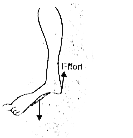
The weight of the body is raised on the toes. The fulcrum is at toes at one end. The load is, (i.e., the weight of the body) is in the middle and effort by muscles at other end. This is thus an example of class II lever.
Promotional Banner

Similar Questions

Explore conceptually related problems

Copy the diagram of the forearm given in figure, indicate the positions of Load, Effort and Fulcrum.

Define fulcrum, load arm and effort arm of a lever.

Name the symptoms of the foot and mouth disease of cattle.

A potted plant is kept horizontally for a considerable time. The three positions of the parts A and B of the potted plant are shown in the following figures: (a) Which figure shows the correct position taken by the parts A and B of the plant? (b) What type of phenomenon is exhibited by the figure chosen in (a) above?

The load arm and effort arm of a lever are 10 cm and 50 cm, respetively. The load and effort are applied on the opposite sides of the fulcrum. Identify the class of the lever. Find its mechanical advantage. If the effort applied is 10 N, how much load can be raised by it?

In the figure, D E and F are midpoints of sedes AB,BC and AC respectively. P is the foot of the perpendicular from A to side BC. Show that points D, E,F and P are concyclic.

From a window (h metres high above the ground) of a house in a street, the angle of elevation and depression of the top and the foot of another house on the opposite side of the street are theta and phi respectively. Show that the height of the opposite house is h(1+tan theta cot phi) metres.

In figure, the angle of elevation of the top of a tower AC from a point B on the ground is 60^@ . If the height of the tower is 20m , find the distance of the point from the foot of the tower.

Given below is a diagram showing defect of human eye . Name the type of lens used to correct the eye defect.

