Home
Class 8
PHYSICS
A ray of light passes through a right an...

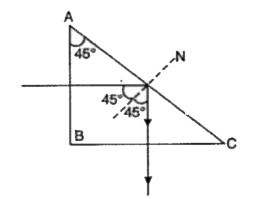
A ray of light passes through a right angled prism as shown in the figure. State the angle of incidence at the faces AC and BC.

Text Solution

Verified by Experts

Since light ray enters normally to the face AB and also emerges normally to face BC, angle of incidence at both faces is zero.
Promotional Banner

Similar Questions

Explore conceptually related problems

A ray of light passes through an equilateral glass prism in such a manner that the angle of incidence is equal to the angle of emergence and each of these angles is equal to 3//4 of the angle of the prism. The angle of deviation is

A ray of light passes through an equilateral glass prism in such a manner that the angle of incidence is equal to the angle of emergence and each of these angles is equal to 3/4 of the angle of the prism. The angle of deviation is

A ray of light passes through an equilateral glass prism in such a manner that the angle of incidence is equal to the angle of emergence and each of these angles is equal to 3/4 of the angle of the prism. The angle of deviation is

A ray of light passes through an equilateral prism such that the angle of incidence is equal to the angle of emergence and latter is equal to (3//4)^(th) the angle of prism. The angle of deviation is

A ray of light passes through an equilateral prism in such a way that the angle of incidence is equal to the angle of emergence and each of these angles is 3//4 th the angle of the prism. Determine the (i) angle of deviation and (ii) the refractive index of the prism.

The path of a ray of light passing through an equilateral glass prism ABC is shown in figure. The ray of light is incident on face BC at the critical angle for just total internal reflection. The total internal reflection. The total angle of deviation after the refraction at face AC is 108^@ . Calculate the refractive index of the glass.

A ray of light passes through an equilateral prism such that the angle of incidence is equal of emergence and later is equal to 3/4th the angle of prism. The angle of deviation is
