Home
Class 8
MATHS
An ant is moving around a few food piece...

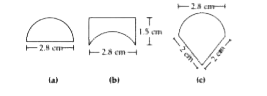
An ant is moving around a few food pieces of different shapes scattered on the floor. For which food-piece would the ant have to take a longer round ? Remember, circumference of a circle can be obtained by using the expression `c = 2pi r`, where `r` is the radius of the circle.

Text Solution

Verified by Experts

The correct Answer is:

figure (b)
Promotional Banner

Topper's Solved these Questions

  • MENSURATION

    MTG IIT JEE FOUNDATION|Exercise NCERT Section (Exercise 11.2)|11 Videos
  • MENSURATION

    MTG IIT JEE FOUNDATION|Exercise NCERT Section (Exercise 11.3)|10 Videos
  • MENSURATION

    MTG IIT JEE FOUNDATION|Exercise Solved Examples|21 Videos
  • LINEAR EQUATIONS IN ONE VARIABLE

    MTG IIT JEE FOUNDATION|Exercise Olympiad/HOTS Corner |15 Videos
  • PLAYING WITH NUMBERS

    MTG IIT JEE FOUNDATION|Exercise Olympiad/HOTS Corner|6 Videos

Similar Questions

Explore conceptually related problems

If the radius ( r ) of a circle is increased by 'x' units , what is the number of units by which the circumference of the circle is increased? A. pi B. 2pi C. 2pi r D. 2pi x

The fact tht a changing magnetic flux produces an electric field is basic to the operation of many high energy particle accelerators. Since the principle was first successfully applied to the acceleration of electrons (or beta particles) in a device called the betatron, this method of acceleration is often given that name. The general idea involved is shown in Fig. An electromagnet is used to produce a changing flux through a circular loop defined by the doughnut shaped vacuum chamber. We see that there will be an electric field E along the circular length of the doughnut, i.e. circling the magnet poles, given by 2piaE = d(phi)//dt , where 'a' is the radius of the doughnut. Any charged particle inside the vacuum chamber will experience a force qE and will accelerate. Ordinarily, the charged particle would shoot out the vacuum chamber and becomes lost. However, if the magnetic field at the position of the doughnut is just proper to satisfy the relation, Centripetal force = magnetic force or mv^(2)//a = qvB then the charge will travel in a circle within the doughnut. By proper shaping of the magnet pole piece, this relation can be satisfied. As a result, the charge will move at high speed along the loop within the doughnut. Each time it goes around the loop, it has, in effect, fallen through a potential difference equal to the induced emf, namely epsilon = (d(phi)//dt) . Its energy after 'n' trips around the loop will be q(n(epsilon)) . Variable magnetic flux

The fact tht a changing magnetic flux produces an electric field is basic to the operation of many high energy particle accelerators. Since the principle was first successfully applied to the acceleration of electrons (or beta particles) in a device called the betatron, this method of acceleration is often given that name. The general idea involved is shown in Fig. An electromagnet is used to produce a changing flux through a circular loop defined by the doughnut shaped vacuum chamber. We see that there will be an electric field E along the circular length of the doughnut, i.e. circling the magnet poles, given by 2piaE = d(phi)//dt , where 'a' is the radius of the doughnut. Any charged particle inside the vacuum chamber will experience a force qE and will accelerate. Ordinarily, the charged particle would shoot out the vacuum chamber and becomes lost. However, if the magnetic field at the position of the doughnut is just proper to satisfy the relation, Centripetal force = magnetic force or mv^(2)//a = qvB then the charge will travel in a circle within the doughnut. By proper shaping of the magnet pole piece, this relation can be satisfied. As a result, the charge will move at high speed along the loop within the doughnut. Each time it goes around the loop, it has, in effect, fallen through a potential difference equal to the induced emf, namely epsilon = (d(phi)//dt) . Its energy after 'n' trips around the loop will be q(n(epsilon)) . Working of betatron is not based upon which of the following theories?

The fact tht a changing magnetic flux produces an electric field is basic to the operation of many high energy particle accelerators. Since the principle was first successfully applied to the acceleration of electrons (or beta particles) in a device called the betatron, this method of acceleration is often given that name. The general idea involved is shown in Fig. An electromagnet is used to produce a changing flux through a circular loop defined by the doughnut shaped vacuum chamber. We see that there will be an electric field E along the circular length of the doughnut, i.e. circling the magnet poles, given by 2piaE = d(phi)//dt , where 'a' is the radius of the doughnut. Any charged particle inside the vacuum chamber will experience a force qE and will accelerate. Ordinarily, the charged particle would shoot out the vacuum chamber and becomes lost. However, if the magnetic field at the position of the doughnut is just proper to satisfy the relation, Centripetal force = magnetic force or mv^(2)//a = qvB then the charge will travel in a circle within the doughnut. By proper shaping of the magnet pole piece, this relation can be satisfied. As a result, the charge will move at high speed along the loop within the doughnut. Each time it goes around the loop, it has, in effect, fallen through a potential difference equal to the induced emf, namely epsilon = (d(phi)//dt) . Its energy after 'n' trips around the loop will be q(n(epsilon)) . Magnetic field which keeps the particles in circular path must

A particle is moving in a circle of radious R with constant speed. The time period of the particle is T = 1s. In a time interval (T)/(6) , if the difference between average speed and the magnitude of average velocity of the particle is 2m/s, then report (49R)/(50) , where R is the radius of the circle (in metres) (take pi = 3.14 )

Linked Comprehension Type Based upon each paragraph, three multiple choice questions have to be answered. Each question has four choices: a, b, c, and d, out of which only one is correct For Problems 1-3 center is at Each side of a square has length 4 units and its (3, 4). If one of the diagonals is parallel to the line y x, then answer the following questions 1. Which of the following is not the vertex of the square? a. (1, 6) b. (5, 2) c. (1, 2) d. (4, 6) 2. The radius of the circle inscribed in the triangle formed by any three vertices is a. 2020V2 1) 2012 1) d. none of these 3. The circle inscribed in the triangle forme radius of the by any two vertices of the square and the center is b. 202 1) a. 2012 1) d. none of these v2012 1) For Problems 4-6 Tangents PA and PB are drawn to the circle (x 4) 4 from the point P on the curve y sin x, where A and B on the circle. Consider the function y f(r) represented by locus of the center of the circumcircle of triangle PAB. T answer the following questions
