

Home
Class 10
PHYSICS
The graph shown gives the temperature al...

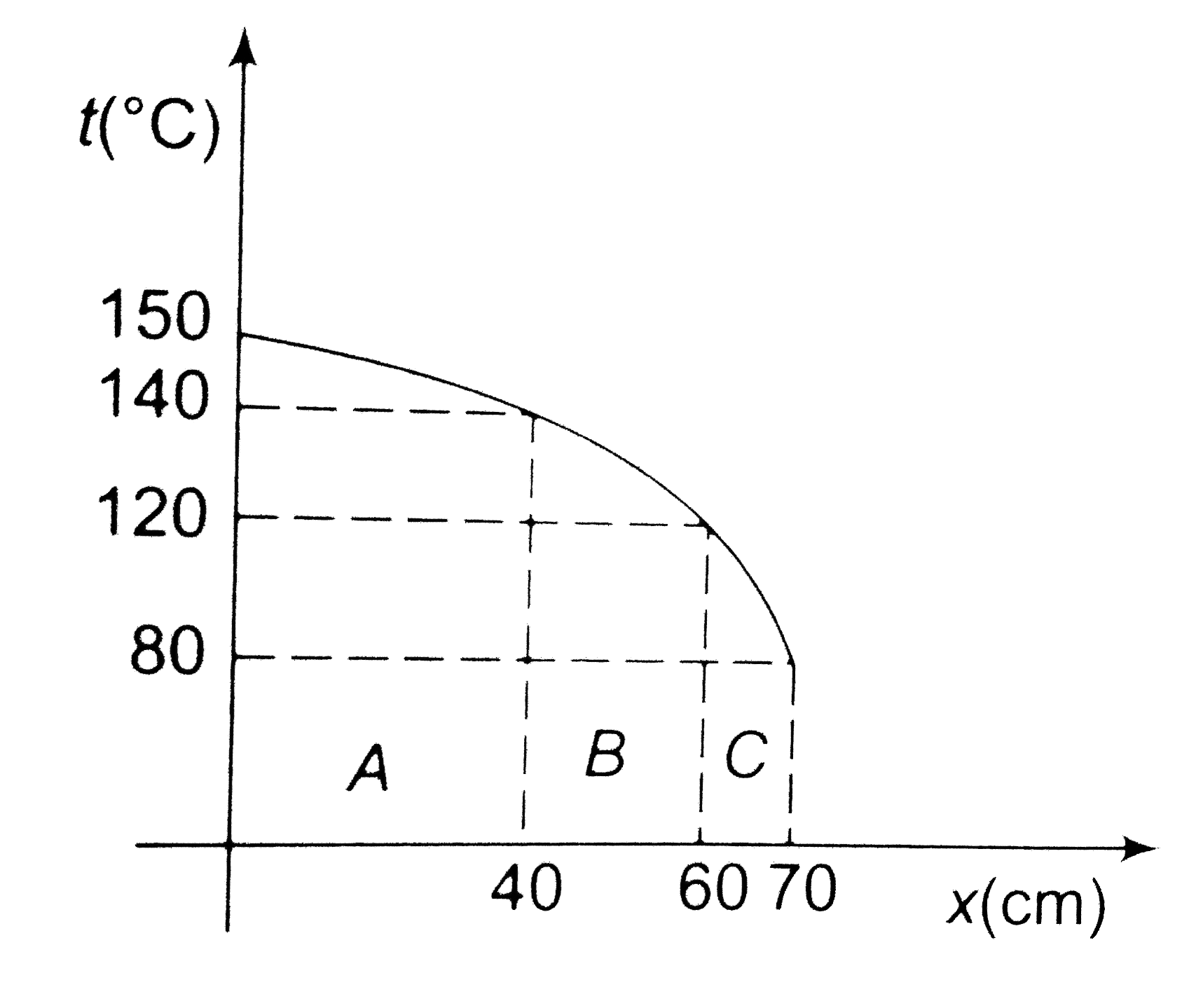
The graph shown gives the temperature along an `X` axis that extends directly through a wall consisting of three layers `A`, `B` and `C`. The air temperature on one side of the wall is `150^(@)C` and on the other side is `80^(@)C`. Thermal conduction through the wall is steady. out of the three layers `A` `B` and `C` thermal conductivity is greatest of the layer

A

A

B

B

C

C

D

Thermal conductivity of A = Thermal conductivity of B.

Text Solution

Verified by Experts

The correct Answer is:
A

Rate of heat transfer is same through all walls
`(K_(1)*A*(10))/(40cm)=(K_(2)A(20))/(20cm)=(K_(3)A(40))/(10cm)`
`rArrK_(1)/4=K_(2)=4K_(4)rArrK_(1)=4K_(2)=16K_(3)`
Promotional Banner

Topper's Solved these Questions

  • TRANSFER OF HEAT

    CENGAGE PHYSICS|Exercise GENERAL EXERCISE|17 Videos
  • STATIC ELECTRICITY

    CENGAGE PHYSICS|Exercise OLYMPIAD AND NTSE LEVEL EXERCISES|10 Videos

Similar Questions

Explore conceptually related problems

If the temperature difference on the two sides of a wall increases from 100^@C to 200^@C , its thermal conductivity

Calculate the quantity of heat conducted through 2m^(2) of a brick wall 12cm thick in 1 hour if the temperature on one side is 8^(@)C and on the other side is 28^(@)C . (Thermal conductivity of brick =0.13Wm^(-1)K^(-1) )

1.56 × 10^5 J of heat is conducted through is 2 m^2 wall of 12 cm thick in one hour. Temperature difference between the two sides of the wall is 20 ^@C. The thermal conductivity of the material of the wall is (in Wm ^(-1) K^(-1) )

Three identical rods A, B and C are placed end to end. A temperature difference is maintained between the free ends of A and C. The thermal conductitvity of B is thrice that of C and half that of A. The effective thermal conductivity of rod A)

Give a condition that three vectors vec a,vec b and vec c from the three sides of a triangle.What are the other possibilities?

The wall of a house consists of two layers with different thermal conductivity coefficients. The ternpera ture of the outer wall is T_1 and that of the inuer wall is T_2 . Temperature variations inside the wall are shown in the figure. What layer, the inner or the outer, has a higher thermal conductivity coefficient?

A composite wall of area A is made of equal thickness of lead and iron having thermal conductivities K and 2K, respectively. The temperature on the two sides of the composite wall are 100^(@)C and 0^(@)C with the layer on the hotter side. Calculate the steady -state temperature of the lead-iron interface.

A copper slab is 2 mm thick. It is protected by a 2 mm layer of stainless steel on both sides. The temperature on one side of this composite slab is 400^(@)C and 200^(@)C on the other side. Value of thermal conductivities are- k_(cu)=400 Wm^(-1)K^(-1) and k_(s)=16 Wm^(-1)K^(-1) (a) Just by knowing that thermal conductivity of steel is much less than copper, find (approximately) the temperature of the copper slab. (b) Plot the variation of temperature across the thickness of the composite wall.

A 100 W heater is placed in a cubical container of edge length 6xx10^(-2)m. The wall thick ness of the container is 1 mm. If inside and outside temperature in steady state are 30^(@)C. and 25^(@)C, find the thermal conductivity of the material of the box.