Home
Class 10
PHYSICS
Charges 2 xx 10^(-6)"C" and 1 xx 10^(-6)...

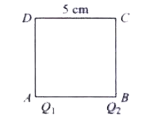
Charges `2 xx 10^(-6)"C" and 1 xx 10^(-6)`C are placed at comers A and B of a square of side 5 cm as shown in the figure. How much work will be done against the electric field in moving a charge of `1 xx 10^(-6)"C"` from C to D?

Text Solution

Verified by Experts

The electric potential at C
`V_( C ) = (1)/( 4pi epsilon_(0) ) ((q_1 )/( AC ) + (q_2)/( BC) )`
From the diagram
`AC = sqrt( AB^(2) + BC^(2) ) = sqrt( 5^(2) + 5^(2) ) = sqrt(50)`
`AC = 5 sqrt2" cm" = 0.05 sqrt(2) m`
`BC = 5" cm" = 0.05" m"`
`therefore V_(C ) = 9 xx 10^(9) [ (2 xx 10^(-6) )/( 0.05 sqrt2) + ( 1xx 10^(-6) )/( 0.05) ]`
`= (9 xx 10^9 xx 10^(-6) )/( 0.05 ) [ (2)/( sqrt2) + 1]`
`V_( C ) = 434.6 xx 10^(3) V`
The electric potential at D
`V_( D) = (1)/( 4pi epsilon_(0) ) [ (q_1)/( AD) + (q_2)/( BD) ]`
`= 9 xx 10^(9) [ (2 xx 10^(-6) )/( 0.05) + (1 xx 10^(-6) ) /( 0.05 sqrt2) ]`
`= (9 xx 10^(9) xx 10^(-6) )/( 0.05 ) [ 2 + (1)/( sqrt2) ]`
`V_( D) = 487.3 xx 10^(3) ` V
The work done against the electric field in moving the charge of `1 xx 10^(-6)` C from C to D is
`W = q (V_( D) V_( C) )`
`W = 1 xx 10^(-6) [ 487.3 - 434.6] xx 10^(3)`
`W = 52.7 xx 10^(-3)`
`W = 0.0527` J
Promotional Banner

Topper's Solved these Questions

  • STATIC ELECTRICITY

    CENGAGE PHYSICS|Exercise MANDATORY EXERCISE (Exercise Set I)|52 Videos
  • STATIC ELECTRICITY

    CENGAGE PHYSICS|Exercise MANDATORY EXERCISE (Exercise Set I) Multiple Choice Questions with One Correct Answer|13 Videos
  • SOURCES OF ELECTRIC CURRENT

    CENGAGE PHYSICS|Exercise OLYMPIAD AND NTSE LEVEL EXERCISES|10 Videos
  • TRANSFER OF HEAT

    CENGAGE PHYSICS|Exercise OLYMPIAD AND NTSE LEVEL EXERCISES|10 Videos

Similar Questions

Explore conceptually related problems

charges 2.0 xx 10^(-6) C and 1.0 xx 10^(-6) C are placed at. corners A and B of a squae of side 5.0cm as shown in. figure .how much work will be done against. the electric field in moving a charge of 1.0 xx 10^(-6) C from. C to D?.

Charges of +(10)/(3) xx 10^(-9) C are placed at each of the four corners of a square of side 8 cm . The potential at the intersection of the diagonals is

Charges 5.0 xx ^(-7) C and 1.0 xx 10^(-7) C are held fixed at the three cornners A, B, C of an equilateral . charge at C due to the rest two.

Find the magnitude of the electric field at a point 4 cm away from a line charge of density 2 xx 10^(-6) C m^(-1) .

Two point charges +10^(-7) C and -10^(-7)C are placed at A and B 20 cm apart as shown in the figure. Calculate the electric field at C, 20 cm apart from both A and B.

A charge of 5 mu C is placed at the center of a square ABCD of side 10 cm . Find the work done ("in" mu J) in moving a charge of 1 mu C from A to B.

Two charges 4 xx 10^(-8) C and -6 xx 10^(-8) C are at points A and B respectively , 50 cm apart . The electrical potential due to them is zero on the line AB at a distance from A equal to

Two particles A and B, having opposite charges 2.0xx 10^(-6) and -2.0 xx10^(-6) C , are placed at a separaton of 1.0 cm.(b) Calculate the electric field at a point on the axis of the dipole 1.0 m away from the centre. (c ) Calculate the electric field at a point on the perpendicular bisector of the dipole and 1.0 m away from the centre.

The potential at a point due to charge of 5xx10^(-7)C located 10 cm away is In the above question work done in bringing a charge of 4 xx 10^(-9)C from infinity to that point is
