Home
Class 10
PHYSICS
Deduce the simple relation e=I(R+r) for ...

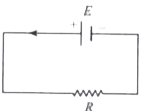
Deduce the simple relation `e=I(R+r)` for the following circuit :

e = emf of the cell, R = external resistance and
r = internal resistance.

Text Solution

Verified by Experts

Let I be the current through the ciruit
e - the emf of the cell
R-ecternal resistance
r-internal resistance of the cell
emf of the cell = PD across R + PD across r
`e=IR+Ir`
`e=I(R+r)`
Promotional Banner

Topper's Solved these Questions

  • SOURCES OF ELECTRIC CURRENT

    CENGAGE PHYSICS|Exercise MANDATORY EXERCISE (Exercise Set II)|22 Videos
  • SOURCES OF ELECTRIC CURRENT

    CENGAGE PHYSICS|Exercise MANDATORY EXERCISE (Exercise Set III)|1 Videos
  • SOURCES OF ELECTRIC CURRENT

    CENGAGE PHYSICS|Exercise OLYMPIAD AND NTSE LEVEL EXERCISES|10 Videos
  • REFRACTION OF LIGHT

    CENGAGE PHYSICS|Exercise OLYMPIAD AND NSE LEVEL EXCERCISES |10 Videos
  • STATIC ELECTRICITY

    CENGAGE PHYSICS|Exercise OLYMPIAD AND NTSE LEVEL EXERCISES|10 Videos

Similar Questions

Explore conceptually related problems

If E is the emf of a cell of internal resistance r and external resistance R, then potential difference across R is given as

A battery of emf epsilon and internal resistance r sends currents I_(1) and I_(2) , when connected to external resistance R_(1) and R_(2) respectively. Find the emf and internal resistance of the battery.

An accumulator of emf epsilon and internal resistance r is first connected to an external resistance R_(1) and then to an external resistance R_(2) for the same time. For what value of r the beats dissipated in R_(1) and R_(2) will be same?

An accumulator of emf epsilon and internal resistance r is first connected to an external resistance R_(1) and then to an external resistance R_(2) for the same time. For what value of r the beats dissipated in R_(1) and R_(2) will be same?

A cell of emf epsilon and internal resistance r gives a current of 0.5 A with an external resistance of 12 Omega and a current of 0.25 A with an external resistance of 25 Omega . Calculate (a) internal resistance of the cell and (b) emf of the cell.

In the figure, the potentiometer wire AB of length L and resistance 9r is joined to the cell D fo emf E and internal resistance r. The emf of the cell C is E/2 and its internal resistance is 2r. The galvanometer G will show no deflection when the length AJ is

In the given circuit, if the potential difference across the internal resistance r_1 is equal to E, then the resistance R is equal to:

An total resistance R is connected to a cell of internal resistance r the maximum current flows in the external resistance, when

A cell of emf epsilon and internal resistance r is charged by a current I, then

Two cells of emf E_(1) and E_(2) are joined in opposition (such that E_(1) gt E_(2) ) . If r_(1) be the internal resistances and R be the external resistance, then the terminal potential difference is
