Home
Class 12
MATHS
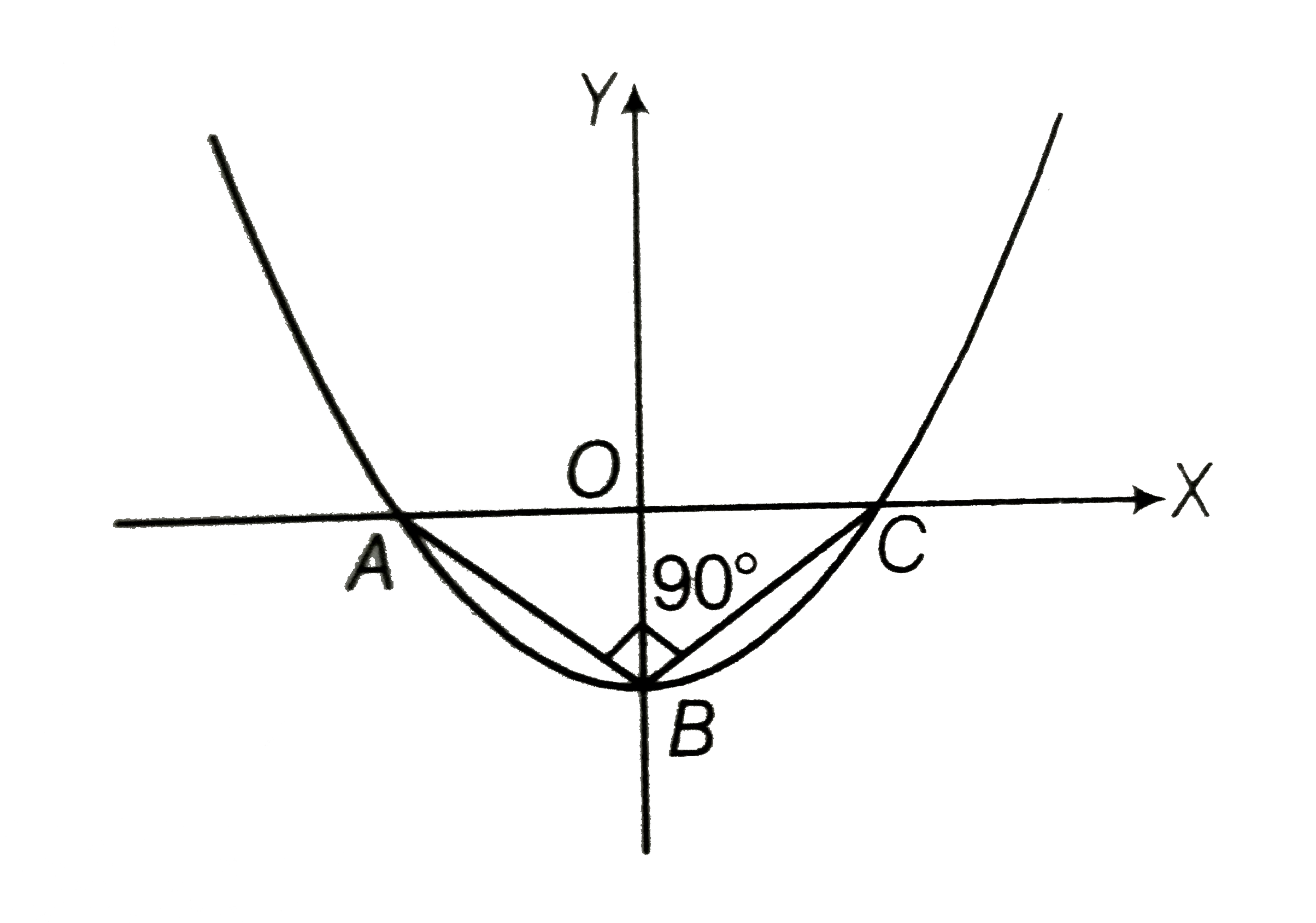
In the given figue vertices of DeltaABC ...

In the given figue vertices of `DeltaABC` lie on `y=f(x)=ax^(2)+bx+c`. The `DeltaABC` is right angled isosceles triangle whose hypotenuse `AC=4sqrt(2)` units.

`y=f(x)` is given by

A

`y=-x^(2)-8`

B

`y=(x^(2))/(2sqrt(2))-2sqrt(2)`

C

`y=x^(2)-4`

D

`y=(x^(2))/2-sqrt(2)`

Text Solution

Verified by Experts

The correct Answer is:

B

Given that `AC=4sqrt(2)` units
`:.AB=BC=(AC)/(sqrt(2))=4` units andd `OB=sqrt((BC)^(2)-(OC)^(2))`
`=sqrt((4)^(2)-(2sqrt(2))^(2))[ :' OC=(AC)/2]`
`=2sqrt(2)` units
`:.` Vertices are `A=(-2sqrt(2),0)`,
`B=-(0,-2sqrt(2))`
and `C=(2sqrt(2),0)`
Since `y=f(x)=ax^(2)+bx+c` passes through A,B and C then
`0=8a-2sqrt(2)b+c-2sqrt(2)=c`
and `0=8a+2sqrt(2)b+c`
We get `b=0, a=1/(2sqrt(20)` and `c=-2sqrt(2)`
`:.y=f(x)=(x^(2))/(2sqrt(2))-2sqrt(2)`
Promotional Banner

Topper's Solved these Questions

  • THEORY OF EQUATIONS

    ARIHANT MATHS|Exercise Exercise (Single Integer Answer Type Questions)|10 Videos
  • THEORY OF EQUATIONS

    ARIHANT MATHS|Exercise Exercise (Matching Type Questions)|2 Videos
  • THEORY OF EQUATIONS

    ARIHANT MATHS|Exercise Exercise (More Than One Correct Option Type Questions)|15 Videos
  • THE STRAIGHT LINES

    ARIHANT MATHS|Exercise The Straight Lines Exercise 8 : (Questions Asked in Previous 13 years Exams)|1 Videos
  • THREE DIMENSIONAL COORDINATE SYSTEM

    ARIHANT MATHS|Exercise Three Dimensional Coordinate System Exercise 12 : Question Asked in Previous Years Exam|2 Videos

Similar Questions

Explore conceptually related problems

In the given figure vertices of DeltaABC lie on y=f(x)=ax^(2)+bx+c . The DeltaABC is right angled isosceles triangle whose hypotenuse AC=4sqrt(2) units. Minimum valueof y=f(x) is

In the given figue vertices of DeltaABC lie on y=f(x)=ax^(2)+bx+c . The DeltaAB is right angled isosceles triangle whose hypotenuse AC=4sqrt(2) units. Number of integral value of lamda for which (lamda)/2 lies between the roots of f(x)=0 , is

ABC is an isosceles triangle right angled at C. Prove that AB^2 = 2AC^2 .

A right angled triangle has legs 1 and x . The hypotenuse is y and angle opposite to the side x is theta . Shown as

For the function y=f(x)=(x^(2)+bx+c)e^(x) , which of the following holds?

The points A(x,y), B(y, z) and C(z,x) represents the vertices of a right angled triangle, if

Let f(x)=ax^(2)+bx+c,ab,c in R. It is given |f(x)|le1,|x|le1 The possible value of |a+c|,if(8)/(3)a^(2)+2ab^(2) is maximum is given by

Suppose that the quadratic function f(x) = ax^(2) + bx +c is non-negative on the interval [-1,1] . Then, the area under tha graph of f over the interval [-1,1] and the X - axis is given by the formula

In a DeltaABC , if 4 cos A cos B + sin 2A+sin 2B+sin 2C=4 , then DeltaABC is a. right angle but not issosceles b. isosceles but not right angled c. right angle isosceles d. obtuse angled

Let A(h, k), B(1, 1) and C(2, 1) be the vertices of a right angled triangle with AC as its hypotenuse. If the area of the triangle is 1, then the set of values which k can take is given by (1) {1,""3} (2) {0,""2} (3) {-1,""3} (4) {-3,-2}

ARIHANT MATHS-THEORY OF EQUATIONS-Exercise (Passage Based Questions)
  1. If G and L are the greatest and least values of the expression(2x^(2)-...

    Text Solution

    |

  2. If G and L are the greatest and least values of the expression(2x^(2)-...

    Text Solution

    |

  3. If roots of the equations x^(4)-12x^(3)+cx^(2)+dx+81=0 are positive. ...

    Text Solution

    |

  4. If the roots of the equaion x^4-12 x^3+c x^2+dx+81=0 are positive then...

    Text Solution

    |

  5. If roots of the equations x^(4)-12x^(3)+cx^(2)+dx+81=0 are positive. ...

    Text Solution

    |

  6. In the given figue vertices of DeltaABC lie on y=f(x)=ax^(2)+bx+c. The...

    Text Solution

    |

  7. In the given figure vertices of DeltaABC lie on y=f(x)=ax^(2)+bx+c. Th...

    Text Solution

    |

  8. In the given figue vertices of DeltaABC lie on y=f(x)=ax^(2)+bx+c. The...

    Text Solution

    |

  9. Let f(x) = x^2 + b1x + c1. g(x) = x^2 + b2x + c2. Real roots of f(x)...

    Text Solution

    |

  10. Let f(x) = x^2 + b1x + c1. g(x) = x^2 + b2x + c2. Real roots of f(x)...

    Text Solution

    |

  11. Let f(x)=x^(2)+bx+c and g(x)=x^(2)+b(1)x+c(1) Let the real roots of f...

    Text Solution

    |

  12. If ax^2-bx + c=0 have two distinct roots lying in the interval (0,1); ...

    Text Solution

    |

  13. If ax^(2)+bx+c=0 have two distinct roots lying in the interval (0,1),a...

    Text Solution

    |

  14. If ax^(2)-bx+c=0 have two distinct roots lying in the interval (0,1),a...

    Text Solution

    |

  15. If 2x^(3)+ax^(2)+bx+4=0 (a and b are positive real numbers) has three ...

    Text Solution

    |

  16. If 2x^(3)+ax^(2)+bx+4=0 (a and b are positive real numbers) has three ...

    Text Solution

    |

  17. If 2x^(3)+ax^(2)+bx+4=0 (a and b are positive real numbers) has three ...

    Text Solution

    |

  18. If alpha, beta, gamma , delta are the roots of the equation x^(4)+Ax^(...

    Text Solution

    |

  19. If alpha, beta, gamma, delta are the roots of the equation x^(4)+Ax^(3...

    Text Solution

    |

  20. If alpha, beta, gamma, delta are the roots of the equation x^(4)+Ax^(3...

    Text Solution

    |
