Home
Class 12
MATHS
If D, E and F are three points on the si...

If D, E and F are three points on the sides BC, CA and AB, respectively, of a triangle ABC such that the lines AD, BE and CF are concurrent, then show that
`" "(BD)/(CD)*(CE)/(AE)*(AF)/(BF)=1`

Text Solution

Verified by Experts
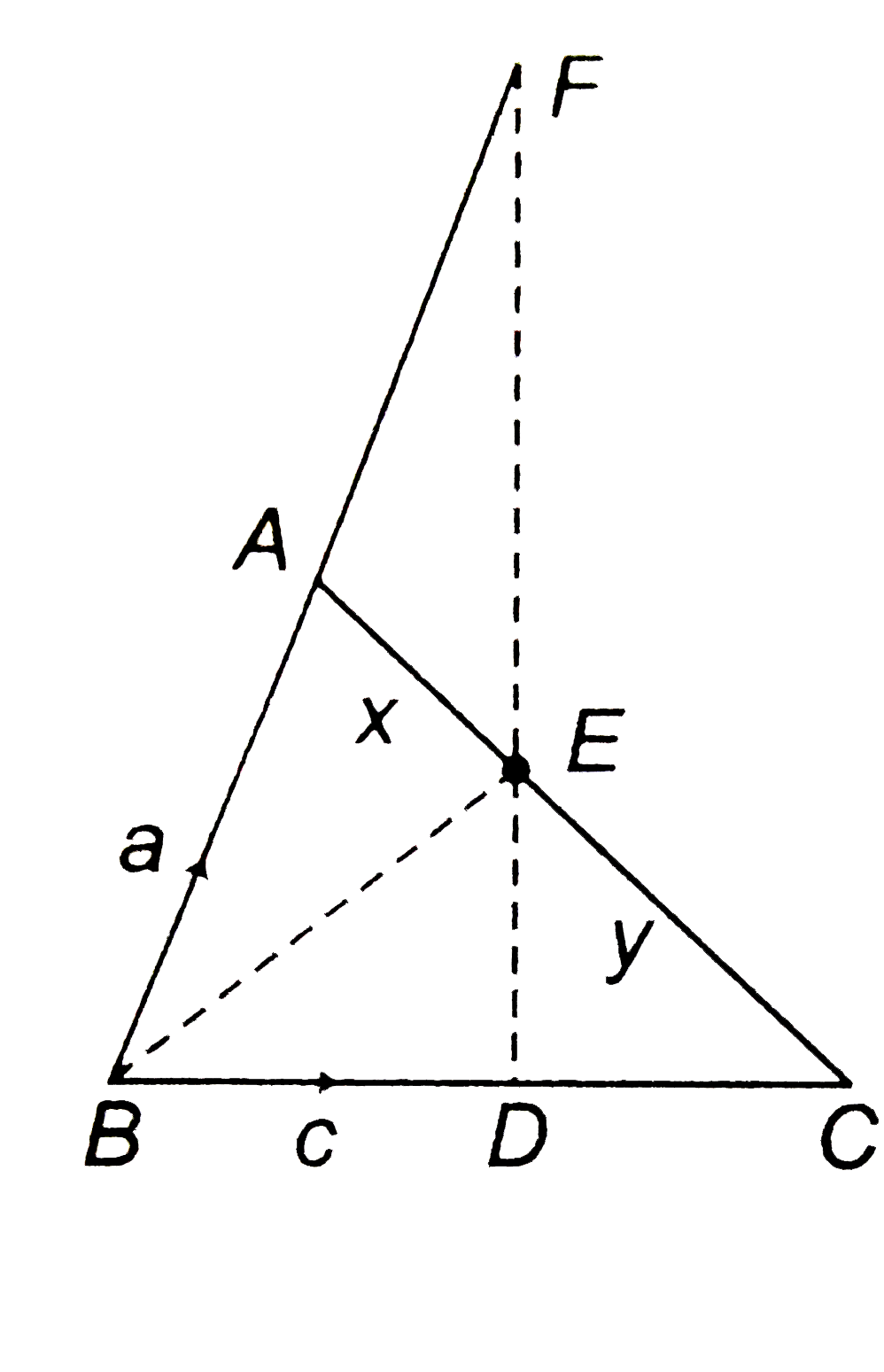
Here, D, E and F be the points on the sides BC,CA and AB respectively of `DeltaABC`. Such that points D,E and F are collinear, be shawn as the adjoining figuece.
Let B as the origin, BA=a and BC=c
The, BF=ka and BD=lc

where, k and l are scalars.
`therefore(BD)/(BC)=l and (BF)/(BA)=k`
`impliesBC:BD=1:l`
`implies(BC)/(BD)-1=(1)/(l)-1implies(DC)/(BD)=(1-l)/(l)`
`implies(BD)/(DC)=(l)/(1-l) and (BA)/(BF)=(1)/(k)`
`implies1-(BA)/(BF)=1-(1)/(k)implies (AF)/(BF)=(k-1)/(k)`
Now, let E divide the line AC in the ratio of x:y
so, that `BE=(xc+ya)/(x+y)=(x*(BD)/(l)+y*(BF)/(k))/(x+y)`
`implies BE-(x)/(l(x+y))BD-(y)/(k(x+y))BF=0`
Since, D,E and F are collinear.
Sum of coefficient must be zero.
hence, `1-(x)/(l(x+y))-(y)/(k(x+y))=0`
`implies(x+y)-(x)/(l)-(y)/(k)=0impliex+y=(x)/(l)+(y)/(k)`
`implies x(1-(1)/(l))=y((1)/(k)-1)impliesx((l-1)/(l))=y((1-k)/(k))`
`implies (l)/(l-1)*(y)/(x)*(k-1)/(k)=1`
`implies(BD)/(DC)*(CE)/(AE)*(AF)/(BF)=1` [using Eqs. (i), (ii) and (iii)].
Promotional Banner

Topper's Solved these Questions

  • VECTOR ALGEBRA

    ARIHANT MATHS|Exercise Exercise For Session 1|7 Videos
  • VECTOR ALGEBRA

    ARIHANT MATHS|Exercise Exercise For Session 2|17 Videos
  • TRIGONOMETRIC FUNCTIONS AND IDENTITIES

    ARIHANT MATHS|Exercise Exercise (Questions Asked In Previous 13 Years Exam)|18 Videos

Similar Questions

Explore conceptually related problems

If D,E and F are the mid-points of the sides BC,CA and AB, respectively of a DeltaABC and O is any point, show that (i) AD+BE+CF=0

D,E and F are mid-points of the sides BC, CA and AB respectively of triangleABC . Prove that ar(triangleDEF) = 1/4 ar (triangleABC)

D,E and F are the middle points of the sides of the triangle ABC, then

Points P, Q and R lie on sides BC, CA and AB respectively of triangle ABC such that PQ || AB and QR || BC, prove that RP II CA.

D,E and F are mid-points of the sides BC, CA and AB respectively of triangleABC . Prove that ar(||gmBDEF)= 1/2 ar (triangleABC)

D, E and F are respectively the mid-points of the sides BC, CA and AB of a triangle ABC . Show that:- BDEF is a parallelogram.

D and E are points on the sides CA and CB respectively of a triangle ABC right angled at C. Prove that AE^2+BD^2=AB^2+DE^2 .

D,E,F are the middle points of the sides [BC],[CA],[AB] respectively of a triangle ABC. Show that : FE is parallel to BC and half of its length.

E and F are the mid points of non-parallel sides AD and BC respectively of a trapezium prove that EF||AB.

In the fig D,E and F are the mid points of the sides BC,CA and AB respectively of triangleABC . If BE and DF intersect at X while CF and DE ntersect at Y. prove that XY=1/4BC

