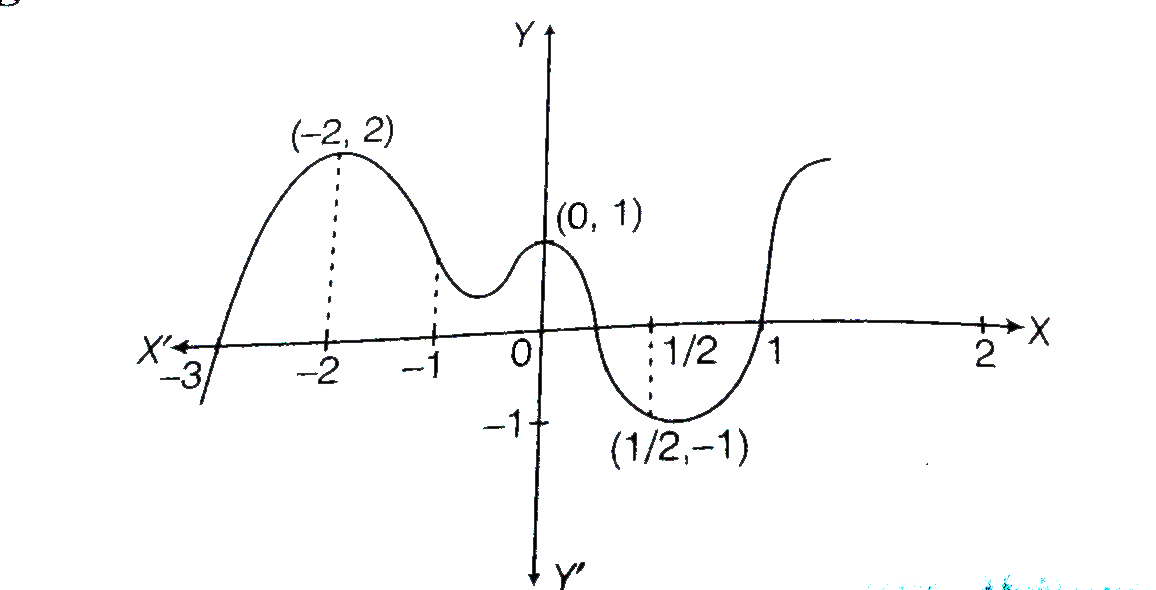
A
B
C
D
Text Solution
Verified by Experts



Topper's Solved these Questions
DIFFERENTIATION
ARIHANT MATHS|Exercise Exercise (More Than One Correct Option Type Questions)|62 VideosDIFFERENTIATION
ARIHANT MATHS|Exercise Exercise (Statement I And Ii Type Questions)|8 VideosDIFFERENTIATION
ARIHANT MATHS|Exercise EXAMPLE|3 VideosDIFFERENTIAL EQUATION
ARIHANT MATHS|Exercise Exercise (Questions Asked In Previous 13 Years Exam)|26 VideosDY / DX AS A RATE MEASURER AND TANGENTS, NORMALS
ARIHANT MATHS|Exercise Exercise (Questions Asked In Previous 13 Years Exam)|7 Videos
Similar Questions
Explore conceptually related problems
ARIHANT MATHS-DIFFERENTIATION -SOLVED EXAMPLES
- Let f(x) be a real valued function not identically zero, which satisfi...
Text Solution
|
- Let f((x+y)/(2))=(f(x)+f(y))/(2) and f(0)=b. Find f''(x) (wherey is in...
Text Solution
|
- The functions u=e^(x).sinx and v=e^(x).cosx satisfy the equation
Text Solution
|
- The leading coefficient of f(x), is,
Text Solution
|
- If f(x)= 18x+11 then find the value of f''(x), is
Text Solution
|
- The minimum number of real roots of equation (p''(x))^(2)+p'(x).p'''(x...
Text Solution
|
- Find a, b, c, and d, where f(x)=(ax+b)cosx+(cx+d)sinxandf'(x)=xcosx i...
Text Solution
|
- If for all x,y the function f is defined by f(x)+f(y)+f(x).f(y)=1 and ...
Text Solution
|