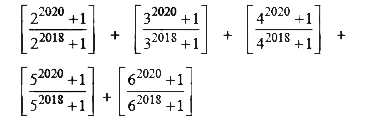
A
B
C
D
Text Solution
Verified by Experts
The correct Answer is:



Topper's Solved these Questions
Similar Questions
Explore conceptually related problems
KVPY PREVIOUS YEAR-QUESTION PAPER 2020-PART-II(MATHEMATICS)
- Let [x] be the greatest integer less than or equal to x, for a real n...
Text Solution
|
- Let a= sum(n=101 )^(200) 2^n sum(k=101 )^(n) (1)/(K!) and b= sum(n...
Text Solution
|
- Let a, b, c be non-zero real roots of the equation x^(3)+ax^(2)+bx+c=0...
Text Solution
|
- Let ƒ(x) = sinx + (x^3 – 3x^2 + 4x – 2)cosx for x in (0, 1). Consid...
Text Solution
|
- Let A be a set consisting of 10 elements. The number of non-empty rela...
Text Solution
|
- In a triangle ABC, the angle bisector BD of angleB intersects AC in D....
Text Solution
|
- Len N be set of natural numbers. For n in N defiine I(n)=int(0)^(p...
Text Solution
|
- for theta in [ 0, pi ] , let f( theta) = sin ( cos theta) and ...
Text Solution
|
- Six consecutive sides of an equiangular octagon are 6, 9, 8, 7, 10, 5 ...
Text Solution
|
- The value of the integral int(1)^(sqrt(2) +1) ((x^2 -1)/(x^2+1)) (1...
Text Solution
|
- Let a = BC, b = CA, c = AB be side lengths of a triangle ABC. And m b...
Text Solution
|