Home
Class 12
CHEMISTRY
Compound 'X' on heating with Zn dust giv...

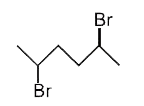
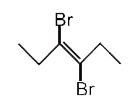
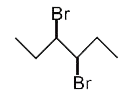
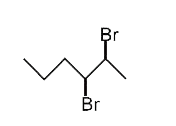
Compound 'X' on heating with Zn dust gives compound 'Y' which on treatment with `O_3` followed by reaction with Zn dust gives propionaldehyde. The structure of 'X' is

A

B

C

D

Text Solution

AI Generated Solution

The correct Answer is:

To solve the problem step by step, we need to analyze the information provided about compound 'X', its reaction with zinc dust, and the subsequent reactions that lead to propionaldehyde. ### Step 1: Identify the Reaction of Compound 'X' with Zinc Dust When compound 'X' is heated with zinc dust, it produces compound 'Y'. This suggests that 'X' is likely a compound that can undergo reduction or dehydrohalogenation in the presence of zinc dust. **Hint:** Think about what types of compounds can be reduced or dehydrohalogenated by zinc dust. ### Step 2: Determine the Structure of Compound 'Y' The problem states that compound 'Y' reacts with ozone (O3) followed by treatment with zinc dust to yield propionaldehyde (CH3CH2CHO). This indicates that 'Y' must be an unsaturated compound (likely an alkene or alkyne) that can undergo ozonolysis. **Hint:** Consider the ozonolysis reaction and how it cleaves double or triple bonds to form carbonyl compounds. ### Step 3: Analyze the Ozonolysis of Compound 'Y' The ozonolysis of 'Y' will break it down into two carbonyl compounds. Since the final product is propionaldehyde, 'Y' must be a compound that, when ozonolyzed, gives propionaldehyde as one of the products. **Hint:** Draw the structure of propionaldehyde and think about how it could be formed from a larger compound. ### Step 4: Identify Possible Structures for Compound 'Y' Given that propionaldehyde is produced, we can deduce that 'Y' could be a compound like 3-hexene (C6H12) or similar, which upon ozonolysis would yield propionaldehyde and another aldehyde or ketone. **Hint:** Consider the carbon skeleton and how many carbons are needed to produce propionaldehyde. ### Step 5: Determine the Structure of Compound 'X' Since 'Y' is derived from 'X' through a reaction with zinc dust, we can hypothesize that 'X' is likely a dibromide or similar compound that can yield 'Y' upon reduction. **Hint:** Look for a compound that has the potential to yield an alkene or alkyne upon reduction with zinc dust. ### Conclusion After analyzing the reactions and the structures, we can conclude that compound 'X' is likely to be a dibromide, specifically 1,2-dibromohexane. This compound, when treated with zinc dust, would yield 3-hexene (compound 'Y'), which upon ozonolysis and subsequent reduction would yield propionaldehyde. **Final Answer:** The structure of compound 'X' is 1,2-dibromohexane.

To solve the problem step by step, we need to analyze the information provided about compound 'X', its reaction with zinc dust, and the subsequent reactions that lead to propionaldehyde. ### Step 1: Identify the Reaction of Compound 'X' with Zinc Dust When compound 'X' is heated with zinc dust, it produces compound 'Y'. This suggests that 'X' is likely a compound that can undergo reduction or dehydrohalogenation in the presence of zinc dust. **Hint:** Think about what types of compounds can be reduced or dehydrohalogenated by zinc dust. ### Step 2: Determine the Structure of Compound 'Y' ...
Promotional Banner

Topper's Solved these Questions

  • QUESTION PAPER 2013

    KVPY PREVIOUS YEAR|Exercise PART-I ( CHEMISTRY)|20 Videos
  • QUESTION PAPER 2013

    KVPY PREVIOUS YEAR|Exercise PART-II ( CHEMISTRY)|10 Videos
  • QUESTION PAPER 2013

    KVPY PREVIOUS YEAR|Exercise PART-II ( CHEMISTRY)|10 Videos
  • MOCK TEST 9

    KVPY PREVIOUS YEAR|Exercise EXERCISE|26 Videos
  • QUESTION PAPER 2020

    KVPY PREVIOUS YEAR|Exercise PART-II(CHEMISTRY)|10 Videos

Similar Questions

Explore conceptually related problems

The compound which gives H_2O_2 on treatment with dilute acid is

1,4-Pentadiene reacts with excess of HCl in the presence of benzoyl peroxide to give compound X , which upon reaction with excess of Mg in dry ether forms Y . Compound Y on treatment with ethyl acelate followed by treatment with dilute acid yields Z . Identify the structure of componds. X, Y and Z .

An organic compound 'X' on treatment with acidified K_(2)Cr_(2)O_(1) gives a compound 'Y' which reacts with I_(2) and sodium carbonate to form triodomethane. The compound 'X' could be
