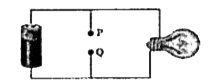
Brad sets up an electrical circuit as shown in the given figure. He connects points P and Q of the circuit with four different rods made of four different materials - glass, wood, copper, and asbestos. The bulb in the circuit will not light up when points P and Q are connected with
Brad sets up an electrical circuit as shown in the figure. He connects points P and Q of the circuit with four different rods made of four different materials - glass, wood, copper, and asbestos. The bulb in the circuit will not light up when points P and Q are connected with
Tommy sets up an electrical circuit as shown in the figure. He connects points P and Q with different materials. The bulb will light up when points P and Q are connected by a plate made of
Tommy sets up an electrical circuit as shown in the figure. He connects points P and Q with different materials. The bulb will light up when points P and Q are connected by a plate made of
The net resistance between points P and Q in the circuit shown in figure is
There is a electric circuit as shown in the figure. Find potential difference between points a and b.
The equivalent resistance between the points P and Q of the circuit given is
The effective resistance between points P and Q of the electrical circuit shown in the figure is
The effective resistance between points P and Q of the electrical circuit shown in the figure is :
The effective resistance between points P and Q of the electrical circuit shown in the figure is
BEIITIANS-ELECTRIC CURRENT AND ITS EFFECTS-IIT JEE WORKSHEET (V. Matrix Matching)