 .
.


Topper's Solved these Questions
Similar Questions
Explore conceptually related problems
JBD PUBLICATION-WORK,ENERGY AND POWER-EXAMPLE
- It is well known that a rain drop falls under the influence of the dow...
Text Solution
|
- To stimulate car accidents auto manufacturers study the collisions of ...
Text Solution
|
- A ball is dropped from a height 4 m.what is the height upto which the ...
Text Solution
|
- What is scalar product?
Text Solution
|
- Define the term collision. Discuss its types with examples.
Text Solution
|
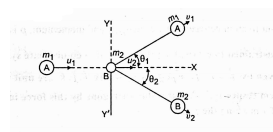
- A and B are two particles having the same mass m. A is moving along X-...
Text Solution
|
- Consider the collision depicted in Figure, to be between two billiard ...
Text Solution
|
- What is scalar product?
Text Solution
|
- Define kinetic energy?
Text Solution
|
- A body constrained to move along the z-axis of a coordinate system is ...
Text Solution
|
- A trolley of mass 200 kg moves with a uniform speed of 36 km//h on a f...
Text Solution
|
- A 2 kg ball moving at 24 ms undergoes inelastic head on collision with...
Text Solution
|
- A body of mass M at rest is struck by a moving body of mass m.Prove t...
Text Solution
|
- State and prove work-energy theorem.
Text Solution
|
- Consider the following figure taking the coefficient fo friction,mu to...
Text Solution
|
- What is non-conservative force?
Text Solution
|
- Define work.Write it's units.
Text Solution
|
- What is spring constant ? What are the SI units?
Text Solution
|
- Write short note on power.
Text Solution
|
- Which of the following is not a perfectly inelastic collision?
Text Solution
|