

Home
Class 9
PHYSICS
Answer the following questions: The cha...

Answer the following questions:
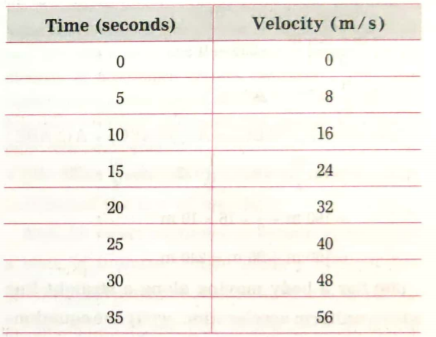
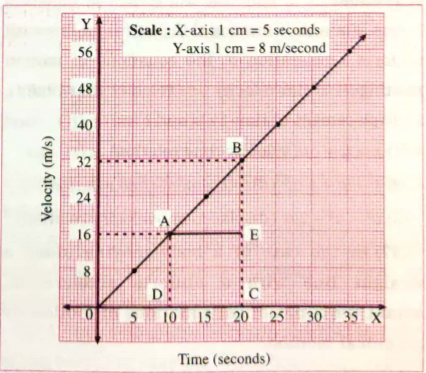
The changes in the velocity of a car in specific time intervals are given in the following table.The velocty-time graph in figure shows that,
The velocity changes by equal amounts in equal time intervals. Thus, this is uniformly accelerated motion. How much does the velocity change in every 5 seconds?
Find the distance covered by the car in the time interval 10 seconds to 20 seconds.

Promotional Banner

Topper's Solved these Questions

  • LAWS OF MOTION

    NAVNEET PUBLICATION|Exercise EXERCISE|196 Videos
  • CURRENT ELECTRICITY

    NAVNEET PUBLICATION|Exercise EXERCISE|215 Videos
  • MEASUREMENT OF MATTER

    NAVNEET PUBLICATION|Exercise EXAMPLES|1 Videos

Similar Questions

Explore conceptually related problems

Answer the following questions: The changes in the velocity of a car in specific time intervals are given in the following table. Explain For all uniformly accelerated motions, the velocity-time graph is a straight line.

Answer the following questions: The changes in the velocity of a car in specific time intervals are given in the following table. The velocty-time graph in figure shows that, For nonuniformly accelerated motions, the velocity-time graph may have any shape depending on how the acceleration changes with time.Explain.

If the velocity changes by equal amounts in equal time intervals, the object is said to be in........

Answer the following questions: The following table shown the distance covered by a car in fixed time intervals. Draw a graph of distance against time taking 'time' along the X-axis and 'distance' along the Y-axis.

Use your brain power: Amar, Akbar and Anthony are travelling in different cars with different velocities. The distance covered by them during different time intervals are given in the following table. Who has covered equal distance in equal time intervals?

Answer the following based on the graph given below. After how many seconds does AC change its direction?

A body starting with an initial velocity of 4 m//s , moves with a uniform acceleration of 0.5 m//s^(2) . After some time its velocity becomes 6 m//s . Calculate the time taken by the body to attain this velocity and the distance covered by it during this time interval.

Answer the following questions: The following table shows the distances covered by a bus in equal time intervals. Draw a graph of distance against time taking the time along the X-axis and distance along Y-axis. Does the graph show a direct proportionality between distance and time?

Use your brain power: Amar, Akbar and Anthony are travelling in different cars with different velocities. The distance covered by them during different time intervals are given in the following table. Considering the distances covered by Amar, Akbar, Anthony in fixed time intervals, what can you say about their speeds?

Use your brain power: Amar, Akbar and Anthony are travelling in different cars with different velocities. The distance covered by them during different time intervals are given in the following table. Are all the distances covered by Akbar in the fixed time intervals the same?

NAVNEET PUBLICATION-LAWS OF MOTION-EXERCISE
  1. Answer the following questions: A train is moving with a uniform velo...

    Text Solution

    |

  2. Answer the following questions: A train is moving with a uniform velo...

    Text Solution

    |

  3. Answer the following questions: The changes in the velocity of a car ...

    Text Solution

    |

  4. Answer the following questions: The changes in the velocity of a car ...

    Text Solution

    |

  5. Answer the following questions: The changes in the velocity of a car ...

    Text Solution

    |

  6. Answer the following questions: For a body moving along a straight li...

    Text Solution

    |

  7. Answer the following questions: In the case of a body moving along a ...

    Text Solution

    |

  8. Answer the following questions: What is uniform circular motion?

    Text Solution

    |

  9. Answer the following questions: Define unifrom circular motion. Stat...

    Text Solution

    |

  10. Answer the following questions: State any five examples of uniform ci...

    Text Solution

    |

  11. What is the direction of velocity of a particle performing uniform cir...

    Text Solution

    |

  12. Answer the following questions: State Newton's first law of motion. W...

    Text Solution

    |

  13. What are the effects of a force acting on an object?

    Text Solution

    |

  14. Answer the following questions: Give any two examples of force in eac...

    Text Solution

    |

  15. Answer the following questions: Give any two examples of force in eac...

    Text Solution

    |

  16. Answer the following questions: Give any two examples of force in eac...

    Text Solution

    |

  17. Answer the following questions: Give any two examples of force in eac...

    Text Solution

    |

  18. Answer the following questions: Give any two examples of force in eac...

    Text Solution

    |

  19. Answer the following questions: Give one example in which force is n...

    Text Solution

    |

  20. Answer the following questions: Give one example of visible effect of...

    Text Solution

    |