Home
Class 12
BIOLOGY
Describe the formation and fate of three...

Describe the formation and fate of three germlayers inamammalian embryo.

Text Solution

Verified by Experts
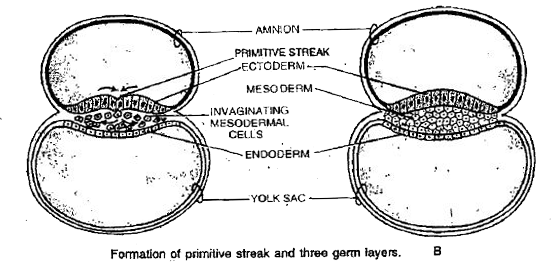
Formation of Germs layers/Embryonic Layers. After the formation of the primitive streak, cells of the epiblast move invward:below the primitive streak and detach from the epiblast. This inverting movement is called invagination. (i) Once the cells have invaginated, some of them displace the hypoblast forming the endoderm. Endoderm develops first during embryonic development. (ii) Other cells remain between the epiblast and newly formed endoderm forms the mesoderm: (iii) Cells remaining in the epiblast form ectoderm.

These three germ layers i.e., ecto, meso and endoderm form all the tissues and organs of the body.
Fate of Germ Layers in mammalian embryo. Each germ layer gives rise to the specific issues, organs and organ-systems.
1. Ectoderm. It gives rise to (i) epidermis of skin, and epidermal derivatives (glands, hair, lails), (ii) nervous system, (iii) medulla of adrenal gland, posterior and intermediate lobes of pituitary gland, pined gland (iv) eye (conjunctiva, cornea, lens, retina, iris and ciliary muscles), (v) internal ear, (vi) nasa epithelium, (vii) lining of stomodaeum and proctodaeum, (viii) lining of external aucutory canal, (ix) lacnmal glands, salivary glands, and (x) enamel of teeth. 2. Mesoderm. It produces (i) dermis of skin, (ii) most muscles, connective tissues, (iii) peritoneum, (iv) kidneys, (v) cortex of adrenal glands, (vi) gonads, (vii) urinary and reproductive ducts, (viii) heart blood and lymph vessels, (ix) spleen (x) wall of gut except its lining epithelium. (xi) pericardium and pleura, (xii) sclera and choroid of eye, (xiii) most of skeleton, (xiv) dentine of teeth, (xv) mesenteries, and (xvi) notochord. 3. Endoderm. It forms (i) lining of gut except that of stomodaeum and proctodaeum, (ii. gastric and intestinal glands, tongue epithelium, liver, pancreas, anterior lobe of pituitary gland. thyroid gland, parathyroid glands, thymus gland, (iii) lining of trachea, bronchi and lungs, (iv) lining of urinary bladder, (v) lining of middle ear, (vi) primordial germ cells, and (vii) greater part of prostate.
Promotional Banner

Topper's Solved these Questions

  • HUMAN REPRODUCTION

    BETTER CHOICE PUBLICATION|Exercise SHORT ANSWER TYPE QUESTIONS (MOAT EXPECTED QUESTIONS)|3 Videos
  • HUMAN HEALTH AND DISEASE

    BETTER CHOICE PUBLICATION|Exercise LONG ANSWER TYPE QUESTIONS (MOST EXPECTED QUESTIONS)|12 Videos
  • MICROBES IN HUMAN WELFARE

    BETTER CHOICE PUBLICATION|Exercise LONG ANSWER TYPE QUESTIONS (MOST EXPECTED QUESTIONS)|2 Videos

Similar Questions

Explore conceptually related problems

Describe the formation of Coal

Describe the formation of a nucleotide.

Describe the formation and functions of corpus luteum in human female.

Describe the formation and state function of periderm in roots.

Describe the formation of image by a concave lens.

BETTER CHOICE PUBLICATION-HUMAN REPRODUCTION-LONG ANSWER TYPE QUESTIONS
  1. Describe human female reproductive system with labelled diagram.

    Text Solution

    |

  2. Explain the role of the following hormones with reference to Menstrual...

    Text Solution

    |

  3. Describe the formation and fate of three germlayers inamammalian embry...

    Text Solution

    |

  4. At which stage of life does oogenesis begin in human females.

    Text Solution

    |

  5. Namethe organ where oogenesis gets completed inhuman females.

    Text Solution

    |

  6. Give a schematic representation of oogenesis in human females.

    Text Solution

    |

  7. What do you call the area of a human ovum from where the sperm makes t...

    Text Solution

    |

  8. Name the enzyme produced by the sperm to facilitate its entry.

    Text Solution

    |

  9. Draw a well labelled diagram of structure of Human ovum.

    Text Solution

    |

  10. Describe in detail the accessory glands of male and female humanbeing.

    Text Solution

    |

  11. What is cleavage ? Write down its characteristics.

    Text Solution

    |

  12. Differentiate between spermatogenesis and oogenesis.

    Text Solution

    |

  13. Explain the role of pituitary and the ovarian hormones in menstrual cy...

    Text Solution

    |

  14. Write the functions of : Corpus luteum

    Text Solution

    |

  15. Write the functions of : Endometrium

    Text Solution

    |

  16. Write the functions of : Acrosome.

    Text Solution

    |

  17. Write functions of : Sperm tail

    Text Solution

    |

  18. Write the functions of : Fimbriae

    Text Solution

    |

  19. The events of the menstrual cycle are represented below. Answer the qu...

    Text Solution

    |

  20. Give below is a flow chart showing ovarian changes during menstrual cy...

    Text Solution

    |

