Home
Class 12
CHEMISTRY
Give the mechanism of heterogeneous cata...

Give the mechanism of heterogeneous catalysed reaction.

Text Solution

Verified by Experts
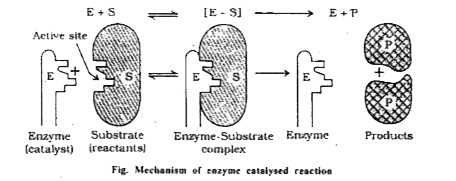
Mechanism of enzyme catalysis can be satisfactorily explained on the basis of lock-and-key model as follows.
There are a number of cavities present on the surface of enzymes. These cavities are of characteristic shape and possess active groups such as `-NH_2`, COOH, -SH, OH, etc. These are actually the active centres on the surface of enzyme. The molecules of the reactant (substrate), which have complementary shape, fit into these cavities just like a key fits into a lock. On account of the presence of active groups, an activated complex is formed which then decomposes to yield the products.

Thus, the enzyme-catalysed reactions may be considered to proceed in two steps.
Step 1 : Binding of enzyme to substrate to form an activated complex.
`E + S to ES^(cancel=)`
Step 2 : Decomposition of the activated complex to form product.
`ES^(cancel=) to E + P`
Promotional Banner

Topper's Solved these Questions

  • STRUCTURE OF ATOM

    BETTER CHOICE PUBLICATION|Exercise NUMERICAL PROBLEMS |6 Videos
  • THE P-BLOCK ELEMENTS

    BETTER CHOICE PUBLICATION|Exercise QUESTION BANK|205 Videos

Similar Questions

Explore conceptually related problems

Give four examples of heterogeneous catalysis.

select correct statement (s) : the role of a catalyst in a reversible reaction is to allow the equilibrium to be achieved quickly , Diffusion process is involved in mechanism of heterogenous catalysis process , Hydrolysis of cane sugar is catalysed by H^(+) , promotors enhance the activity of a catalyst.

Taking two examples of heterogeneous catalytic reactions, explain how a heterogeneous catalyst helps in the reaction.

Read the given passage and answers following questions : A catalytic process in which the catalyst and the reactants are present in different phases is known as a heterogeneous catalysis. This heterogeneous catalytic action can be explained in terms of the adsorption theory. The mechanism of catalysis involves the following steps: (i) Adsorption of reactant molecules on the catalyst surface. (ii) Occurrence of a chemical reaction through the formation of an intermediate. (iii) De-sorption of products from the catalyst surface (iv) Diffusion of products away from the catalyst surface. In this process, the reactants are usually present in the gaseous state and the catalyst is present in the solid state. Gaseous molecules are then adsorbed on the surface of the catalyst. As the concentration of reactants on the surface of the catalyst increases, the rate of reaction also increases. In such reactions, the products have very less affinity for the catalyst and are quickly desorbed, thereby making the surface free for other reactants. Which theory explains heterogeneous catalytic action?

Give the mechanism of chlorination of methane.

Explain the mechanism of acid catalysed hydration of an alkene to form corresponding alcohol.

Give the mechanism of sulpho'nation and nitration of benzene.

Read the given passage and answers following questions : A catalytic process in which the catalyst and the reactants are present in different phases is known as a heterogeneous catalysis. This heterogeneous catalytic action can be explained in terms of the adsorption theory. The mechanism of catalysis involves the following steps: (i) Adsorption of reactant molecules on the catalyst surface. (ii) Occurrence of a chemical reaction through the formation of an intermediate. (iii) De-sorption of products from the catalyst surface (iv) Diffusion of products away from the catalyst surface. In this process, the reactants are usually present in the gaseous state and the catalyst is present in the solid state. Gaseous molecules are then adsorbed on the surface of the catalyst. As the concentration of reactants on the surface of the catalyst increases, the rate of reaction also increases. In such reactions, the products have very less affinity for the catalyst and are quickly desorbed, thereby making the surface free for other reactants. What is heterogeneous catalysis.

BETTER CHOICE PUBLICATION-SURFACE CHEMISTRY -Question Bank
  1. How do enzymes differ from catalysts ?

    Text Solution

    |

  2. What are Enzymes ? Give important characteristics of enzyme catalysis.

    Text Solution

    |

  3. Give the mechanism of heterogeneous catalysed reaction.

    Text Solution

    |

  4. Explain two applications of enzymes.

    Text Solution

    |

  5. What are colloids ?

    Text Solution

    |

  6. which are the properties of colloidal solution ?

    Text Solution

    |

  7. What is the difference between true solution and colloidal solution?

    Text Solution

    |

  8. Give three differences between suspension and colloid solution.

    Text Solution

    |

  9. Name the dispersed phase and dispersion mediumin fog.

    Text Solution

    |

  10. Comment on the statement that “colloid is not a substance but a state ...

    Text Solution

    |

  11. What are lyophilic and lyophobic sols ? Give one example of each. Why ...

    Text Solution

    |

  12. What are gels ? Give an example of elastic and non-elastic gel.

    Text Solution

    |

  13. How will you differentiate Lyophilic colloids from Lyophobic colloids?

    Text Solution

    |

  14. Lyophillic colloids are more stable than lyophobic colloids. Explain.

    Text Solution

    |

  15. What is the difference between multimolecular and macromolecular collo...

    Text Solution

    |

  16. Give three differences between multimolecular colloids and macromolecu...

    Text Solution

    |

  17. What are micelles ? Give one example of a micellar system.

    Text Solution

    |

  18. Explain the mechanism of the cleansing action of soaps

    Text Solution

    |

  19. Discuss cleansing action of soap by micelle formation.

    Text Solution

    |

  20. Write short note on peptisation.

    Text Solution

    |

