Home
Class 12
CHEMISTRY
Discuss cleansing action of soap by mice...

Discuss cleansing action of soap by micelle formation.

Text Solution

Verified by Experts
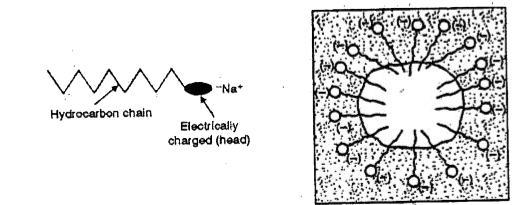
Soaps are sodium salts of higher fatty acids such as stearic acid.
`underset("Sodium Stearate (Soap)")(C_(17)H_(35) COO^(-) Na^+) overset(H_2 O)hArr underset("Stearate ions")(C_(17) H_(35) COO^(-)) + Na^+`
The anionic part or sterate ion `(-COO^-)` is hydrophillic nature and thus has a great affinity for water. On the other hand, the hydrocarbon part `(C_2 H_(35)^-)` is hydrophobic in nature and thus has a great affinity for oil etc.

When soap is dissolved in water, and the resulting solution acts on oil present on dirty cloth, the anions `(C_(17) H_(35) COO^-)` form micelles encapasulating oil inside. These micelle are removed by rinsing with water forming oil in water type emulsion. The freed dirt either settle down or is washed away by water.
Promotional Banner

Topper's Solved these Questions

  • STRUCTURE OF ATOM

    BETTER CHOICE PUBLICATION|Exercise NUMERICAL PROBLEMS |6 Videos
  • THE P-BLOCK ELEMENTS

    BETTER CHOICE PUBLICATION|Exercise QUESTION BANK|205 Videos

Similar Questions

Explore conceptually related problems

Read the given passage and answers following questions : The cleansing action of soap is due to emulsification and micelle formation. Soaps are basically sodium and potassium salts of long chain fatty acids, R-COO- Na^(+) . The end of the molecule to which the sodium is attached is polar in nature, while the alkyl-end is non-polar. Thus, a soap molecule contains a hydrophilic (polar) and a hydrophobic (nonpolar) part. When soap is added to water containing dirt, the soap molecules surround the dirt particles in such a manner that their hydrophobic parts get attached to the dirt molecule and the hydrophilic parts point away from the dirt molecule. This is known as micelle formation. Thus, we can say that the polar group dissolves in water while the non-polar group dissolves in the dirt particle. Now, as these micelles are negatively charged, they do not coalesce and a stable emulsion is formed. What is micelle formation?

Read the given passage and answers following questions : The cleansing action of soap is due to emulsification and micelle formation. Soaps are basically sodium and potassium salts of long chain fatty acids, R-COO- Na^(+) . The end of the molecule to which the sodium is attached is polar in nature, while the alkyl-end is non-polar. Thus, a soap molecule contains a hydrophilic (polar) and a hydrophobic (nonpolar) part. When soap is added to water containing dirt, the soap molecules surround the dirt particles in such a manner that their hydrophobic parts get attached to the dirt molecule and the hydrophilic parts point away from the dirt molecule. This is known as micelle formation. Thus, we can say that the polar group dissolves in water while the non-polar group dissolves in the dirt particle. Now, as these micelles are negatively charged, they do not coalesce and a stable emulsion is formed. Define soaps ?

Read the given passage and answers following questions : The cleansing action of soap is due to emulsification and micelle formation. Soaps are basically sodium and potassium salts of long chain fatty acids, R-COO- Na^(+) . The end of the molecule to which the sodium is attached is polar in nature, while the alkyl-end is non-polar. Thus, a soap molecule contains a hydrophilic (polar) and a hydrophobic (nonpolar) part. When soap is added to water containing dirt, the soap molecules surround the dirt particles in such a manner that their hydrophobic parts get attached to the dirt molecule and the hydrophilic parts point away from the dirt molecule. This is known as micelle formation. Thus, we can say that the polar group dissolves in water while the non-polar group dissolves in the dirt particle. Now, as these micelles are negatively charged, they do not coalesce and a stable emulsion is formed. How many parts of soaps exist ?

Read the given passage and answers following questions : The cleansing action of soap is due to emulsification and micelle formation. Soaps are basically sodium and potassium salts of long chain fatty acids, R-COO- Na^(+) . The end of the molecule to which the sodium is attached is polar in nature, while the alkyl-end is non-polar. Thus, a soap molecule contains a hydrophilic (polar) and a hydrophobic (nonpolar) part. When soap is added to water containing dirt, the soap molecules surround the dirt particles in such a manner that their hydrophobic parts get attached to the dirt molecule and the hydrophilic parts point away from the dirt molecule. This is known as micelle formation. Thus, we can say that the polar group dissolves in water while the non-polar group dissolves in the dirt particle. Now, as these micelles are negatively charged, they do not coalesce and a stable emulsion is formed. What is polar and non-polar groups ?

Discuss the buffer action.

Action of soap is due to emulsification and micelle formation comment.

Discuss the formation of monel metal?

Discuss the formation of constantan?

Discuss the formation of bell metal?

