

Home
Class 12
CHEMISTRY
Explain Brownian movement....

Explain Brownian movement.

Text Solution

Verified by Experts

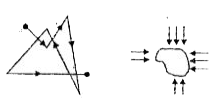
The colloidal particles of dispersed phase are seen to be moving in a zig-zag manner when seen under ultramicroscope, This zig-zag motion of the colloidal particles is known as Brownian movement.
Cause. It is due to unequal bombardment of colloidal particles by the molecules of the dispersion medium.

Significance. (i) It explains the nonsettling nature of colloidal particles.
(ii) It supports the postulate of ceaseless motion of molecules in gases and liquid (Kinetic Theory).
Promotional Banner

Topper's Solved these Questions

  • STRUCTURE OF ATOM

    BETTER CHOICE PUBLICATION|Exercise NUMERICAL PROBLEMS |6 Videos
  • THE P-BLOCK ELEMENTS

    BETTER CHOICE PUBLICATION|Exercise QUESTION BANK|205 Videos

Similar Questions

Explore conceptually related problems

Read the following passage and answer the questions. When colloidal solutions are viewed under a powerful ultramicroscope, the colloidal particles appear to be in a state of continuous zig-zag motion all over the field of view. This motion was first observed by the British botanist, Robert Brown, and is known as Brownian movement. This motion is independent of the nature of the colloid but depends on the size of the particles and viscosity of the solution. Smaller the size and lesser the viscosity, faster is the motion. The Brownian movement has been explained to be clue to the unbalanced bombardment of the particles by the molecules of the dispersion medium. The Brownian movement has a stirring effect which does not permit the particles to settle and thus, is responsible for the stability of sots. What is Brownian movement ?

Read the following passage and answer the questions. When colloidal solutions are viewed under a powerful ultramicroscope, the colloidal particles appear to be in a state of continuous zig-zag motion all over the field of view. This motion was first observed by the British botanist, Robert Brown, and is known as Brownian movement. This motion is independent of the nature of the colloid but depends on the size of the particles and viscosity of the solution. Smaller the size and lesser the viscosity, faster is the motion. The Brownian movement has been explained to be clue to the unbalanced bombardment of the particles by the molecules of the dispersion medium. The Brownian movement has a stirring effect which does not permit the particles to settle and thus, is responsible for the stability of sots. What is the effect of particle size on Brownian movement ?

The cause of Brownian movement is

Read the following passage and answer the questions. When colloidal solutions are viewed under a powerful ultramicroscope, the colloidal particles appear to be in a state of continuous zig-zag motion all over the field of view. This motion was first observed by the British botanist, Robert Brown, and is known as Brownian movement. This motion is independent of the nature of the colloid but depends on the size of the particles and viscosity of the solution. Smaller the size and lesser the viscosity, faster is the motion. The Brownian movement has been explained to be clue to the unbalanced bombardment of the particles by the molecules of the dispersion medium. The Brownian movement has a stirring effect which does not permit the particles to settle and thus, is responsible for the stability of sots. What is the effect of viscosity of dispersion medium on Brownian movement ?

Read the following passage and answer the questions. When colloidal solutions are viewed under a powerful ultramicroscope, the colloidal particles appear to be in a state of continuous zig-zag motion all over the field of view. This motion was first observed by the British botanist, Robert Brown, and is known as Brownian movement. This motion is independent of the nature of the colloid but depends on the size of the particles and viscosity of the solution. Smaller the size and lesser the viscosity, faster is the motion. The Brownian movement has been explained to be clue to the unbalanced bombardment of the particles by the molecules of the dispersion medium. The Brownian movement has a stirring effect which does not permit the particles to settle and thus, is responsible for the stability of sots. What is the cause of Brownian movement ?

Read the following passage and answer the questions. When colloidal solutions are viewed under a powerful ultramicroscope, the colloidal particles appear to be in a state of continuous zig-zag motion all over the field of view. This motion was first observed by the British botanist, Robert Brown, and is known as Brownian movement. This motion is independent of the nature of the colloid but depends on the size of the particles and viscosity of the solution. Smaller the size and lesser the viscosity, faster is the motion. The Brownian movement has been explained to be clue to the unbalanced bombardment of the particles by the molecules of the dispersion medium. The Brownian movement has a stirring effect which does not permit the particles to settle and thus, is responsible for the stability of sots. What is the role of Brownian movement in the stability of sols ?

What is the difference between the manner is which movement takes place in a sensitive plant and the movement in our leg.