Home
Class 12
CHEMISTRY
In which of the following reaction 2^(@)...

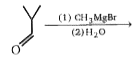
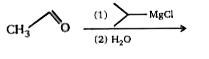
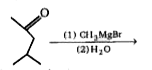
In which of the following reaction `2^(@)` alcohol is obtained as a product ?

A

B

C

D

Both (a) and (b)

Text Solution

AI Generated Solution

The correct Answer is:

To determine which reactions yield a secondary alcohol as a product, we will analyze each of the provided options step by step. ### Step 1: Analyze the First Reaction The first reaction involves an aldehyde (let's denote it as RCHO) reacting with a Grignard reagent (R'MgX). 1. **Nucleophilic Addition**: The nucleophile (R'MgX) attacks the electrophilic carbon of the carbonyl group (C=O) in the aldehyde. 2. **Formation of Alkoxide**: This results in the formation of an alkoxide intermediate (RCH(OR')MgX). 3. **Hydrolysis**: Upon hydrolysis (addition of water), the alkoxide is converted to a secondary alcohol (RCH(OH)R'). Thus, the first reaction produces a secondary alcohol. ### Step 2: Analyze the Second Reaction The second reaction involves a different aldehyde (let's denote it as R'CHO) reacting with another Grignard reagent (R''MgX). 1. **Nucleophilic Addition**: Similar to the first reaction, the Grignard reagent attacks the carbonyl carbon. 2. **Formation of Alkoxide**: An alkoxide intermediate is formed. 3. **Hydrolysis**: Hydrolysis of the alkoxide leads to the formation of another secondary alcohol (R'CH(OH)R''). Thus, the second reaction also produces a secondary alcohol. ### Step 3: Analyze the Third Reaction The third reaction involves a ketone (let's denote it as R2C=O) reacting with a Grignard reagent (R'MgX). 1. **Nucleophilic Addition**: The Grignard reagent attacks the carbonyl carbon. 2. **Formation of Alkoxide**: An alkoxide intermediate is formed. 3. **Hydrolysis**: Hydrolysis of the alkoxide leads to the formation of a tertiary alcohol (R2C(OH)R'). Thus, the third reaction produces a tertiary alcohol, not a secondary alcohol. ### Step 4: Analyze the Fourth Reaction The fourth reaction is not specified in the transcript, but based on the analysis of the first three reactions, we can conclude that only the first and second reactions yield secondary alcohols. ### Conclusion The reactions that yield secondary alcohols are: - **First Reaction** - **Second Reaction** ### Final Answer Both the first and second reactions yield secondary alcohols as products. ---

To determine which reactions yield a secondary alcohol as a product, we will analyze each of the provided options step by step. ### Step 1: Analyze the First Reaction The first reaction involves an aldehyde (let's denote it as RCHO) reacting with a Grignard reagent (R'MgX). 1. **Nucleophilic Addition**: The nucleophile (R'MgX) attacks the electrophilic carbon of the carbonyl group (C=O) in the aldehyde. 2. **Formation of Alkoxide**: This results in the formation of an alkoxide intermediate (RCH(OR')MgX). 3. **Hydrolysis**: Upon hydrolysis (addition of water), the alkoxide is converted to a secondary alcohol (RCH(OH)R'). ...
Promotional Banner

Similar Questions

Explore conceptually related problems

In which of the following reactions phenol is not obtained:

In which of the following reaction, phosphine is not obtained as product

In which of the following reactions, alcohol is formed as product gives positive iodoform test?

Which of the following reactions will not yield alcohol as the major product ?

In the following reaction, the major product obtained is

In the following reaction, the major product obtained is

In which of the following reaction product obtained is a hydrocarbon having sp hybrid carbon?
