Home
Class 12
CHEMISTRY
An optically active compound 'X' has mol...

An optically active compound 'X' has molecular formula `C_(4)H_(8)O_(3)`. If evolves `CO_(2)` with`NaHCO_(3)`. 'X' reacts with `LiAlH_(4)` to give an achiral compound 'X' is -

A

`CH_(3)CH_(2)underset(OH)underset(|)CHCOOH`

B

`CH_(3)underset(Me)underset(|)CHCOOH`

C

`CH_(3)underset(CH_(2)OH)underset(|)(CHCOOH)`

D

`CH_(3)underset(OH)underset(|)CHCH_(2)COOH`

Text Solution

Verified by Experts

The correct Answer is:
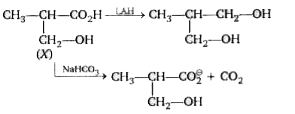
C

Promotional Banner

Similar Questions

Explore conceptually related problems

An optically active compound 'X' has molecular formula C_(4)H_(8)O_(3) . It evolves CO_(2) with NaHCO_(3) . 'X' reacts with LiAIH_(4) to give an achiral compound 'X' is:

Draw the isomers of a compound with the molecular formula C_(4)H_(4)O_(4)

The number of optically active compounds in the isomers of C_(4)H_(9)Br is

Which compound give CO_(2) with NaHCO_(3) ?

An optically activ compound (A) has the molecular formula C_(6)H_(10) . The compound gives a ppt. When treated with Ag(NH_(3))_(2)OH . On catalytic hydrogenation, A yields B(C_(6)H_(14)) which is only optically inactive identify the total number of alphaH in product formed by treatment of A with O_(3)//H_(2)O_(2) then LAH and then H^(o+)//Delta

A certain compound has the molecular formula X_(4)O_(6) . If 10 g of X_(4) O_(6) has 5.72 g X , the atomic mass of X is

A compound has the molecular formula X_(4)O_(6) . If 10 g "of" X_(4)O_(6) has 5.72 g X , atomic mass of X is:

How many acids and esters are possible for the compound with molecular formula, C_(4)H_(8)O_(2) ?

An organic compound (X) has molecular formula C_(7)H_(6)O_(2) and it does not effervesces with NaHCO_(3). X on treatment with excess of HBr(aq) gives Y(C_(6)H_(6)O_(2)) and CH_(2)Br_(2) . Y forms a violet coloured solution with FeCl_(3) . If X treated with Br_(2)Fe, how many different monobromination product would result?

