Home
Class 12
CHEMISTRY
Presence of chiral center is not an esse...

Presence of chiral center is not an essential condition to show optical isomerism. Essential condition is, compound should show non-superimposable mirror image.
Allenes do not contain chiral center but show optical isomerism when different groups are attached on double bonded carbons.
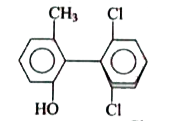
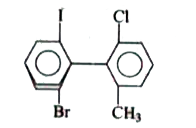
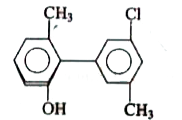
Biphenyls also show optical isomerism when both rings are perpendicular to each other and any ring should not contain plane of symmetry.
Which of the following biphenyl compounds is optically active?

A

B

C

D

All are correct

Text Solution

AI Generated Solution

The correct Answer is:

To determine which biphenyl compound is optically active, we need to analyze the conditions for optical isomerism, particularly in biphenyl compounds. Here’s a step-by-step solution: ### Step 1: Understand the Conditions for Optical Activity Optical activity in compounds is primarily determined by the presence of a non-superimposable mirror image. For biphenyls, this means that: - The two phenyl rings must be oriented in such a way that they are not coplanar (i.e., they must be perpendicular). - There should be no plane of symmetry in the molecule. ### Step 2: Analyze the Given Biphenyl Compounds We need to evaluate each biphenyl compound provided in the options based on the criteria mentioned above. #### Option 1: - If both rings are in the same plane or if there is a plane of symmetry, the compound will be optically inactive. - If one ring is in the plane and the other is out of the plane but has a plane of symmetry, it will also be inactive. #### Option 2: - If both rings are perpendicular and have different bulky substituents (like iodine and chlorine), and there is no plane of symmetry, this compound is likely to be optically active. #### Option 3: - If the substituents are in such positions that they create a planar structure (for example, if they are in ortho or meta positions with less steric hindrance), the compound will be optically inactive due to the presence of a plane of symmetry. ### Step 3: Conclusion After analyzing the options: - The compound that has bulky groups, is non-planar, and has no plane of symmetry is the one that will be optically active. - Therefore, the correct answer is the biphenyl compound from Option 2, which has different bulky groups and satisfies the conditions for optical activity. ### Final Answer The biphenyl compound that is optically active is the one with bulky substituents (Option 2). ---

To determine which biphenyl compound is optically active, we need to analyze the conditions for optical isomerism, particularly in biphenyl compounds. Here’s a step-by-step solution: ### Step 1: Understand the Conditions for Optical Activity Optical activity in compounds is primarily determined by the presence of a non-superimposable mirror image. For biphenyls, this means that: - The two phenyl rings must be oriented in such a way that they are not coplanar (i.e., they must be perpendicular). - There should be no plane of symmetry in the molecule. ### Step 2: Analyze the Given Biphenyl Compounds ...
Promotional Banner

Similar Questions

Explore conceptually related problems

Presence of chiral center is not an essential condition to show optical isomerism. Essential condition is, compound should show non-superimposable mirror image. Allenes do not contain chiral center but show optical isomerism when different groups are attached on double bonded carbons. Biphenyls also show optical isomerism when both rings are perpendicular to each other and any ring should not contain plane of symmetry. Which of the following compounds is optically inactive?

Presence of chiral center is not an essential condition to show optical isomerism. Essential condition is, compound should show non-superimposable mirror image. Allenes do not contain chiral center but show optical isomerism when different groups are attached on double bonded carbons. Biphenyls also show optical isomerism when both rings are perpendicular to each other and any ring should not contain plane of symmetry. Which of the following compounds can be resolved in enantiomeric form?

Which one of the following compounds show optical activity ?

Write the essential conditions for geometrical isomerism.

Which one of the following compounds show optical activity

Which of the following compounds shows geometrical isomerism ?

The essential condition of optical activity is :

Which compounds will show optical isomerism
