

Home
Class 12
CHEMISTRY
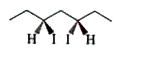
Draw the enantiomer and a diastereomer f...

Draw the enantiomer and a diastereomer for this compound.

Promotional Banner

Similar Questions

Explore conceptually related problems

Draw Fischer projection of Find the absolute configuration for asymmetric carbon atoms and also write the configuration of enantiomer and diastereomers of the given compounds .

Identify the pairs of enantiomers and diastereomers from the following compounds I, II, and III :

What are enantiomers

Identify the pairs of enantiomers and diastereomers from the following:

Enantiomers have: -

Broadly speaking there are four types of stereisomers namely conformational isomers geometrical isomers, enantiomers and diastereomers.Although conformational isomers , have same configuration geometrical isomers have different atoms attached to each of the doubly bonded carbon atom, and enantiomers are due to chirality in the molecule Enantiomers are also known as optical isomers and diastereomers are those stereoisomers which are not enantiomers.In simple compound, number of stereoisomers.In chiral molecule is given by the reaction 2^n , where n is the number of dissimilar chiral carbon. Observe the following structures and answer the questions given below : How many stereoisomers are possible in pent-3-en-2-ol, CH_3CH=CHCHOHCH_3

Write the appropriate structural formule for: a. A cyclic molecule that is a consitutional isomer of cyclohexane b. Molecules with the formula C_(6)H_(12) that contain one ring and are enantiomers of each other. c. Molecules with formula C_(6)H_(12) that contian one ring and are diastereomers of each other. d. Molecules with formula C_(6)H_(12) that contain no ring and are enantiomers of each other. e. Molecules with formula C_(6)H_(12) that contain no ring and are diastereomers of each other.

How is the following compound related to the simple sugar D-erythrose? Is it an enantiomer, diastereomer, or identical?

How is the following compound related to the simple sugar D-erythrose? Is it an enantiomer, diastereomer, or identical?

How is each compound related to the simple sugar D-erythrose? Is it an enantiomer, diastereomer, or identical?