
Home
Class 12
CHEMISTRY
Cyclohexanol can be converted into cyclo...

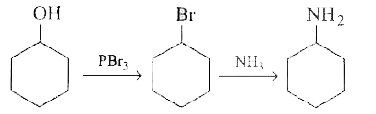
Cyclohexanol can be converted into cyclohexylamine by following two routes. Which of the following methods is expected to give good yield of cyclohexylamine ?

A

B

C

both are equally suitable

D

neither of the two

Text Solution

AI Generated Solution

The correct Answer is:

To determine which method is expected to give a good yield of cyclohexylamine from cyclohexanol, we can analyze the two proposed routes step by step. ### Step-by-Step Solution: 1. **Identify the Starting Material**: - The starting material is cyclohexanol (C6H11OH). 2. **Route 1: Oxidation followed by Reduction**: - In the first method, cyclohexanol is oxidized using potassium dichromate (K2Cr2O7), a strong oxidizing agent. This oxidation converts cyclohexanol to cyclohexanone (C6H10O). - The reaction can be represented as: \[ \text{C6H11OH} \xrightarrow{\text{K2Cr2O7}} \text{C6H10O} \] - Following this, cyclohexanone is treated with ammonia (NH3) in the presence of nickel (Ni) to produce cyclohexylamine (C6H11NH2). - The reaction can be represented as: \[ \text{C6H10O} + \text{NH3} \xrightarrow{\text{Ni}} \text{C6H11NH2} \] - However, this process involves multiple steps and the reagents used (K2Cr2O7 and Ni) are toxic, which can complicate the reaction and reduce the overall yield. 3. **Route 2: Halogenation followed by Amine Formation**: - In the second method, cyclohexanol is first converted to cyclohexyl bromide (C6H11Br) using phosphorus tribromide (PBr3). - The reaction can be represented as: \[ \text{C6H11OH} \xrightarrow{\text{PBr3}} \text{C6H11Br} \] - Then, cyclohexyl bromide is treated with ammonia (NH3) to produce cyclohexylamine. - The reaction can be represented as: \[ \text{C6H11Br} + \text{NH3} \rightarrow \text{C6H11NH2} + \text{HBr} \] - This method is more straightforward, involves fewer steps, and uses non-toxic reagents. 4. **Comparison of Yields**: - The first route involves toxic reagents and multiple steps, which can lead to lower yields and complicate the process. - The second route is simpler, involves fewer reagents, and is expected to give a better yield of cyclohexylamine due to the direct conversion from cyclohexyl bromide to cyclohexylamine. 5. **Conclusion**: - Based on the analysis, **Route 2** (halogenation followed by amine formation) is expected to give a better yield of cyclohexylamine. ### Final Answer: **Route 2 is expected to give a good yield of cyclohexylamine.**
Promotional Banner

Similar Questions

Explore conceptually related problems

Which of the following order is expected to be correct ?

Which of the following compounds is expected to be coloured?

Which of the following alcohols is expected to give haloform test ?

Which of the following is expected to be coloured?

Which of the following is expected to be aromatic ?

Which of the following are expected to be covalent?

Which of the following species is not expected to exist ?

Which of the following ligands is expected to bidentates?

Which of the following yields citric acid :

Which of the following is expected to be coloured in solutions
