Home
Class 12
CHEMISTRY
H(3) C - CH(2) - overset(overset(CH3) (|...

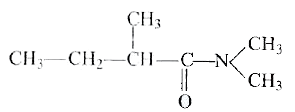
`H_(3) C - CH_(2) - overset(overset(CH_3) (|))CH - underset(underset(O)(||))C- NH_(2) underset(Delta) overset(Br_(2) + KOH) (to) A underset(2. AgOH, Delta) overset(1. CH_3 I("excess") ) (to) B`
The major product (B) is :

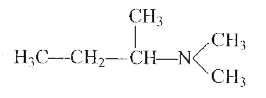
A

`CH_3 - CH_2 - CH = CH_2`

B

C

`H_(3) C - CH = CH - CH_3`

D

Text Solution

AI Generated Solution

The correct Answer is:

To solve the problem step by step, we will analyze the reactions described in the question. ### Step 1: Identify the starting compound The starting compound is: \[ H_3C - CH_2 - \overset{CH_3}{|} CH - \underset{O}{||} C - NH_2 \] ### Step 2: Reaction with Br₂ and KOH (Hofmann degradation) When this compound reacts with bromine (Br₂) and potassium hydroxide (KOH) in the presence of heat, it undergoes the Hofmann degradation. In this reaction, the carbonyl group (C=O) is removed, and the amine group (NH₂) is attached to the adjacent carbon atom. The reaction can be summarized as follows: - The carbonyl group (C=O) is omitted. - The NH₂ group is now attached to the carbon adjacent to the one that was originally part of the carbonyl. This gives us compound A: \[ H_3C - CH_2 - CH_2 - NH_2 \] or simply: \[ CH_3 - CH_2 - CH_2 - NH_2 \] ### Step 3: Reaction with excess CH₃I Next, compound A reacts with excess methyl iodide (CH₃I). In this reaction, the hydrogen atom on the nitrogen (NH₂) is replaced by a methyl group (CH₃). Since there is excess CH₃I, the nitrogen can be fully quaternized, resulting in: \[ CH_3 - CH_2 - CH_2 - N(CH_3)_3^+ \] ### Step 4: Reaction with AgOH and heat The next step involves the reaction of the quaternized nitrogen compound with silver hydroxide (AgOH) in the presence of heat. In this reaction, the hydroxide ion (OH⁻) attacks the nitrogen, leading to the formation of a double bond and the release of a methyl group. The reaction can be summarized as follows: - The nitrogen loses a methyl group and forms a double bond with the adjacent carbon. This results in the final product B: \[ CH_3 - CH_2 - CH = CH_2 \] ### Final Answer The major product (B) is: \[ CH_3 - CH_2 - CH = CH_2 \]

To solve the problem step by step, we will analyze the reactions described in the question. ### Step 1: Identify the starting compound The starting compound is: \[ H_3C - CH_2 - \overset{CH_3}{|} CH - \underset{O}{||} C - NH_2 \] ### Step 2: Reaction with Br₂ and KOH (Hofmann degradation) When this compound reacts with bromine (Br₂) and potassium hydroxide (KOH) in the presence of heat, it undergoes the Hofmann degradation. In this reaction, the carbonyl group (C=O) is removed, and the amine group (NH₂) is attached to the adjacent carbon atom. ...
Promotional Banner

Similar Questions

Explore conceptually related problems

CH_(3)-CH=CH_(2)underset(773 K)overset(Br_(2))to[A]underset("Heat")overset(KOH(alc.))to[B]

CH_(3)-overset(O)overset(||)(C)-CH_(2)- overset(CH_(3))overset(|)underset(CH_(3))underset(|)(C)-CHO overset(KOH,H_(2)O)underset(Delta)to product (C_(7)H_(10)O) :

CH_(3)-underset(CH_3)underset(|)overset(CH_3)overset(|)(C )-underset(Br)underset(|)(C )H-CH_(3) underset(Delta)overset("El mechanism")(rarr) (A) Major product (A) is
