Home
Class 12
CHEMISTRY
Passage-4 An organic compound 'A' has ...

Passage-4
An organic compound 'A' has molecular formula `C_9 H_13 NO` and it can be resolved into enantiomers. A does not decolourise bromine water solution. A on refluxing with dilute `H_(2) SO_(4)` yields another resolvable compound B `(C_(9) H_(14) O_(3) )` which gives effervescence with `NaHCO_(3)`. B on treatment with `NaBH_(4)` yields `C (C_(9) H_(16) O_3)` on heating with concentrated `H_(2) SO_(4)` yields ester `D (C_(9) H_(14) O_(2) )`.
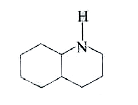
Compound A on reduction with `LiAIH_(4)`, followed by treatment of `H_(2) SO_(4)` yields following compound :

Due to reduction of optically pure' B' two isomeric product 'C' form. Isomeric product 'C' are :

A

Enantiomers

B

Diastereomers

C

Position isomers

D

Functional isomers

Text Solution

Verified by Experts

The correct Answer is:

B

Promotional Banner

Similar Questions

Explore conceptually related problems

The oxide that give H_(2)O_(2) on treatment with dilute H_(2)SO_(4) is

An organic compound A has molecular formula C_(10)H_(17)Br and it is non-resolvable. A does not decolourize brown colour of bromine water solution. A on treatement with (CH_(3))_(2 COK//(CH_(3))_(3)COH yields B as majot product. B on treatment with H_(2)//Pt yields (C_(10)H_(16)) which on treatment with CI_(2)//hv yields three monochloro derivative. Also B on boiling with acidic permanganate solution yields C(C_(10)H_(16)O_(3))C . on heating with sodalime yields D(C_(9)H_(16)O).D on reducing with LiAIH_(4) followed yields C(C_(10)H_(16)O_(3)).C on heating with sodalime yields D(C_(9)H_(16)O).D on reducing with LiAIH_(4) followed by heating product with concentrated H_(2)SO_(4) yields E(C_(9)H_(16)) as major product. E on treatment with ozone followed by work-up with Zn-H_(2)O yields 6-Ketononanal. Compound B is:

An organic compound A has molecular formula C_(10)H_(17)Br and it is non-resolvable. A does not decolourize brown colour of bromine water solution. A on treatement with (CH_(3))_(2 COK//(CH_(3))_(3)COH yields B as majot product. B on treatment with H_(2)//Pt yields (C_(10)H_(16)) which on treatment with CI_(2)//hv yields three monochloro derivative. Also B on boiling with acidic permanganate solution yields C(C_(10)H_(16)O_(3))C . on heating with sodalime yields D(C_(9)H_(16)O).D on reducing with LiAIH_(4) followed yields C(C_(10)H_(16)O_(3)).C on heating with sodalime yields D(C_(9)H_(16)O).D on reducing with LiAIH_(4) followed by heating product with concentrated H_(2)SO_(4) yields E(C_(9)H_(16)) as major product. E on treatment with ozone followed by work-up with Zn-H_(2)O yields 6-Ketononanal. Compound C is:

An organic compound A has molecular formula C_(10)H_(17)Br and it is non-resolvable. A does not decolourize brown colour of bromine water solution. A on treatement with (CH_(3))_(2 COK//(CH_(3))_(3)COH yields B as majot product. B on treatment with H_(2)//Pt yields (C_(10)H_(16)) which on treatment with CI_(2)//hv yields three monochloro derivative. Also B on boiling with acidic permanganate solution yields C(C_(10)H_(16)O_(3))C . on heating with sodalime yields D(C_(9)H_(16)O).D on reducing with LiAIH_(4) followed yields C(C_(10)H_(16)O_(3)).C on heating with sodalime yields D(C_(9)H_(16)O).D on reducing with LiAIH_(4) followed by heating product with concentrated H_(2)SO_(4) yields E(C_(9)H_(16)) as major product. E on treatment with ozone followed by work-up with Zn-H_(2)O yields 6-Ketononanal. Compound D is:

An organic compound A has molecular formula C_(10)H_(17)Br and it is non-resolvable. A does not decolourize brown colour of bromine water solution. A on treatement with (CH_(3))_(2 COK//(CH_(3))_(3)COH yields B as majot product. B on treatment with H_(2)//Pt yields (C_(10)H_(16)) which on treatment with CI_(2)//hv yields three monochloro derivative. Also B on boiling with acidic permanganate solution yields C(C_(10)H_(16)O_(3))C . on heating with sodalime yields D(C_(9)H_(16)O).D on reducing with LiAIH_(4) followed yields C(C_(10)H_(16)O_(3)).C on heating with sodalime yields D(C_(9)H_(16)O).D on reducing with LiAIH_(4) followed by heating product with concentrated H_(2)SO_(4) yields E(C_(9)H_(16)) as major product. E on treatment with ozone followed by work-up with Zn-H_(2)O yields 6-Ketononanal. Compound A is:

An alkene (A)C_(16)H_(16) on ozonolysis gives only one product (B)(C_(8)H_(8)O) . Compound (B) on reaction with NH_(2)OH followed by reaction with H_(2)SO_(4), Delta gives N - methyl benzamide the compound 'A' is -

On electrolysis of a solution of dilute H_(2)SO_(4) between platinum electrodes , the gas evolved at the anode is (a) SO_(2) (b) SO_(3) (c) O_(2) (d) H_(2)

An alkyl bromide A has molecular formula C_(8)H_(17)Br and four different structures can be drawn for it, all optically active. A on refluxing with ethanolic KOH solution yields only one elirnination product B(C_(8)H_(16)) which it still enantiomeric. B on treatment with H_(2)//Pt yields C(C_(8)H_(18)) which does not rotate the plane polarized light, B on ozonolysis followed by work-up with H_(2)O_(2) yields D(C_(7)H_(14)O) as one product which it still resolvable. Deduce structures of A to D.

A compound (X) with the molecular formula C_(3)H_(8)O can be oxidized to another (Y) whose molecular formula is C_(3)H_(6)O_(2) The compound (X) may be

A compound Z with molecular formula C_(3)H_(9)N reacts with C_(6)H_(5)SO_(2)Cl to give a solid, insoluble in alkali. Identify Z.

