Home
Class 12
CHEMISTRY
D (+) Glucose has melting point 146^@C a...

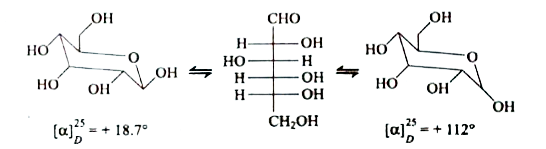
D (+) Glucose has melting point `146^@`C and specific rotation `[alpha]_(D)^(25)` is + `112^@`C. Another D(+) Glucose has melting point `150^@`C and specific rotational `[alpha]_(D)^(25)`is +`18.7^@`C. The two form have significantly different optical rotation but when an aqueous solution of either form is allowed to stand, it rotation changes. The specific rotation of one form decreases and rotation of other increases until both solution show the same value `+52.7^@`. The change in rotation towards an equilibrium value is called mutarotation.

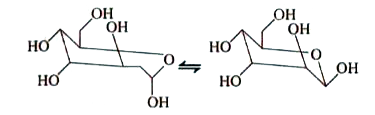
For mannose the mutarotation can be shown in brief as follow:

A

`alpha`-form

B

`beta`-form

C

open chain

D

None of these

Text Solution

Verified by Experts

The correct Answer is:

B

`beta`-form
Promotional Banner

Similar Questions

Explore conceptually related problems

D (+) Glucose has melting point 146^@ C and specific rotation [alpha]_(D)^(25) is + 112^@ C. Another D(+) Glucose has melting point 150^@ C and specific rotational [alpha]_(D)^(25) is + 18.7^@ C. The two form have significantly different optical rotation but when an aqueous solution of either form is allowed to stand, it rotation changes. The specific rotation of one form decreases and rotation of other increases until both solution show the same value +52.7^@ . The change in rotation towards an equilibrium value is called mutarotation. Mutarotation is characteristic feature of:

Define specific rotation.

What is optical rotation ?

rotation -45^(@) , so optical rotation of

Which has no rotation of symmetry ?

Magnitude of specific rotation of a compound is independent of :

Name the instrument used for measuring specific rotation.

During mutarotation of beta -D-glucose in aqueous solution angle of optical rotation

State two ways to increase the speed of rotation of a D.C. motor.
