Home
Class 12
CHEMISTRY
A mixture of two organic compound gives ...

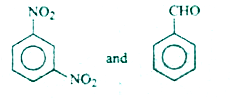
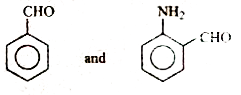
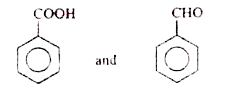
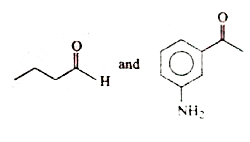
A mixture of two organic compound gives red coloured precipitate with cuprous chloride and silver mirror on heating with Zn and `NH_(4)Cl` followed by `AgNO_(3)+NH_(4)OH` solution. The mixture contains :

A

B

C

D

Text Solution

AI Generated Solution

The correct Answer is:

To solve the question regarding the mixture of two organic compounds that gives a red-colored precipitate with cuprous chloride and a silver mirror on heating with zinc and ammonium chloride followed by AgNO3 + NH4OH solution, we can follow these steps: ### Step-by-Step Solution: 1. **Identify the Reactions:** - The red-colored precipitate with cuprous chloride indicates the presence of a reducing sugar or an aldehyde, as cuprous chloride (CuCl) reacts with aldehydes to form a red precipitate of cuprous oxide (Cu2O). - The formation of a silver mirror upon heating with zinc and ammonium chloride suggests the presence of an aldehyde, as this is a characteristic reaction of the Tollens' test. 2. **Determine the Functional Groups:** - Since the silver mirror test is positive, we can conclude that at least one of the compounds in the mixture is an aldehyde. - The reaction with zinc and ammonium chloride can reduce nitro groups (NO2) to amine groups (NH2). Therefore, one of the compounds must also contain a nitro group. 3. **Analyze the Options:** - We need to find a combination of compounds where one is an aldehyde and the other is a nitro compound. - Review the provided options: - Check for the presence of an aldehyde group (–CHO) and a nitro group (–NO2) in each option. 4. **Eliminate Incorrect Options:** - If an option does not contain an aldehyde, it can be eliminated. - If an option contains an amine but not a nitro group, it can also be eliminated. 5. **Select the Correct Option:** - After analyzing the options, the correct combination would be one compound with an aldehyde group and another with a nitro group. - The option that fits this criterion is the one that contains both an aldehyde and a nitro group. ### Conclusion: - The correct answer is **Option C**, which contains one aldehyde and one nitro compound.

To solve the question regarding the mixture of two organic compounds that gives a red-colored precipitate with cuprous chloride and a silver mirror on heating with zinc and ammonium chloride followed by AgNO3 + NH4OH solution, we can follow these steps: ### Step-by-Step Solution: 1. **Identify the Reactions:** - The red-colored precipitate with cuprous chloride indicates the presence of a reducing sugar or an aldehyde, as cuprous chloride (CuCl) reacts with aldehydes to form a red precipitate of cuprous oxide (Cu2O). - The formation of a silver mirror upon heating with zinc and ammonium chloride suggests the presence of an aldehyde, as this is a characteristic reaction of the Tollens' test. ...
Promotional Banner

Similar Questions

Explore conceptually related problems

An organic compound undergoes addition reactions and gives a red precipitate with ammoniacal cuprous chloride. Therefore, the organic compound could be:

Which of the following organic compounds unable to give precipitation after reaction with silver nitrate (AgNO_3) ?

Which of the following compounds gives red ppt with Cu_(2)Cl_(2)//NH_(4)OH ?

A white, sublimable inorganic substance gives a brown precipitate on treatment with nessler's reagent and a whiite precipitate (soluble in NH_(3) ) with ann AgNO_(3) solution. The substance is :

Which of the following pairs of cations can be separated by adding NH_(4)Cl and NH_(4)OH to the mixture?

When NH_(4)Cl is added to a solution of NH_(4)OH :

On heating a mixture of NH_4 Cl and KNO_2 , we get

Amongst the following, the compound not soluble in excess of NH_(4)OH solution is:

Which of the following pairs of cations cannot be separated by adding NH_(4)Cl and NH_(4)OH to the mixture and then passing H_(2)S through it?

Which of the following pairs of cations cannot be separated by adding NH_(4)Cl and NH_(4)OH to the mixture and then passing H_(2)S through it?
